
By Xavier Kataquapit
For almost three decades I have been writing a column and producing writing mostly involving First Nations. At the start I felt more like an activist, as did many of our leaders. We had been through more than a hundred years of colonization, residential school atrocities, reservations and living in poverty with insufficient housing, poor health care and little support for education.
All kinds of resource developers in mining, forestry and power generation had been earning billions of dollars on First Nation traditional lands, but my people were very much ignored and there were few opportunities for employment with these huge projects.
We began to organize as we accessed more education and, with the wisdom of our Elders and major organizations, tribal councils and advocacy groups, life slowly began to get better.
Then came Free, Prior, and Informed Consent (FPIC), which is a principle within the United Nations Declaration on the Rights of Indigenous Peoples (UNDRIP) that emphasizes the right of Indigenous peoples to give or withhold their consent to activities that affect their lands, territories, and resources. Court decisions also bolstered this principle.
Finally, resource developers were legally bound to consult with First Nations when they entered onto traditional lands to do any type of work. Within a few years I was writing about all kinds of First Nations agreements with mining companies, forestry corporations and other resource development initiatives. These developers quickly realized that, if they wanted their projects to move ahead, they had to negotiate agreements with First Nations.
The next thing you know, government, resource developers and First Nations were sharing the spotlight with photos of everyone involved in project developments. First Nation representatives were invited to major industry gatherings and meetings and featured as a voice for First Nations culture, tradition and hopes. First Nation people were finding good jobs, getting important training and starting businesses through resource development on traditional lands.
Over the years I noticed that the resource development corporations were getting closer to First Nation organizations. There was concern by some First Nation people that making money was taking over as a priority and the traditional and cultural role of protecting the land and creatures, water and air seemed to be secondary.
Ontario’s Bill 5, the Protect Ontario by Unleashing our Economy Act, 2025, and Canada's Bill C-5, the One Canadian Economy Act, which encompasses the Building Canada Act, were established as a reaction to insulate the Canadian economy against the threat of U.S. tariffs. It is strange to suggest that this is protecting Canadian interests when it is well known that two-thirds of Canada’s major industries and sectors are either majority owned, or majority controlled, by foreign interests. Press Progress in April 2019 pointed out how 'Multinational corporations currently own 67% of all assets in Canada's economy’.
If the question of who would benefit from such government legislation as Bills 5 and C-5 is not troubling enough, then the prospect of what it would do for global warming should be far more concerning.
In a recent interview on iPolitics with David Suzuki, a well known and trusted science educator and environmental activist, he insists that the fight against climate change has been lost and that we have to now deal with this new dire global warming reality. Scientists and researchers from all over the world agree.
If you doubt we are in an emergency, just step outside in most parts of Canada and you will witness the smoke from hundreds of fires burning this summer in Manitoba and Saskatchewan. Our Elders have never seen so much smoke from so far away drifting by on an almost daily basis. Tornado and severe weather alerts are happening here for the first time on a regular basis in Northern Ontario. Turn on your television or media device and you will see news of terrible storms, heatwaves, flash flooding and fires globally. This year was the hottest historically on record.
In the midst of these obvious signs of global warming, our leaders, both First Nation and non-Native, are not doing enough to honour treaty rights or deal with climate change. They are ignoring this global environment emergency as they make agreements to move onto First Nation lands. In northern Ontario, the Hudson Bay Lowlands peatlands, one of the world’s largest natural carbon sinks, is being threatened by the development of the Ring of Fire mining area. There are also discussions of pipelines that will run across Canada's north. All these developments will only exponentially make worse the dangers of global warming.
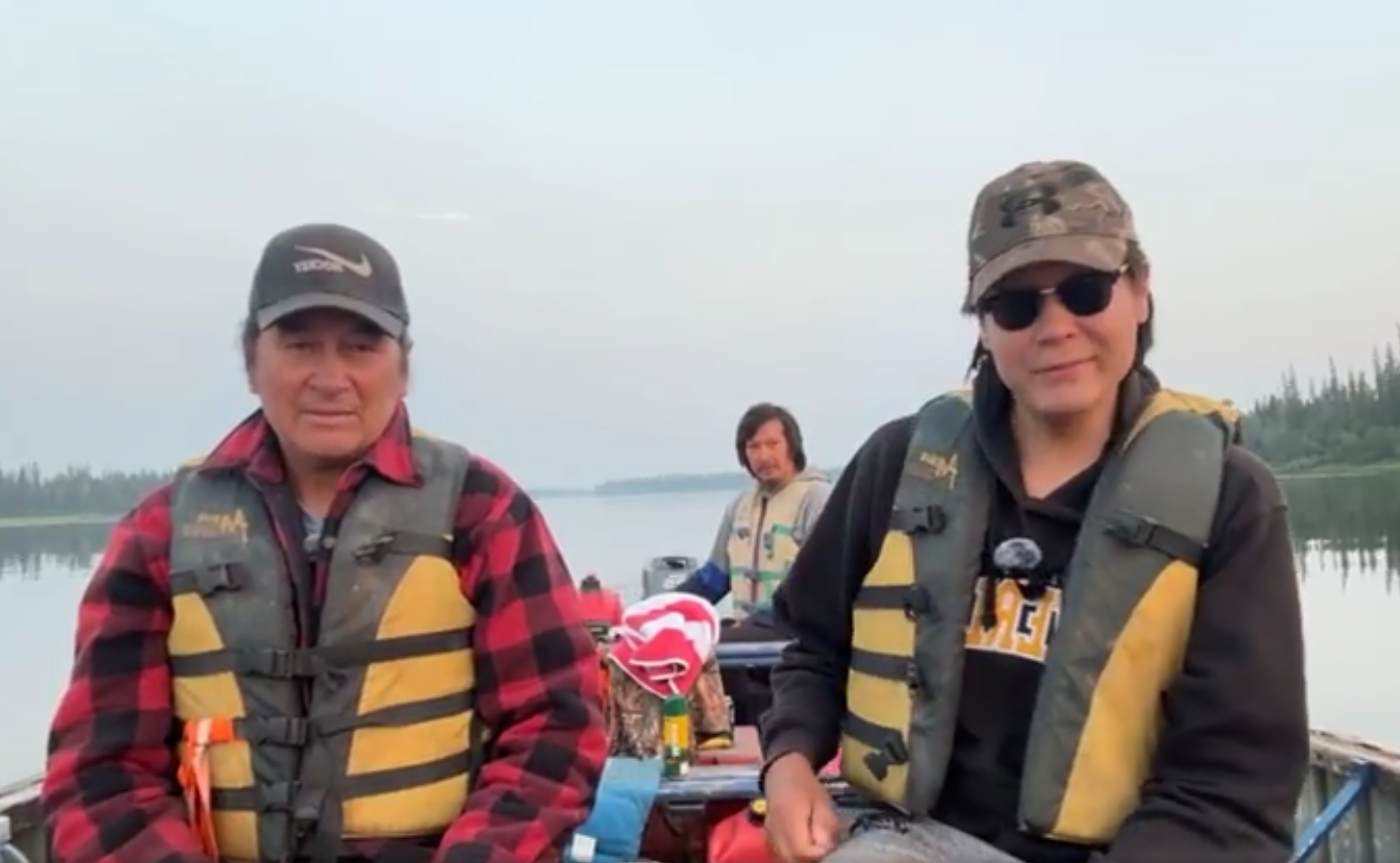
The only people that seem to be standing up are First Nation youth who will have to live with the fallout of the decisions of our leaders today. Youth-led movements here in northern Ontario include Here We Stand – Call To Action led by Jeronimo Kataquapit; Okinawak with Ramon Kataquapit and Kohen Chisel; Mahmo Inninuwuk Wiibuseego-stamok youth walkers from Timmins, and Youth Rising Together in Timmins. We need to support these brave, intelligent, committed youth in every way we can. Find them on popular social media sites and support them all on their gofundme pages.
Connect with them to see how you or your organization or community can help. If you want your grandchildren and great grandchildren to have a world where they can breathe clean air, drink clean water and enjoy our natural world, then you really have to pitch in and help out. They are all counting on you.
Photo Caption: Jeronimo Kataquapit (on the right) is pictured with his father James Kataquapit (left) and his brother Jonathan Edwards (centre) in a freighter on the Attawapiskat River as they conduct one of their daily livestreams on the Facebook page Here We Stand – Call To Action.