
Image
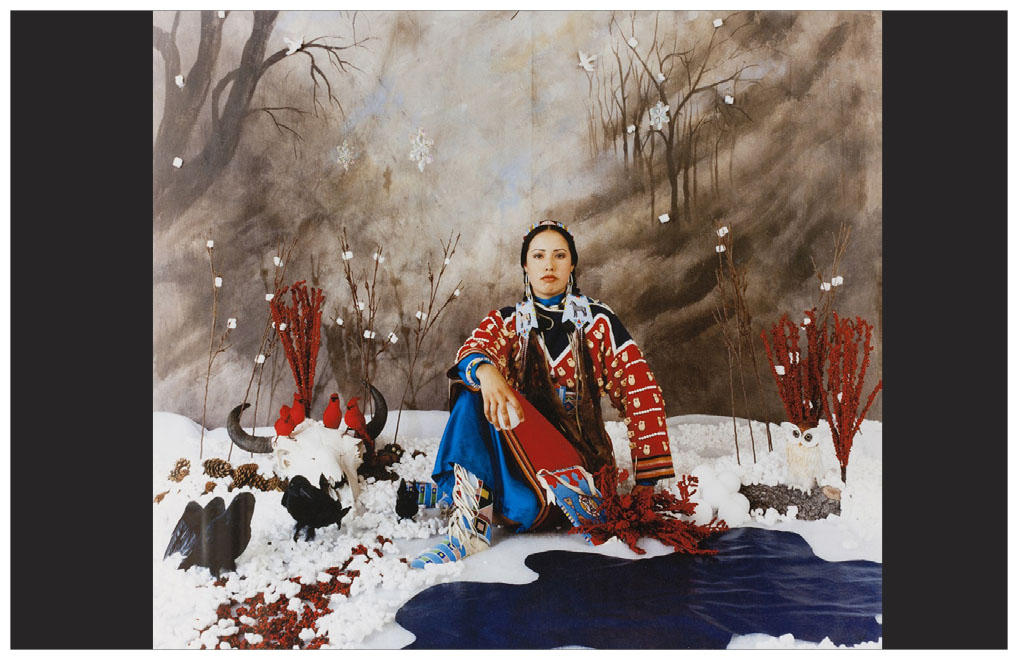
Image Caption
Local Journalism Initiative Reporter
Windspeaker.com
The National Gallery of Canada's newest exhibition explores perspectives of the winter season across diverse cultures and artistic expressions. Comprising more than 160 works spanning two centuries, Winter Count: Embracing the Cold marks the first major collaborative project between the gallery's Canadian, European and Indigenous curatorial departments.
“Winter will never stop being our first common language,” wrote director Jean-François Bélisle in the exhibition catalogue. “A tongue of resilience, imagination and kinship. Winter Count reflects the Gallery's desire to weave together multiple art histories around a theme that has been extremely impactful in Canada.”
The exhibition is named for the tradition among many Plains peoples to record the passing of each year with the painting of its most significant event onto buffalo hide. Winter Count is also the title of a large installation of tipi covers from Cree artist Duane Linklater that feature markings alluding to residential school unmarked graves. It fills an entire room at the gallery in Ottawa.
“When we were beginning to work on this exhibition, we were just in the process of acquiring it, so it was definitely a starting point,” said Wahsontiio Cross, associate curator of Indigenous art.
“I really wanted to include the Wendy Red StarWinter from her Four Seasons series, and Krystle Silverfox's Spear Game.”
Red Star's piece satirizes museum dioramas depicting cultural habitats that perpetuate the myth of the “vanishing Indian”, said Cross. Wearing traditional regalia from her Crow Nation, the artist's wintery self-portrait is surrounded by bird ornaments and Styrofoam snowballs.
“She is in these landscapes that are very obviously staged,” Cross explained. “She is engaging with the history of representation, but she is her own subject. So she has taken back that agency.”
The cross-cultural collaboration has sometimes enabled provocative juxtapositions of artistic narratives from different times and places. Associate curator Jocelyn Piirainen said this is most prominent in the exhibition's opening room, where Kent Monkman’s large 2007 painting Charged Particles in Motion is displayed as commentary on two adjacent works by Canadian settlers.
Contrasted with Paul Kane's romanticized depiction of a British military man journeying by dogsled through the snowy northwest with two Indigenous guides in the distant background, Monkman inserts into Charged Particles his flamboyant alter ego, Miss Chief Eagle Testickle, whipping past a settler's poodle-led overturned sled.
The exhibition's catalogue illuminates the extent that settlers relied on Indigenous innovations to survive harsh Canadian winters and how settler artists often sought comfort in nostalgic imagery that misrepresented Indigenous communities. The curators wanted to highlight contemporary Indigenous artists who have challenged dominant myths about the Great White North.
“There was always this concentric idea of starting from the Indigenous systems and building that backward,” said Anabelle Kienle Ponka, senior curator of European, American and Asian art. “We whittled it down to seven themes so there would be juxtapositions and dialogue that ultimately would make our visitors think about winter in a different way.”
Struggles against winter such as Cornelius Krieghoff’s 1862 painting Crossing the Ice with the Royal Mail, Quebec are contrasted with snowy fun like Pangnirtung artist Malaya Akulukjuk’s Winter Games. Senior curator Katerina Atanassova said that the chosen works demonstrate how artistic interpretations of the season have progressed to the present day.
“These narratives, starting with views of the frontier, evolved into modern outlooks on life, encompassing both the inhospitable surroundings and the warmth of the community,” Atanassova said. “We find powerful hints of our collective and individual identities.”
Since the establishment of the gallery’s Indigenous Ways and Decolonization department in 2022, the gallery has hired more Inuit staff than any other southern gallery. Piirainen, originally from Iqaluktuuttiaq (Cambridge Bay), is the first Inuk to hold a permanent curatorial position at a Canadian institution.
Traditional knowledge is highlighted in works such as Pitseolak Ashoona's Snowhouse of My Youth and Helen Kalvak's Game in Snowhouse. These artists depict sewing winter clothing throughout the summer, gathering dried moss and cotton to keep the qulliq burning, building igluit (igloos) and qamutiik (dog sleds), and other activities vital for survival.
A wide range of Inuit prints, sculptures, ceramics and textiles are featured, with Iqaluit-born Couzyn van Heuvelen’s Qamutiik sculpture greeting visitors near the entrance. Regional differences can be observed with displays of sealskin-based coastal garments and those made of caribou fur found more inland. The catalogue explains how the influence of a fur-trading family that came from Alaska in the 1930s informed more recent additions like the brightly coloured Mother Hubbard Parka.
“I know there are a number of young Inuit seamstresses these days looking towards the past to historical garments but modernizing it,” said Piirainen. “I felt happy the clothing fit the exhibition thematically and is being recognized as forms of art.”
Piirainen is pleased that visitors are finding the results of the curatorial collaboration enriching. Atanassova said some people have been reduced to tears to find such a common subject “so inspiring and so uplifting and so diverse.” The Queen of Sweden declared Winter Count the favourite part of her recent trip to Canada.
“Visitors are very surprised and delighted by how these artworks come together,” said Cross. “I hope people walk away feeling that connection between the artworks in the show and a connection that so many artists have to their ancestry and to their culture.”
Winter Count: Embracing the Cold is on view at the National Gallery of Canada in Ottawa until March 22, 2026.