
Image
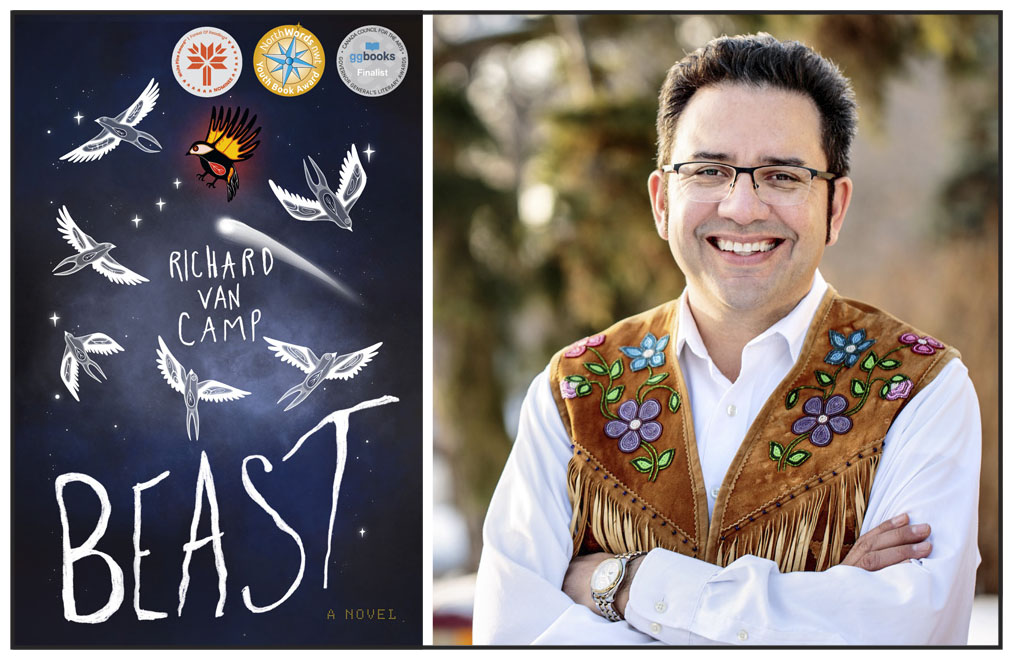
Image Caption
Windspeaker.com Books Feature Writer
Local Journalism Initiative Reporter
Seven years in the writing. Five editors. A publisher with vision. It all added up to the right combination as Tłįchǫ Dene author Richard Van Camp garnered his first nomination for a prestigious award.
Beast: A Novel, released in October 2024, was shortlisted for the 2025 Governor General’s Award in the category of Young People’s Literature. While it fell just short, Van Camp says he’s “so proud to take Northern literature to that level nationally. But I know to this day I'm still breaking trail for other Northern writers, and I'm breaking trail for more Indigenous writers.”
Beast is Van Camp’s 30th literary work in 30 years. He has won the R. Ross Arnett Award for Children’s Literature, the Georges Bugnet Award for Fiction (twice), CODE Burt Award for First Nations, Inuit and Métis Young Adult Literature, and a 2020 Alberta Book Award.
Van Camp, who grew up in Fort Smith, N.W.T. and now resides in Edmonton, notes he’s not alone in breaking that literary trail pointing to Dene writers Antoine Mountain, George Blondin, and Cece Hodgson-McCauley.
Beast was 417 pages when Van Camp presented it to Douglas & McIntyre publisher Anna Comfort O’Keefe. Because young people are no longer reading lengthy novels, Comfort O’Keefe recommended dropping the page count by 100. Over the next eight months, Van Camp worked with five editors, each in charge of a different aspect of the novel, including plot, continuity, and an expert in the 1980s.
“When we went to press, I went through it one more time by myself and said, ‘We have earned every single word.’ And I'm so glad we did that,” said Van Camp.
But perhaps just as valuable as the people Van Camp had surrounding him on the business end of Beast is “the magic” he drew on from his home community of Fort Smith in the 1970s and ‘80s for the fictional community of Fort Simmer. Van Camp has used Fort Simmer in past tales.
He sets Beast in 1986 when there’s no internet or texting and when Canadian and rock music ruled.
Van Camp masterfully intertwines the Dogrib teachings of the Creation Story and the Dogrib Chipewyan Peace Treaty with his dark creations of Slitter and The Dead One. The result is a chilling tale of three reluctant teenage heroes—Lawson Sauron, who is from the Dogrib Tribe (Tłįchǫ Dene) and a Yahbati (protector), Isaiah Valentine, who is a Cree grass dancer, and Shari Burns, Métis, who communes with the dead. The trio teams up with their spirit cousins. With Lawson leading and pulling on his traditional knowledge while blasting rock music from his truck’s cassette deck, they take on the Big Bad Evil.
Van Camp’s mother told him the stories of the Dogrib when he was growing up. Now the father of an 11-year-old, he finds himself wondering if the younger Tłįchǫ Dene and Chipewyan are aware of the peace treaty between them that forbids them from raising their hands against each other and “bring(ing) back that spirit of warfare between us.”
Growing up in Fort Smith, Van Camp not only engrossed himself in some great Canadian and rock music (the novel includes Lawson’s playlists), he also indulged in horror movies and read Stephen King books voraciously.
“I love the idea of Pennywise (from King’s novel It) and I remember when I got to the end of that huge novel… I wanted to throw that book across the room because I was so disappointed with what Pennywise is, when you see what kind of creature it is,” said Van Camp. “I think that looking back now that Beast is out, this is the beast I wish Pennywise could have been. I had all those years of disappointment to turn it around.”
That meant using his extensive knowledge of botflies. Van Camp took great glee in describing to Windspeaker.com how the botfly “mom” sprays her eggs up the nose of a moose or caribou, and then they “warble” their way to the back of the animal before taking months to “pop through your skin” and then are “born little hairy flies.”
“I just never forgot that. I was like, ‘Oh my God, the terror of that.’ And so, I thought ‘Well, wait a minute’, and that's how Slitter came to be,” said Van Camp.
“I'm a huge fan of horror. I love great horror. I love great terror. And for me to dive deep and say, ‘Okay, if we're going to do Northern Dene horror, what's a new kind of horror I can bring to the world based on what I've known or what I've been told and what I've seen?’ I can bring that to the page for the first time in a way nobody else can.”
And so he did.
But Beast isn’t only horror and gore. It draws on tradition, culture, love and cooperation to fight the ancient evil.
Van Camp hopes Indigenous youth can see “the strength and the resilience of their cultural teachings” in his novel. He also hopes they see the similarities between their Indigenous teachings and traditions and those of other Indigenous groups.
As for non-Indigenous youth, he hopes “that this is a gateway novel for them where they say, ‘Oh my God. This was awesome. I didn't know this before. I love how Indigenous people see the world. I love the courage here. I love the beauty here. I love the resilience here. I want to read more’.”
For Indigenous youth, he also hopes Beast inspires them to do their own writing and create their own monsters and develop their own traditional ways to fight against them.
“As an Indigenous writer who has a whole pile of friends who are Indigenous writers and creators, we are living in a time where it's an embarrassment of wealth,” said Van Camp. “(It) speaks to the beauty of never being able to catch up to all the gorgeous Indigenous literature that's out there now. I'm really proud of that. I'm proud to be part of it.”
Beast is published by Douglas & McIntyre. It can be purchased at bookstores or online at here.