
Image
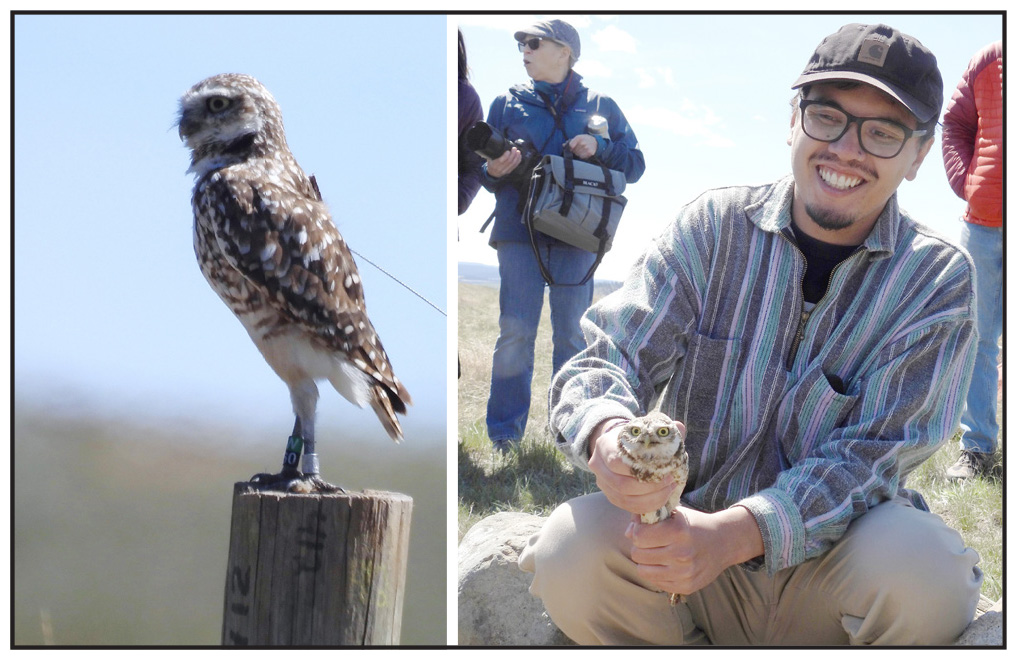
Image Caption
Local Journalism Initiative Reporter
Windspeaker.com
A decade after the first burrowing owls were released onto its reserve lands, the Upper Nicola Band is marking what leaders and partners describe as a rare conservation success in a province where the species remains on the brink.
On April 22, community members, knowledge keepers, and conservation partners gathered on the Douglas Lake reserve to release six more captive-raised burrowing owls as part of an ongoing recovery effort that has quietly become one of the most productive breeding sites for the species in British Columbia.
Since 2016, the program has produced 125 wild-born fledglings, with both captive-born and wild-born owls returning annually to breed — a key indicator of long-term viability.
“The program has exceeded all our expectations,” said Loretta Holmes, an Upper Nicola member and senior resource technician. “The owls, which we call sq̓əq̓axʷ, have responded better than we dared to hope 10 years ago. And community interest and involvement has been strong since the start.”
The success stands out in a region where burrowing owls have disappeared from much of their former habitat and where recovery efforts are still uncertain.
Burrowing owls — small, ground-dwelling birds that rely on grassland ecosystems — are designated as endangered in the province. Their decline has been driven by habitat loss, pesticide use, and the disappearance of burrowing mammals like badgers.
Dawn Brodie, a consultant who has worked on burrowing owl recovery for more than three decades, said the species’ survival in B.C. remains precarious.
“I used to tell people that burrowing owl populations in B.C. are basically on life support,” she said. “If it weren’t for programs like the one at Upper Nicola and other owl programs, we wouldn’t have any owls in B.C.”
Even with ongoing releases, wild return numbers remain low across the province. Brodie noted that Upper Nicola’s site saw four owls return from migration this year, a figure she described as “really quite amazing” given the species’ overall decline.
“That’s the most exciting news,” she said. “We usually see one or two birds return.”
What distinguishes the Upper Nicola program is not only its outcomes, but how it was developed.
The project began in 2014 with habitat surveys led by biologists and band members, supported by oral histories from Elders who confirmed the owls’ historical presence on the land. That knowledge helped guide site selection, alongside scientific assessments of elevation, vegetation, and prey availability. Artificial burrows were installed by community members, including students, before the first owls were released in 2016.
“When the site was chosen, we spoke with Elders within the band, and they provided a lot of valuable information,” Brodie said. “It’s a blend of what we heard from the Elders and my experience managing the program.”
That integration reflects a broader approach rooted in Syilx stewardship principles, which emphasize the interconnected relationship between people, wildlife and the land, and the responsibility to protect those relationships through long-term care, observation and respect for natural systems.
Chief Dan Manuel underscored that connection in a statement released ahead of the anniversary event.
“For our people, the cultural, spiritual, and environmental importance of sq̓əq̓axʷ are one,” he said. “Our culture is rooted in co-existence with the world around us. We have a responsibility to care for the land and the beings on it. We must help rebuild what has been lost, and it will continue to support us.”
Among the Syilx people, burrowing owls are understood as more than a species at risk, as they are regarded as guardians and guides woven into cultural teachings.
The program also highlights a less visible crisis: the decline of grassland ecosystems in British Columbia, which are critical to the species’ survival. Brodie noted that grasslands now make up less than one per cent of the province’s landscape, yet support roughly 30 per cent of its threatened and endangered species.
“Since the 1980s, there has been increased agriculture and development, which is a major factor,” she said. “That leads to a loss of prey, along with increased pesticide and herbicide use. All of those factors take a real toll on wildlife, particularly birds.”
Burrowing owls play a critical role in grassland ecosystems, acting as both predator and prey. A single owl family can consume hundreds of rodents and thousands of insects in a season, helping maintain ecological balance.
That role makes their presence a key indicator of ecosystem health. Their recovery signals broader environmental stability, Brodie said, while their decline reflects ongoing pressures on grassland habitats, including development, pesticide use, and loss of prey.
At Upper Nicola, that work is supported through partnerships with the Burrowing Owl Conservation Society of BC, which provides captive-bred owls and collaborates on monitoring and research.
In recent years, the program has expanded into satellite tracking, offering new insight into migration patterns. One owl tagged through the program was tracked as far south as San Jose, Calif., travelling at night across hundreds of kilometres.
“We have a general idea of where they go based on band returns, but we don’t know exactly where they winter or how long it takes them to get there,” Brodie said. “Satellite transmitters can help answer those questions.”
At the same time, the Upper Nicola site has developed what Brodie described as a “gold standard” for field monitoring — combining careful observation, data collection and ongoing habitat management. That consistency is critical for a species that still relies heavily on human support, including supplemental feeding and artificial nesting sites.
“They still use artificial burrows, and that will likely continue for a long time,” Brodie said. “But I would love to see a burrowing owl use a natural burrow. That would really make our day.”
The program’s success is drawing attention as a potential model for other Indigenous-led conservation efforts, especially as First Nations across Canada assert greater control over land stewardship and species-at-risk recovery.
Upper Nicola’s broader Species at Risk program also includes work on the American badger, Lewis’s woodpecker and Great Basin spadefoot, combining habitat protection with education and community-based engagement.
The burrowing owl project, however, stands as a flagship example of what sustained, community-driven conservation can achieve, even under challenging conditions.
“The Upper Nicola Band is honoured to be an important part of establishing a self-perpetuating population of sq̓əq̓axʷ on our traditional lands and reversing the decline of burrowing owls in B.C. and Canada,” Chief Manuel said.
For Brodie, the meaning of the work extends beyond the numbers to its long-term continuity.
“Their lands are going to remain that way,” she said. “They won’t be subject to land-use changes or development, so burrowing owls can be established there long term.”
As Canada continues to grapple with biodiversity loss and the impacts of development, the Upper Nicola Band’s experience offers a clear lesson: recovery is possible, but it requires time, cultural grounding, and local leadership.
In a landscape where many species remain in decline, the return of even a handful of owls carries weight.
“It’s a steady population at the moment,” Brodie said. “Because of these programs, the Upper Nicola effort is making a difference.”
For further information, visit UpperNicola.com/departments/stewardship.