
Image
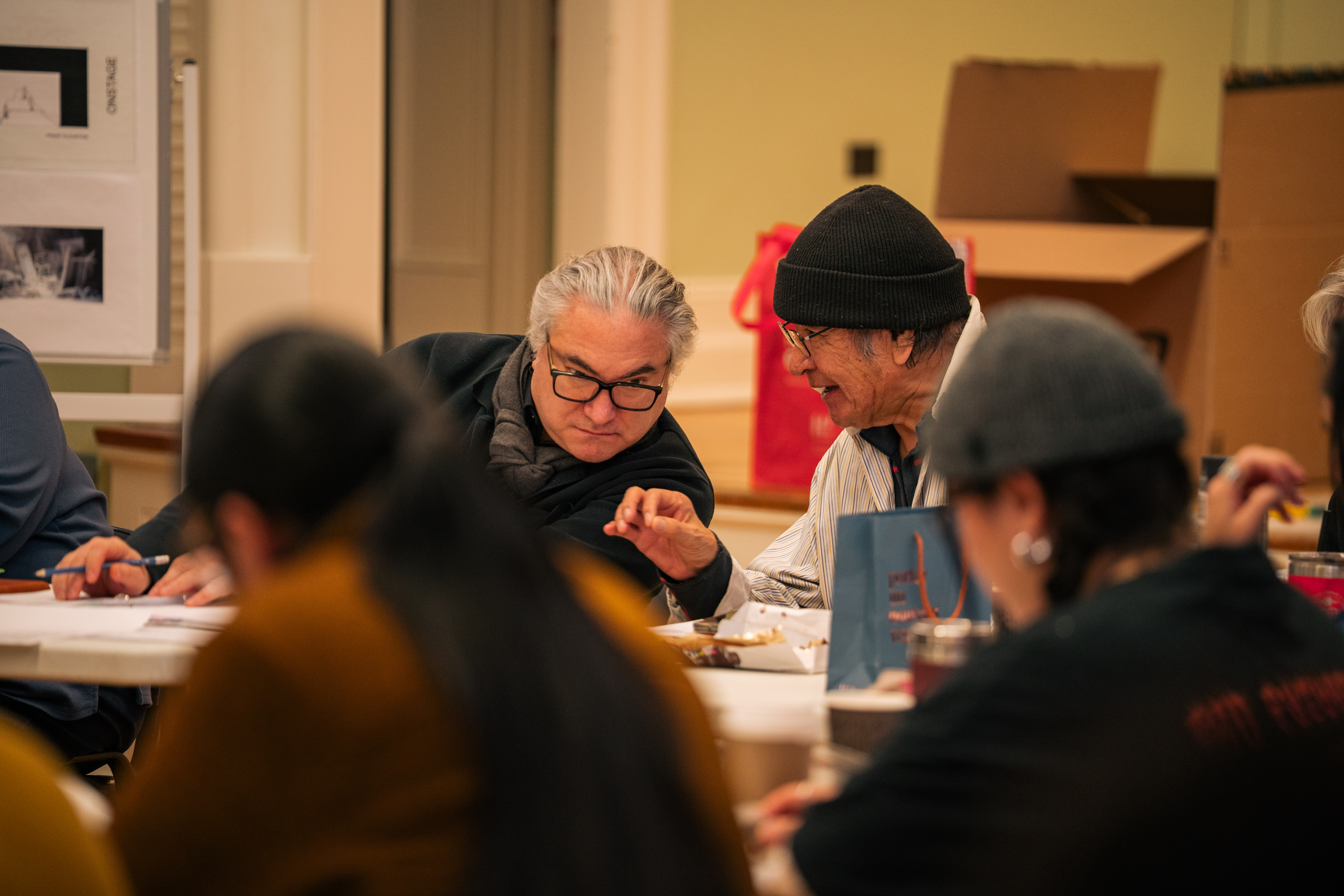
Image Caption
Windspeaker.com Books Feature Writer
Local Journalism Initiative Reporter
Conversation with Cree playwright and novelist Tomson Highway opens in laughter. His introduction includes describing the land, people and languages that birthed him, and then he adds, “One of these days I'm going to get outed. My answer to that is ‘Yes, it's true. I am not Cree. I'm actually half Sasquatch’.”
The joke sets the tone for the conversation that follows—a mix of humour, philosophy, language and stories that circle outward while explaining the ideas behind his play Rose, which is getting its professional world premiere at the National Arts Centre Indigenous Theatre March 25, to run until April 4.
This will be the largest production to date that NAC Indigenous Theatre in Ottawa has undertaken with an all-Indigenous cast, including Patricia Cano as Emily Dictionary, Trevor Duplessis as Big Joey, and Renae Morriseau as Chief Big Rose. It is under the direction of Kevin Loring, the Theatre’s artistic director.
Written in 1992, the production has remained professionally unstaged for more than three decades “due to its monumental scale and ambition,” reads a press statement. Rose, a musical complete with six-piece band, is the third part of Highway’s “Rez” cycle, which includes acclaimed plays The Rez Sisters (1986) and Dry Lips Oughta Move to Kapuskasing (1989). All focus on life in the fictional reserve Wasaychigan Hill. The play examines love, sexuality, spirituality and survival within a changing Indigenous community.
Highway’s work emerged in the second wave of Indigenous literature, when writers began bending Western literary forms to carry Indigenous worldviews rather than explaining Indigenous life to outsiders.
“I come from Northern Manitoba. It was a totally isolated community, probably the most isolated Native community in the provinces,” he says. He’s a member of Mathias Colomb First Nation.
His parents spoke several Indigenous languages, but not English.
“My father was trilingual,” he said. “Cree, which is his mother tongue, Dene… and then Inuit, because we lived so far north that we fraternized with the Inuit people.”
Never attending school himself, his father insisted his children pursue education.
“He never wanted that for us,” Highway says. “He wanted us to be very, very beautifully educated.”
Today Highway speaks multiple languages and encourages others to do the same.
“Speaking another person's language is an act of respect. It means you love those people. It's an act of love.”
Language, he says, is also deeply musical. When writing dialogue, rhythm matters as much as words. “Music is the very, very base of my existence as a human being.” Highway is a classically-trained pianist and sees musicality in all the languages he speaks.
Rose is rooted in the difference between European religious traditions and Indigenous cosmologies, said Highway.
“I believe that the problem with Christianity… When Christopher Columbus arrived in North America he brought one item of luggage on that boat that was most essential,” Highway says. “And that is he brought the idea of God.”
“Our problem with that God, from our linguistic perspective, is that that God was male. Not female, but male,” he says. For Highway, this absence of the feminine raises difficult questions.
“So the question we have for him (God), theoretically, is why did you come alone? Where's your wife? Where's your girlfriend? What do you do to get your rocks off? Why do you have to have sex with our children? With our little boys?”
He pauses. “The idea of divinity in female form is completely absent,” Highway explains, and Indigenous cosmologies offer another perspective.
“So we have to look to other places to find God in female form,” he says. “And that place is in Native cosmology, Native theology, Native mythology.”
“At the very center of our existence is the idea of God as a woman,” he said. “The basic idea of Rose is God as… the death of God as male and the rebirth of his wife.”
Humour, he said, is never far from these philosophical questions. Highway has written extensively about the role of Trickster humour in Indigenous storytelling.
“The trickster comes from… the anus,” he says matter-of-factly. “Which is why farts are so funny.” The line arrives with mischievous timing, laughter woven directly into spiritual teaching.
Highway circles back to the landscape he grew up in, massive lakes filled with islands with fresh, drinkable water.
“When I was a child, there was no such thing as a forest fire,” he says. “It was perfectly safe for humans and animals to live up there.”
Today, he says, that reality has changed.
“Every year there are hundreds of Native communities being evacuated every summer. And the problem is getting worse and worse and worse.”
In the face of those changes, he believes art has an essential role to play. Highway compares artists to doctors, working in a different but equally necessary field.
“Medical doctors look at the human body after the disease has taken hold,” he says. Artists work earlier in the process. “We look at the body, the spirit, human spirit, before the disease takes hold. We take care of the soul.”
Preparing to head to rehearsal with the cast of Rose, Highway says, “Kevin Loring has done an extraordinary job of putting this company together, of hiring the actors. He's just absolutely brilliant.”
And the spirit of the world, Highway suggests, may be waiting to be remembered again.
“At the very center of our existence is the idea of God as a woman.”
For more information and showtimes, visit: https://nac-cna.ca/en/event/38352