
Image
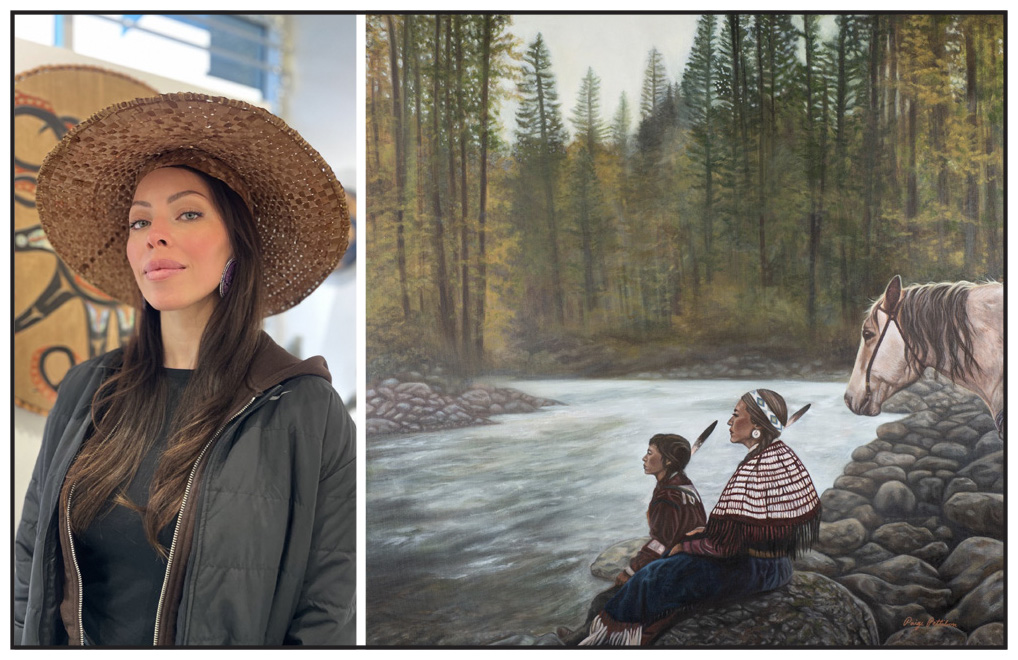
Image Caption
Local Journalism Initiative Reporter
Windspeaker.com
Every River Has a Mouth: The Visual Languages That Connect Us opens at the Bill Reid Gallery of Northwest Coast Art in Vancouver on Feb. 14 and runs to Feb. 14, 2027. It is the gallery’s first Salish-focused show since 2017.
It features 11 Interior and Coast Salish artists showcasing their unique work in sculpture, printmaking, textiles, painting and mixed media.
“Every River Has a Mouth really talks about how the rivers connect us and that we share so much… and it just speaks to the ways that this knowledge flows on the river in the same way our cultures flow on the rivers,” said guest curator Eliot White-Hill.
White-Hill is an artist and storyteller from the Snuneymuxw First Nation. He has been working on the exhibit for the past two years and said it was his vision to tell the stories passed down from generation to generation.
Participating artists are Angela Paul, Danielle Morsette, Grace Edwards,James Harry, Manuel Axel Strain, Ocean Hyland, Paige Pettibon, Ryza Marston, Susan Point, Sydney Pascal and Taylor Baptiste.
“I’m really, really excited to bring together these artists and to ask them to respond to the themes of the show and share the work that they’ve made,” said White-Hill. His goal for the show is to preserve Salish knowledge through both written and visual narratives.
From a 21-foot-long canoe by the Marstons to an installation piece by Pascal that references the importance of salmon as a food source, the variety of work in the exhibit illustrates the wide variety of culture of the Salish peoples.
“Initially, it was kind of more of a Coast Salish focused show, but as we were working, I just felt really drawn to bring in Interior Salish artists as well, and artists whose work that I’ve seen before who I really admire,” explained White-Hill.
Pettibon, from the Confederated Salish Tribe in Montana, is a multi-media artist who will showcase handmade jewelry in addition to a painting.
“Paige is an amazing artist… She has a really incredible beading practice and really awesome earrings and necklaces. She does it in a very traditional way, very old school, using dentalium shells, abalone shells… They really look like something that you would see one of our ancestors wearing in a photo from 200 years ago,” said White-Hill.
Pettibon also has a visual art practice that White-Hill said “weaves her styles of both Coast and Interior Salish so beautifully.”
For this exhibit, Pettibon has contributed a contemporary style painting set along a river.
“It’s a 36” by 36” painting in acrylic on a canvas of an Elder woman and a young teen or teenager and a horse resting on the river; Jocko River, which is a river that runs through my reservation in Montana,” said Pettibon. “The theme (of the exhibit) is to connect us Salish cultures, Interior and Coast Salish, which I thought was really cool because we don’t usually get to work together.”
The idea for her painting came from a black and white photo she saw of a young woman, a teen boy, and a horse. In her rendition of the picture, she changed it to colour and included an Elder to represent multi-generations and how “culture changes through generations yet still remains grounded in place” Pettibon said.
Interior Salish peoples are often categorized as Plateau tribes, though their cultural identity reflects a blend of influences from the Plateau, Plains and Coast Salish regions. Their language shares similarities with Coast Salish languages, placing them in a geographic and cultural middle ground, said Pettibon.
Prior to European settlement, Interior Salish communities traveled widely throughout the region, connected by a shared landscape and common communication with neighbouring tribes. Despite these connections, their interior location shaped traditions that developed distinctly from those of coastal groups.
This distinction is especially evident in art. Interior Salish artistic traditions differ significantly from Coast Salish art, which is highly specific and visually recognizable and is sometimes mistakenly associated with Alaskan form-line styles.
Instead, Interior Salish art emphasizes functional and material-based practices, such as basketry, weaving and textile production.
Using materials like mountain goat wool, Interior artists created blankets, baskets, and other utilitarian objects. Their work also reflects influences from Plateau traditions, including elements of ledger art and pictorial beadwork like Yakima Plateau–style beadwork, which includes imagery of horses, floral motifs, and human figures.
Pettibon uses both practices to illustrate tradition shaped by movement, exchange, and a position between cultural regions rather than by a single, dominant visual style.
Pettibon said being part of the Every River Has a Mouth exhibit has given her the recognition for her work she has strived for.
“I feel so fortunate, so honoured, that my work is considered like something that should be a part of this. I mean, I’m very confident in my work, but to have Eliot think that my work should be shown in this way means a lot to me,” she said.
The Bill Reid Gallery was named after acclaimed Haida artist Bill Reid (1920–1998) who is known as a master goldsmith, carver, sculptor, writer, and broadcaster.
Throughout the year the gallery will be offering public programs, including artist talks and artist-led workshops to provide visitors with a greater awareness and appreciation of the Salish culture and art.
For more information visit Bill Reid Gallery of Northwest Coast Art