
Image
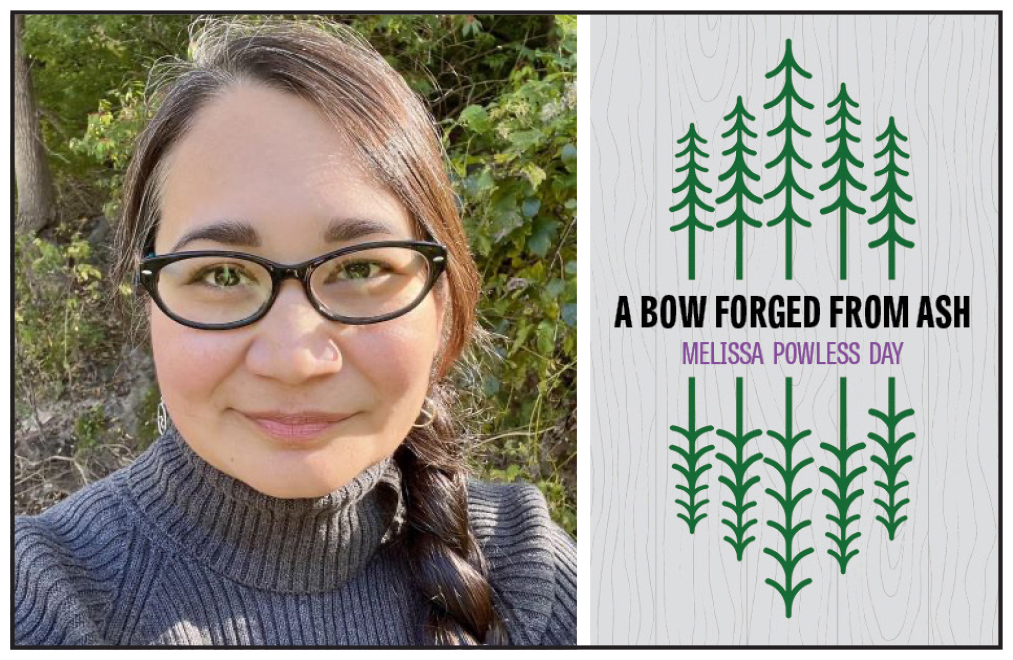
Image Caption
Windspeaker.com Books Feature Writer
Local Journalism Initiative Reporter
Part of Melissa Powless Day’s reclamation journey is her language, which she sprinkles throughout her newest poetry collection A Bow Forged in Ash.
“I knew from the beginning I wanted to include Anishinaabemowin in my poetry in the book,” said the Anishinaabe and Kanien’kehá:ka writer. “At the time when I was first starting, I didn't know how much that was going to be. But definitely later on in the book, I get a bit more confident with using longer phrases and that sort of thing,” said Powless Day, who is from Bkejwanong territory (Walpole Island First Nation) with family ties in Six Nations of the Grand River.
It took her a year-and-a-half to two years to complete the collection, which was based on conversations and experiences she’d been thinking about. While her use of Anishinaabemowin grew throughout, she states in her afterword, “My Anishinaabemowin is not perfect or fluent but my use of it in this collection is truthful.”
Powless Day uses Anishinaabemowin words and phrases without italics, without translation, without footnotes and without a glossary.
“I chose to do it, to present the language in the way that I did, because I really want to normalize Anishinaabemowin. We're talking about my territory, where I'm at right now, and this is the language that's been spoken here for hundreds, if not thousands, of years prior to Europeans coming over. This is the language that the land knows, and yet, when we walk into spaces and cities, if I were to say, ‘Boozhoo, miigwetch,’ any of these kind of words, most people don't even know what language that is or what I'm saying to them,” said Powless Day, who resides in London, Ont.
In offering her language without explanation, Powless Day is hopeful that people will be curious enough to find out what the words mean.
A Bow Forged in Ash is divided into three sections—Nock, Pull, Loose—all of which refer to aspects of shooting a bow. “Draw” is the more common middle term.
Powless Day says she was deliberate in replacing “draw” with the verb “pull,” which “has more of an impact because it has more of a sonic, aesthetic quality to it…Going into the second section of the book or the second phase, as I think of it, this idea of the pull is also getting ready, but getting ready in that more active way of really starting to question things or to go back to community or to go back to language, whatever it might be. To start seeing things and feeling things in ways that aren't defined by that colonial mindset.”
The sections Nock, Pull, and Loose represent the three stages of return and reclamation, she says, but points out that the stages are cyclical and not linear.
Powless Day begins her collection with poems that were published in a chapbook in 2023. Those poems were a “love letter, a thank you letter” to her mother, who taught her how to be a proud Indigenous woman. This grounds what she considers to be the Nock or first stage of “preparing and remembering and just gathering all of those things that we carry with us.”
Loose or the final stage, she said, is “the arrow…flying and we're really starting at that point to find our own way in terms of the reclamation and the return and figure out where are we going.”
The anchor poem for the collection is found near the end of the book and references the title of the collection. It comes as a stanza in “Field Poem 3”: “My cousin makes bows/Shows me how two fingers draw velocities with a snap/Warns me of the learning curve/The flesh sacrifice/To fly an arrow shaft/Hands me a blow, hand-forged from ash.”
Powless Day says the collection is about “reclamation and returning home and all the layers of that”, including both a physical return as well as a philosophical or cultural return.
While she’s trying to evoke certain thoughts and experiences from the reader “other people might get something out of this completely different and that's okay. That's the beauty of art,” Powless Day says.
Powless Day is deliberate in the words she uses in her poetry. Sometimes those words are “there on the page and it’s exactly as you want it to be,” but more often, it’s a process of working on brevity, playing with language and “really tucking as much meaning into as few words as possible… It's about selecting words that are going to have, hopefully, some sort of impact when they're read.”
With English as her first language and her “brain’s operating system,” Powless Day is hopeful she’ll be able to master Anishinaabemowin the same way.
“I'm definitely going to continue to try. And the more I learn about the language and the way the language works and how much it carries, I get to be there bit by bit,” she said.
Powless Day is a scholar and educator currently pursuing a PhD in Indigenous Education at Western University. She serves as the chair for Western’s Indigenous Writers’ Circle and as a Visiting Cultural Teacher for the London District Catholic School Board.
Her poetry has appeared in the Temz Review, TNQ, the Windsor Review, Luna Station Quarterly and Yellow Medicine Review, and her first chapbook, Secondhand Moccasins, was published in 2023 by Anstruther Press and shortlisted for the bpNichol Chapbook Award.
A Bow Forged in Ash is published by Palimpsest Press. It can be ordered through https://palimpsestpress.ca/books/a-bow-forged-from-ash-melissa-powless-…