
Image
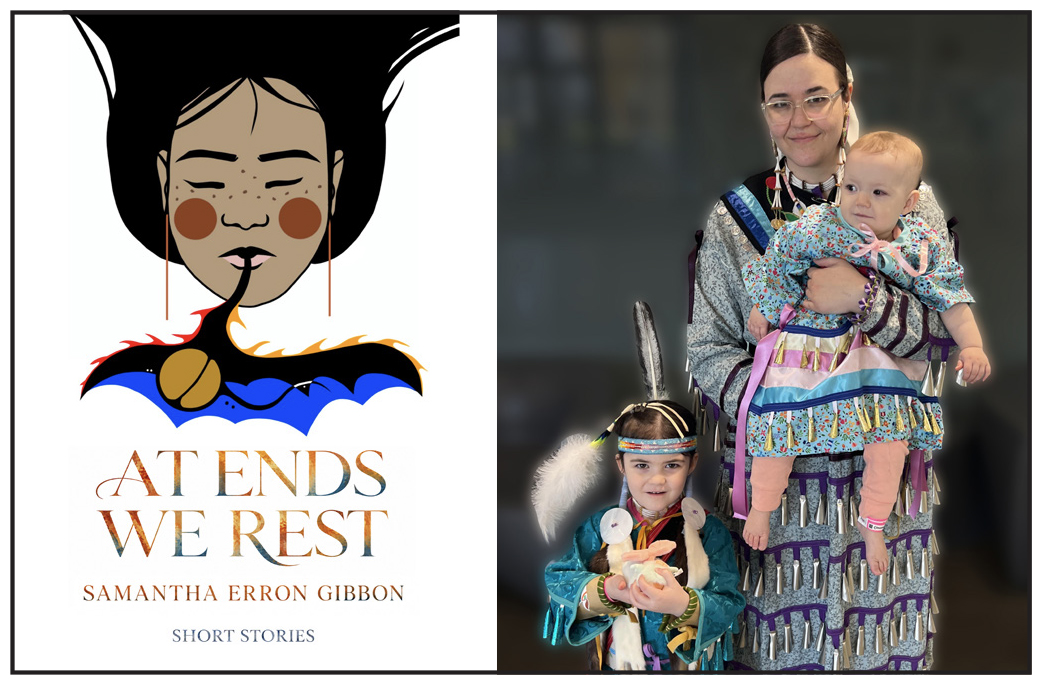
Image Caption
Windspeaker.com Books Feature Writer
Local Journalism Initiative Reporter
Samantha Erron Gibbon admits she didn’t set out to write a collection of short stories for youth, but “then it came about that the stories I was writing were youth oriented.”
The four short stories and one long poem that comprise Gibbon’s debut collection At Ends We Rest are powerful, sad and hopeful. And realistic, she stresses.
“Unfortunately, our lives are touched by loss, and our lives are touched by the MMIWG (Missing and Murdered Indigenous Women and Girls) tragedies and by addiction,” said Gibbon, a Métis-Cree physician from Edmonton.
“If I weren’t to depict those in our stories, I'd be taking away from not only the reality of what my youth have to live with and what we have to deal with. But I think by not highlighting these aspects, it takes away a bit from the truth... And I do think it's heavy.”
“My youth” is a term Gibbon uses to refer to the “beloved youths who follow me in my mind and my heart.”
As a teenager in the Edmonton Catholic School Division, Gibbon spent time tutoring youth and working as a liaison or a “professional auntie” as she calls it. She would smudge with students at lunch time and listen to their stories.
The spirit of these students has been imbued into her stories, she says.
As for the title of the collection, At Ends We Rest, Gibbon said, “I feel like all of these characters in my book and all the youth that I work with are always in this perpetual fight. And I wanted to pay attention to what does that end look like? What are each of these characters striving for? Where are those ends that we rest, and what do we see there? I just wanted to pose that to the audience.”
It’s an open-ended question as the characters lives are left unresolved in the stories.
“Our lives are characterized by loss but with that comes strength,” said Gibbon. “These characters, I think all of them depict so much strength. And that's also what I want to see. I don't want it to be death without hope, death without strength.”
She points to the single long poem in the collection. In “Garbage Guts,” Gibbon counts down the amount of money Noa has to feed her three little sisters. Noa starts with $219.62. The poem ends with Noa having no money left but a fridge packed with food and sisters with full bellies.
Gibbon admits she wonders where Noa’s story goes next, but she’s hopeful because she sees Noa as resourceful.
“She wants to go to school. She has the supportive family. Maybe there's some sort of social assistance. I'm not really sure, but she's the character who figures things out. And she has her siblings back with her…She's like, ‘Okay, this is the time where we start and we gather together as a family.’ Because ultimately those little girls are part of her strength, right?” said Gibbon.
The short story “The Flex-Arm Tree” offers the only element of traditional storytelling in the collection.
“When we tell our traditional stories, there's a lot of…animism. This depiction of our nature in our world as being alive,” said Gibbon. “I wanted to incorporate that somewhere in my stories. And I think it adds a lot. It pulls you out of the rest of the stories.”
The tree in the story is based on a tree that Gibbon encountered as a child on daily walks in the Edmonton River Valley with her mother. It stands as a symbol of her childhood.
“The Flex-Arm Tree” also offers “an element of maternity…(which is) really a big highlight of my writing,” said Gibbon, who is an obstetrics and gynecology resident. “I wanted to highlight that even a little bit in the book just to stay true to myself, my own journey.”
Gibbon says writing helps her cope with “some of the pretty horrible stuff” she deals with as a physician.
“(Writing) helps remind me that I really care about the humanity in medicine. I care about the humanity in others. And then it also reminds me that I went into medicine to truly look after my people, my Indigenous people,” she said.
The book also includes illustrations by Gibbon.
At Ends We Rest is part of the Indigenous Spirit Series published by Durvile & UpRoute. It was released Sept. 16 and is in its second printing. The book can be purchased through https://durvile.com/Shopify/Buy_At_Ends.html