
Image
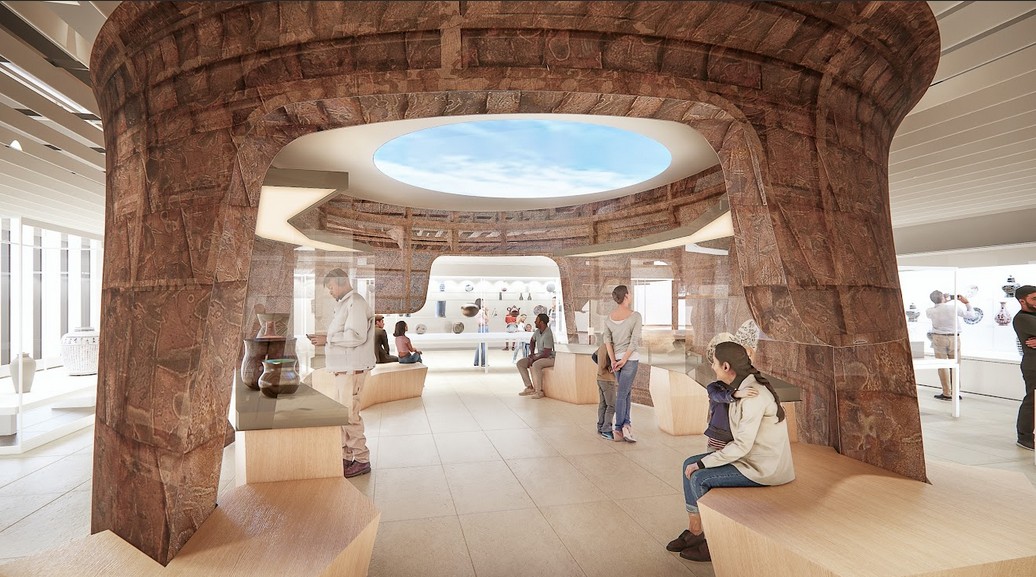
Image Caption
Local Journalism Initiative Reporter
Windspeaker.com
The Gardiner Museum in Toronto will open its new 9,000 sq. ft. ground floor space on Nov. 6 following a $15.5 million transformation, described as a once-in-a-generation renovation.
The museum is one of the world’s leading institutions devoted to ceramics. Located on the University of Toronto’s St. George campus, and founded in 1984 by George and Helen Gardiner, it houses more than 5,000 ceramic objects, from the ancient Americas and Europe to the works of contemporary artists. It’s dedicated to “clay” serving as “a bridge between cultures, histories, and people.”
The newly renovated space features the new Collection Galleries; a fully-equipped clay studio called the “Makerspace”, where visitors of all ages can experiment with the medium; a Community Learning Centre for education programs and public talks; and the Gardiner’s first-ever Gallery of Indigenous Ceramics, a permanent display dedicated to exploring Indigenous knowledge, creativity and cultural expression.
Chris Cornelius, an Oneida architect with studio:indigenous, designed the space for the first exhibit, Indigenous Immemorial: Ceramics of the Great Lakes Region. Curator Franchesca Hebert-Spence, Anishinaabe and member of the Sagkeeng First Nation, gathered work from the Indigenous communities of Manitoulin Island, Six Nations of the Grand River and Curve Lake for the exhibit.

Hebert-Spence said she was drawn to ceramics from early age. She began her studies at Brandon University in Manitoba in the visual arts program. While Hebert-Spence also studied drawing and painting, her passion was ceramics and that became her major. She has gone on to work with the National Gallery of Canada and the Art Gallery of Alberta.
“There’s a really big community aspect to ceramics. There’s like potlucks, woodfires, where everybody takes turns tending to the kiln, and it really reminds me of beading circles and things like that, so that’s what really drew me to ceramics,” Herbert-Spence explained.
When it comes to curating, she said she thinks about what people want to see in the space, but also what isn’t always there, she said.
“It’s really about bringing stories and works that are important to community members into gallery spaces and into museum spaces and not necessarily focusing on what’s new and what’s big but really telling stories that are important to the people,” Hebert-Spence said.
One example of such storytelling featured in the exhibit is from Six Nations about artist Oliver Smith.
Each year around special occasions such as Mother’s Day or Christmas, Smith would sell these little tipi incense holders to children for five cents. He did this so the kids would be able to give their parents a special gift.
“So, this object has a significance with Six Nations and is recognizable by a lot of folks,” she said.
In the Euro-western understanding of “excellence”, these tipi holders may not be considered worthy of a gallery space. “I want to change the idea of what excellence is and what belongs in these spaces and that means pushing against those pressures,” said Hebert-Spence.
By focusing on a few communities within Ontario, it allowed the curator to get an intimate sense of what was created and why within each community.
Through multiple meetings with community members, Hebert-Spence was able to “dive deeper” into each communities’ artistic history and was able to uncover stories and collections from both well-known and not so well-known artists.
“I think that deep research and visiting is really important because, even as I was doing my work, there’s so many artists from Six Nations who have passed and there are artists in Manitoulin who haven’t gotten their dues, so it was really important to be able to work deeply and closely and say that ‘I’ll represent you’,” Hebert-Spence explained.
The exhibit includes a very large piece from the late Carl Beam, an Ojibwe multi-media artist whose art confronted Canada's colonial legacy. And there’s a piece by Sarah Smith that includes sgraffito pottery atop a large slab. Sgraffito is a technique in which the artist scratches or carves lines in the surface of a clay object to reveal different layers of colours underneath. The Smith piece is meant to illustrate the history of Six Nations.
“Most of the works are quite small and quite intimate, so in a way it also challenges these ideas of what kind of works belong in galleries, because when we think about what goes into a museum or what goes into a gallery you kind of expect to come upon these large pieces. But I’ve also always kind of gravitated to artwork that you live with. That was another thing that I really loved about ceramics was that you were making things that were like in peoples lives and people were putting their mouths on it and holding food with it,” Hebert-Spence said.
Another installation is for the entrance to the ground floor. Nadia Myre, an Algonquin member of Kitigan Zibi Anishinaabeg First Nation, is a contemporary visual artist and the 2014 Sobey Art Award recipient. She was commissioned to do the piece because of her practice of exploring themes of belonging, resilience, memory and the politics of recognition.
“It’s woven with ceramic beads that are handmade,” said Myre about her installation, adding it is a form of tapestry. “It’s kind of like a gradient actually, going from pale white and beiges to these orangey, reddy kind of autumnal (colours).”
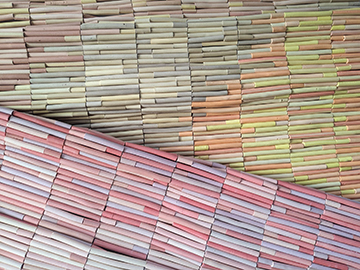
The beads are different sizes and heights but together create a pattern.
“The significance (of the project) is to think about history and archive and pieces, fragments, but also how those histories kind of intermingled between cultures,” Myre said. “It’s about moving through history and coming to a very contemporary moment.”
Each bead is carefully built by extruding them or hand rolling. They are then glazed with varying finishes, then put through a kiln.
Although most of the beads were handmade, some are fragments of clay pipe stems.
“Our standard size is maybe 2.5 inches long, but in this piece there’s pieces that are smaller too,” she explained. “And this piece is special because we started using found pieces of pipes. Sometimes they’re tapered, but sometimes they’re tapered to something called a foot, like the foot of the bowl where you would put the tobacco.”
It took Myre “many hundreds of hours” to complete the piece, she said.
Funding for the renovation of the Gardiner Museum space was provided by public and private partners in collaboration with the government of Canada, which provided funding through the Department of Canadian Heritage’s Canada Cultural Spaces Fund.
For more information, visit www.gardinermuseum.com.