
Image
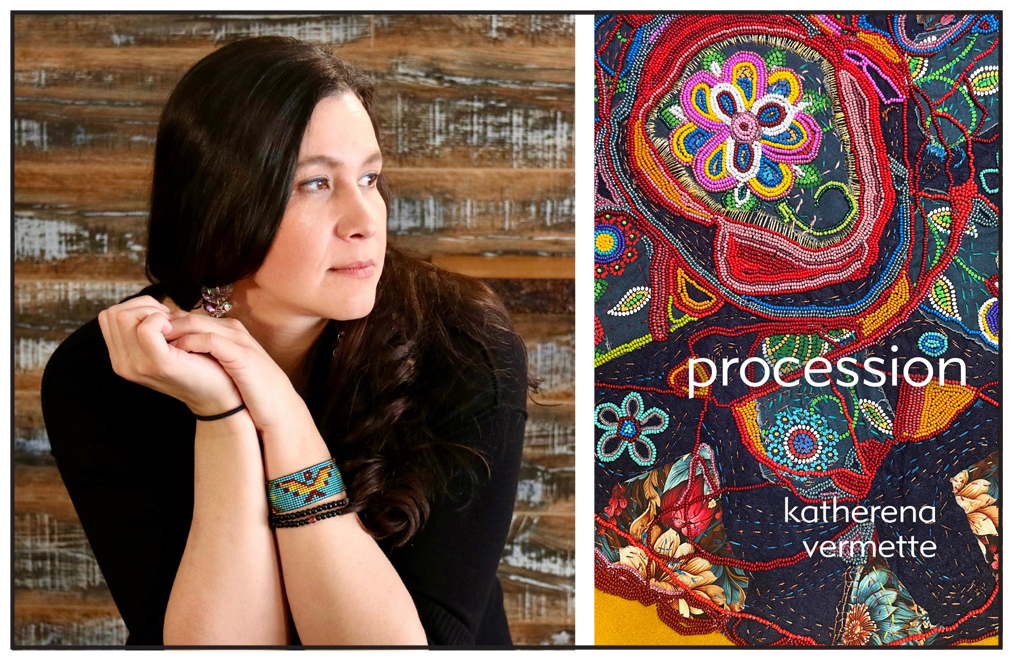
Image Caption
Windspeaker.com Books Feature Writer
Local Journalism Initiative Reporter
Métis writer Katherena Vermette says it is “incredibly humbling” when she considers that she’s here for only a finite amount of time.
“When we think about what's most important, it ends up being our loved ones; those we care for and we'll leave behind when we pass from this plane. The idea of legacy. And we also come from a great legacy. We're many, many centuries into this. So, we're coming from something and building something out. It does feel incredibly humbling,” she said.
“It also feels like it makes life very simple. There's things that matter and there's things that don't. It really draws that line really quickly.”
It's that theme that Vermette explores in procession, her third and most recent collection of poetry.
“procession talks about honouring those who've come before and making a space for those after. And that's really the premise of the whole book. How to be in that space in the middle,” she said.
As she writes in the titular poem, “…you inherit/and you/pass on/only going/for/ward.”
The poem “procession” doesn’t lead off the collection. In fact, it’s offered as the first of three interludes in a book with four sections.
“I love organizing poems. I love the, I call it the macro view of things, where I just take the worldview of the book and move things around,” said Vermette.
The word ‘procession’ fascinated her. Most people think of funeral processions, she says, but processions occur in weddings, graduation and other “monumental” occasions in life.
“But, also, that idea of the process, (of) constantly being in motion and action. So that felt more appropriate as the title of the book, if not the first introductory poem,” she said.
“Grimoire” starts off the collection and it’s the perfect placement, she says.
“It talks about ‘before I was this, I was formed. Before I was this human form, I come from all these other ancestors before me’. And that to me felt like such a sure beginning,” she said.
Vermette examines both process and connection revisiting her life and those of various family members. Her father is Red River Métis and her mother is Mennonite.
In “make beautiful 1992” she pens, “writing is one of two things-/it’s for you/or it’s for other people.”
While the work Vermette has published is “definitely for other people,” she admits her first draft “comes from the heart” and is for her.
“But then when I start doing the editing, then I feel very conscious that other people have to read that…You have to make it clear for other people to understand,” she said. “And that filter is really interesting because it changes it. Not the heart of something, but it changes what the dressing of it looks like, the outside, how it feels. Because you're trying to make yourself understood as you're trying to understand whatever you're describing.”
Poetry has always been intimate to her, says Vermette, and “very close to my own story.”
In “make beautiful 1992”, she writes, “it didn’t matter/poem had already done its job/it held your grief/took it out of you/made it beautiful/cringey but/beautiful.”
“I love poetry and…I've always said I'd never write a memoir because I'm afraid of memoirs and how people unpack memoirs and there's such an intimacy there. (But) most poetry is more intimate in a lot of ways because it bears down into the nitty-gritty of something. But for some reason, it feels safer almost because there's a certain crypticness to poetry,” said Vermette. And then she laughs.
“I don't know, because when I read other people's poems, I don't see that crypticness. I just see truth and beauty and image. But when you're writing poetry, you think you're so smart. And you're like, ‘Oh, I'm being so cryptic. No one's going to understand what I'm talking about.’ But of course, everyone does.”
Vermette confesses that sometimes she feels like she reveals a little too much about herself, which makes her feel vulnerable. But each poem offers up only a version of herself.
“That's part of the process. Even when you're writing non-fiction, (even when) you're writing a totally truthful memoir, it's still not you. It's a version of you. It's a voice that you created to tell your story. My poetic voice and what I explore in the poetry, it isn't all me. It's kind of a version of me,” she said.
It’s a concept Vermette explores in the section “carry memory” which focuses on photographs and photography.
In “her story notes,” Vermette writes, “photos frame identity/learn how to read them/visual literacy/…Matriarchs…curated own narrative/highly edited/controlled…made her own story/not her own.”
While Vermette doesn’t tell her story through photographs, she said, “I'm constantly telling my own story through characters or thinking about it through my children or taking this life and really using it as a place to honour my ancestors and prepare for my children. We all do that all the time. We're making our story not our own story (and it) becomes about so much more than us.”
In the final poem of the collection, “peyahtik”, Vermette writes, “as inadequate as I may be/I am all they have.”
She says that realization “brought resolve.”
“Thinking about it from the matriarch and doing it for those who come before you, that really resolves the issue of whether or not you're going to speak. Because, of course, you're going to speak for them. You might not speak for yourself, but you're going to speak for those who come before you. You're going to speak for those who come after you,” she said.
Along with poetry, Vermette writes novels, graphic novels, children’s books and documentaries. Her debut novel, The Break (House of Anansi; 2016) was a finalist for CBC's Canada Reads in 2017. It was also shortlisted for the Writers' Trust Fiction Prize and the Governor General's Award for Fiction.
But it’s poetry, she concedes, that she loves best.
“I always say poetry is my home. It feels like a comfortable place,” said Vermette. “When you write poetry, it takes away all the other stuff and it's more bare bones. It's more of what the essence of something is. That's why I write poetry, to find that essence.”
Vermette's previous collection of poems, river woman (House of Anansi; 2018), received widespread critical acclaim. Her debut collection, North End Love Songs (The Muses' Company; 2013), was awarded the Governor General's Award for Poetry.
procession, published by House of Anansi in September, can be purchased in bookstores or online at houseofanansi.com.