
Image
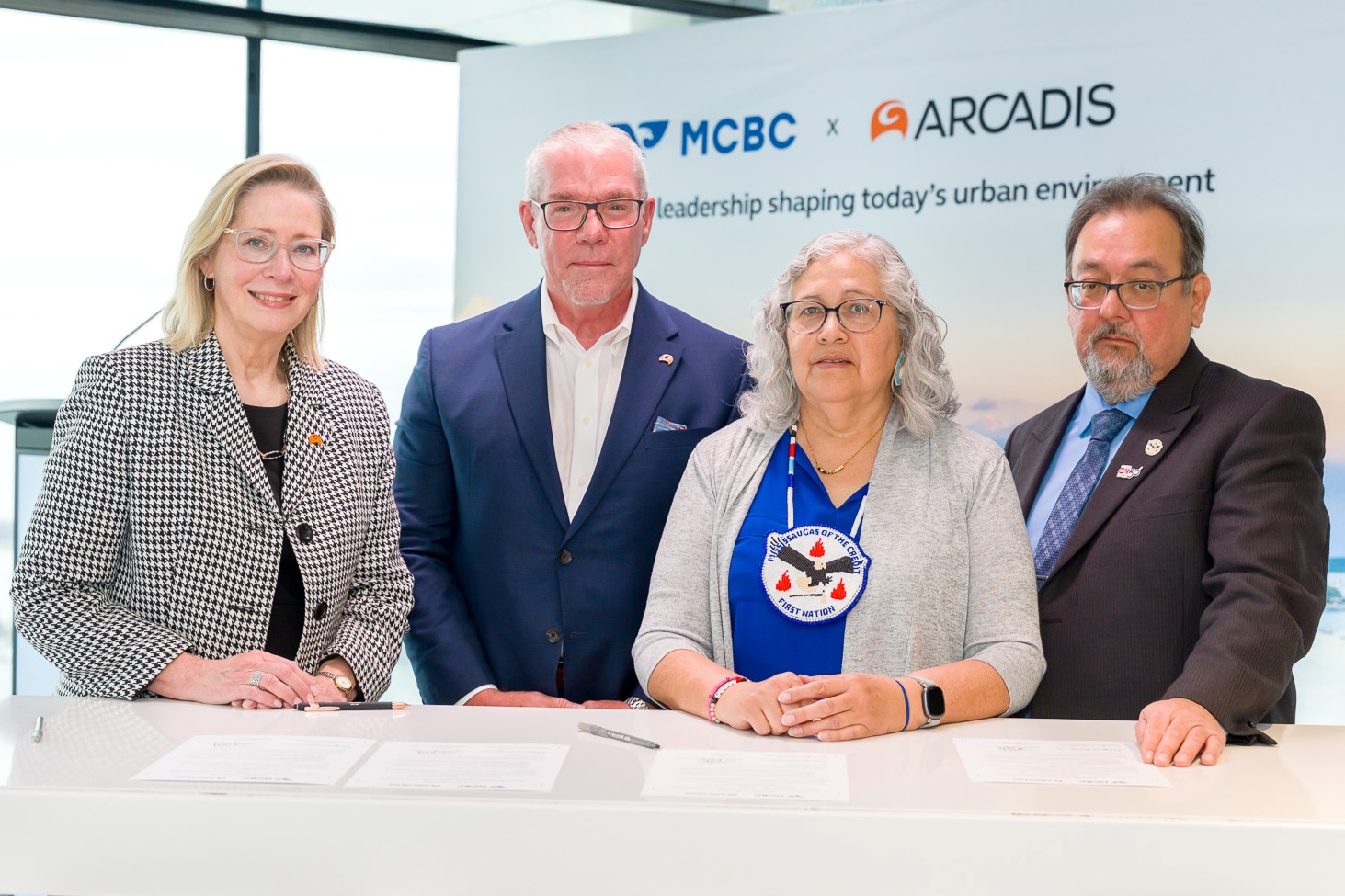
Image Caption
Local Journalism Initiative Reporter
Windspeaker.com
Correction made May 19, 2026 to Scott Arbuckle's title with Arcadis:
The Mississaugas of the Credit First Nation (MCFN) believes a newly-formed partnership could reshape how it participates in development projects across southern Ontario.
Announced April 30 in Toronto, the partnership is between the Mississaugas of the Credit Business Corporation (MCBC) and global design and engineering firm Arcadis Professional Services (Canada) Inc.
The MCBC-Arcadis Limited Partnership will focus on infrastructure, planning, architecture, climate adaptation, and development opportunities across MCFN treaty lands, an area encompassing more than 60 municipalities throughout the Greater Toronto and Golden Horseshoe region.
According to the partnership announcement, the territory spans roughly 3.9 million acres and includes a population approaching 10 million people.
While First Nations are to be consulted on projects affecting their traditional territories and treaty lands, leaders involved in the new partnership say this model moves beyond consultation toward direct ownership, equity participation, and long-term involvement in shaping development.
Warren Sault, president and CEO of MCBC, said the business arm of MCFN partnered with Arcadis after seeing what he described as a strong alignment between the two organizations’ values, particularly around sustainability, development, and long-term planning.
“I think it’s a big step. Before, with the duty to consult, it was like you consult, but that’s all. It’s just talk. There’s nothing behind it. But when you move forward into partnerships, then comes equity and ownership opportunities,” said Chief Margaret Sault of the MCFN. “We’re really partners. We’re working together. They can help us, and we can help them.”
The new entity is majority-owned by MCBC and will jointly pursue opportunities with Arcadis across the treaty area. According to the announcement, the entity will be managed by representatives from both organizations, with offices located within MCFN treaty Lands in Hagersville, Ont. and in downtown Toronto.
The initiative is intended to ensure MCFN is involved in development projects from the outset.
“Often, First Nations are asked to be involved at the tail end of a project,” Warren Sault said. “This partnership allows us to be involved at the front end of development.”
He said First Nations are often invited into projects only after key planning and construction decisions have already been made, limiting opportunities to influence design, environmental protections, land stewardship, and cultural considerations from the start.
For MCFN leadership, the agreement represents part of a broader push toward economic self-determination.
“For so long, we’ve been under the Indian Act and the limitations that come with it,” said Chief Sault. “Now we can hopefully be self-determining, and we can determine our own future.”
She described the partnership as part of an effort to position the Nation for greater economic independence and long-term involvement in development across its treaty lands.
“This is just our first step in letting people know the Mississaugas of the Credit are open for business,” Chief Sault said.
The agreement also places renewed attention on the practical implications of treaty relationships in one of Canada’s fastest-growing urban regions.
In promotional material tied to the partnership, MCFN describes itself as the “sole and rightful Treaty Holder” for the territory covered under the agreement. That language, combined with the partnership’s geographic scope, raises broader questions about how municipalities, developers, and governments understand their responsibilities on treaty lands.
Chief Sault said many municipalities and private-sector proponents still have limited understanding of treaty obligations and Indigenous inclusion requirements.
“People aren’t aware,” she said. “People talk about First Nation people like we’re not here anymore. Well, we are still here, and I think our voices are being heard. Some proponents, municipalities, and members of the general public are becoming more aware of that.”
She pointed to the Truth and Reconciliation Commission’s Call to Action 57, which calls on governments and public servants to receive education on Indigenous rights, treaties and Crown-Indigenous relations.
“We’re trying to create a better future for our Nation,” Chief Sault said. “We’re going beyond consultation.”
Warren Sault said understanding of treaty obligations and responsibilities remains limited in many parts of Ontario, but he believes partnerships like this can help improve awareness and education around those relationships. He described the agreement as fundamental to the Nation’s long-term economic self-determination goals.
“I think this partnership is fundamental,” Warren Sault said. “MCBC would like to take a 360-degree approach to its involvement in development, and that starts with planning and design.”
In recent years, Indigenous equity participation has become a growing part of discussions surrounding natural resource development, infrastructure and energy projects. The MCBC-Arcadis partnership applies a similar model to urban planning and city-building projects within one of the country’s largest economic corridors.
Scott Arbuckle, Country Director, Arcadis Canada, described the partnership as more than just a business agreement.
“I think it’s a philosophical shift first and foremost,” Arbuckle said. “MCBC and MCFN bring a very different perspective to projects. The seven-generation approach is something we’re incredibly drawn to. Sustainability is an important part of what Arcadis does, so that long-term approach to sustainable development aligns extremely well within the partnership.”
Arbuckle said Arcadis has previously participated in project-specific Indigenous partnerships and master service agreements, but described the broader limited partnership model as something different.
“As far as we know, it’s the first time something like this has been done within our industry,” he said. “It moves beyond a specific project and looks at how we create projects together and pursue opportunities together.”
The partnership’s early priorities are expected to focus heavily on infrastructure and housing, particularly affordable housing projects.
“There are tremendous infrastructure deficits within the treaty area,” Arbuckle said. “I’m particularly excited about where we’re going in the housing sector, specifically affordable housing, which is a massive issue throughout the treaty area.”
Arbuckle said municipal governments and other industry partners have already shown interest in the model.
“People are seeing it as a very different opportunity and approach to project delivery,” he said.
At the operational level, both parties say Indigenous leadership will shape projects from their earliest stages.
“This is an Indigenous-owned entity,” Arbuckle said. “From a strategic perspective, from the board level down, that vision is what guides us.”
He said project planning will begin with conversations between MCFN leadership and MCBC before design work starts.
“Our architects don’t even put pencil to paper until we sit down with the teams from MCBC and MCFN to discuss the vision for a project, historical perspectives and related considerations,” Arbuckle said. “That thinking then informs the design process.”
Chief Sault said Indigenous involvement could also influence how environmental considerations are approached during development.
“First Nation people take their role as caretakers of the land very seriously,” she said. “I think it will bring greater awareness and help guide projects in a respectful and meaningful way when it comes to caring for the land.”
The partnership’s scale and treaty-based framing also reflect ongoing discussions around development, consultation, and jurisdiction within southern Ontario, where multiple Nations maintain historical and contemporary connections to parts of the region.
While the agreement is being framed by its partners as a model for Indigenous-led economic participation and long-term involvement in planning and infrastructure projects, it also reflects ongoing conversations across Canada about how treaty relationships, territorial responsibilities and Indigenous authority intersect with modern urban development.
Arbuckle said the initiative is not intended to “corner the market” on Indigenous-led development models.
“We hope it serves as a bit of a call to arms within our industry,” he said. “It’s a different model and something others may want to consider in how they approach partnerships going forward.”
For MCFN leadership, the agreement represents what they see as a broader evolution in how Indigenous Nations engage with governments, developers, and major projects within their territories.
Warren Sault said the working relationship also reflects what he believes is a greater shift toward greater Indigenous participation in planning and development decisions.
“I think this is a great step toward that,” he said. “If we can work with professional firms that reflect those values and uphold them through partnerships with the First Nation, I think that will go a long way.”
Chief Margaret Sault said the partnership reflects a widening effort to change how First Nations are included in development and economic decision-making.
“The more people understand that they don’t have to shy away from First Nations — that we want the same things, that we want to prosper, be self-sustaining, and be self-determining — the better,” Chief Sault said.
“Sometimes we have to take those steps forward ourselves. I think this is a big step for us, and I can only see good things happening.”