
Image
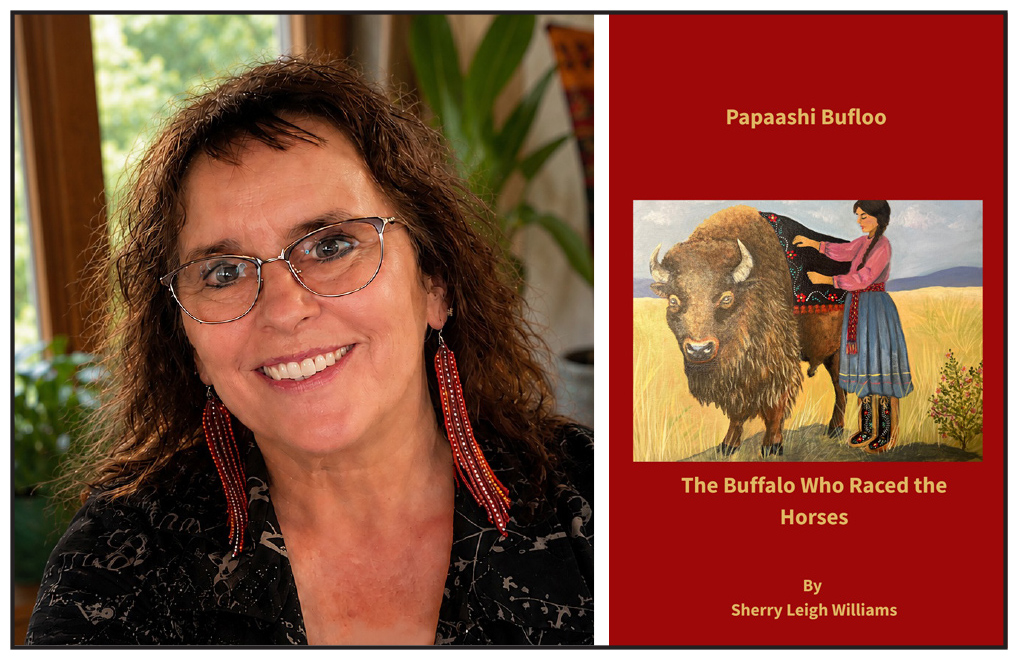
Image Caption
Windspeaker.com Books Feature Writer
Local Journalism Initiative Reporter
Growing older with16 grandchildren was all the impetus Métis Cree writer and artist Sherry Leigh Williams needed to produce her first children’s picture book.
“As the (Elders) die off, there isn't anybody left to tell the story,” Williams said. “It felt to me really important to do something for the kids.”
In Papaashi Bufloo: The Buffalo Who Raced Horses, Williams tells the story of her great-grandmother Mary Anne Deschamps Rabaska, who was born in 1875 near Pigeon Lake, Alta.
Williams has been documenting and researching her maternal family’s history, who are Papaschase First Nation and Red River Métis.
Papaashi Bufloo starts with a government official telling Mary Anne’s family that even though they had travelled west in their Red River carts to Papaschase land, pushed out of Manitoba because of conflict between Métis and the Dominion of Canada government, they had to leave once more.
“Three of my own family members starved to death during that time. And I was always really struck by that idea that here we are. We've already come through so much and we finally make it out west… finally are settled with the people for quite some time, and then it happens again,” said Williams.
However, she did not want to make her story one about loss.
“I wanted to do a positive spin on it. Something wonderful about our survival and our resilience as opposed to ‘Oh my gosh, here we go again’,” she said.
As for the domesticated buffalo, Williams had heard about a man who raced buffaloes. She had considered writing that book. However, her research uncovered that he was “quite a horrible person.”
“Because I was a horse person myself and trained horses, I could imagine how this might happen… I was going to make (Mary Anne’s) father the hero. And then I said, ‘No, I'm going to make my great-grandmother the heroine in the story’,” said Williams.
In Papaashi Bufloo, Mary Anne befriends an abandoned buffalo calf. She names him Toneur (Thunder) and their friendship develops in such a way that Toneur lets Mary Anne ride him. Years later Mooshoom (grandfather) signs Mary Anne and Toneur up for a horse race that has big prize money. He doesn’t tell anybody at the time that Toneur is a buffalo.
Williams includes numerous cultural references in her book. Mooshoom plays the Red River jig to celebrate and there’s the spirit bead, which is “that odd bead (used) to show that only Li Boon Jheu (the Creator) can be perfect.”
“Because we had to be moved so many times, our material culture had to be small, had to be things we carried or songs we carried,” she said. “It was really important for me to talk about that and express the culture because it is so radically different than, let's say, Coast Salish people.” Williams lives on Salt Spring Island, the ancestral and unceded traditional territories of the Coast Salish peoples.
Williams liberally peppers the text with Southern Michif words and includes a glossary at the end of the book. She says it was important to include the language as there are less than 100 Southern Michif speakers remaining. Williams is not fluent in her language.
“I feel our ancestors around us when we're trying to learn the language and express the language,” she said. “I think it's just so important. I feel there's a lot of loss that's happened in our communities with the loss of language.”
Being an acrylic artist for 30 years, Williams admits illustrating the book was easier than preparing the text.
“I would have loved to have said a lot more but trying to keep it in that 32-page format for a younger audience…that part was tough for me,” she said. “So it was a very interesting learning curve for me to do it.”
As for the illustrations, Williams said in retrospect she wishes she had done them on a larger sized paper because it was difficult to paint detail on the small canvas of 11 inches by 14 inches.
Williams received grant funding for her work through the Métis Nation British Columbia. The book was launched on June 21, National Indigenous Peoples Day, on Salt Spring Island.
Papaashi Bufloo: The Buffalo Who Raced Horses is available for purchase at www.sherryleighwilliams.com.