
Image
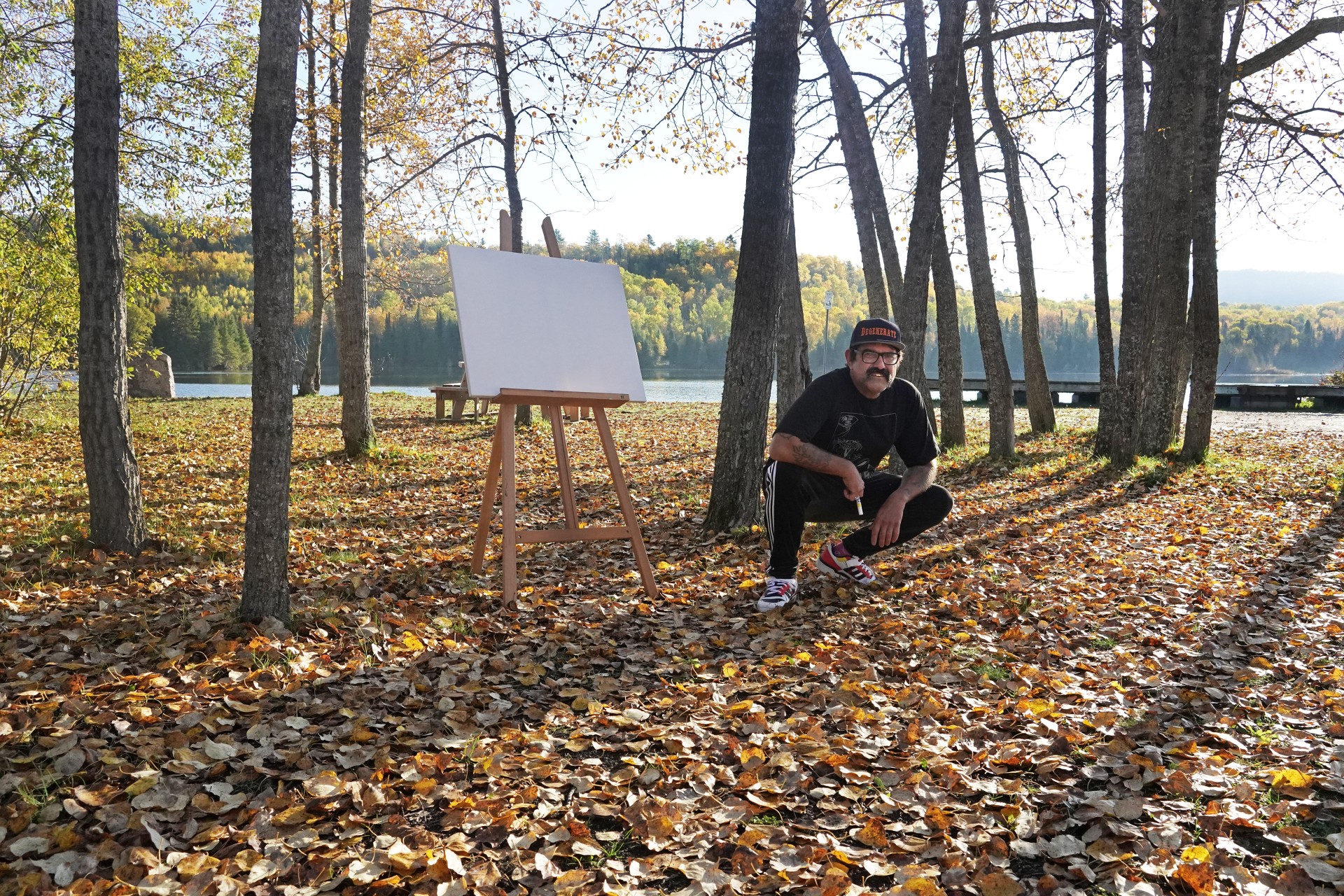
Image Caption
Local Journalism Initiative Reporter
Windspeaker.com
East Vancouver-based Métis artist Jean Paul Langlois brings humour and family storytelling into paintings that are both playful and sharp-edged. Through brilliant saturated colours that spring from pop-culture themes and motifs, his works explore the complexity of identity through stories about his Métis and settler heritage.
Langlois’ solo exhibition War and Peace, and Smoky the Cowhorse is on view in Vancouver at the Fazakas Gallery until Dec. 19. Langlois says the title sums up “the serious, dark nature of the work and the ridiculous rainbow bright nature of the palette and execution.”
Red River Métis through his father, with a “kind of WASPy Scottish-English” mother, Langlois grew up away from community, without cultural teachings or Indigenous language at home. He spent his childhood on Vancouver Island, B.C., navigating two very different family realities.
His father’s family struggled through poverty; his mother came from a prominent settler family.
“From my mom’s side I was this wild, savage kid,” Langlois said. “From my dad’s family I was Little Lord Fauntleroy.”
Things changed. His parents divorced when he was young, and his father “went from being working class in the Navy” to university.
“All of a sudden, he had his degree and became a school administrator and had some money in his pocket and was sort of always wheeling and dealing,” Langlois said.
“He was very strict. And I was actually just thinking about this the other day, like how weird it is. He started his own education system at one of the school districts here and had his own school. It was like a super disciplinarian school for what they called ‘overactive underachievers’…” students with ADD and other developmental issues, Langlois explained.
Langlois’ grand-dad had gone to residential school, but here was Langlois’ father with his own school where “the whole entire thing was based on punishment. There was no corporal punishment, but you had to run laps around the field.”
“It was just so interesting that like, you know, his father went to residential school and then here he is kind of almost emulating it with his own system, right?”
Langlois learned how his grandparents lived through the Great Depression with “one bag of flour to last the whole winter, and they’d just go hunting muskrats” and the correlation between that type of stress and hardship with beatings. The intergenerational impacts of residential school were clear, and those stories stayed with Langlois, along with what was left unsaid.
Writers helped fill in some of the gaps about his father’s Métis background, including Maria Campbell’s Halfbreed. He said Jean Telliet’s The North-West is Our Mother was a revelation in learning about his relatives.
“My family were buffalo hunters,” he said.
Reconnection
This last summer, Langlois participated in the Kapishkum (to transcend) Métis Gathering visual arts residency at The Banff Centre in Alberta. Among the 17 Métis artists, he felt the community he’d never had access to growing up.
“It was really moving. We had an instant bond,” he said.
Halfway through, another artist shared her family’s migration route after leaving Red River. Langlois recognized every town, the paths that his own relatives had travelled.
When they shared family names, “I was like, ‘Oh my God, we’re cousins’.”
A genealogist at the residency confirmed even more connections, with 16 of the cohort related by blood or marriage. “I was related by blood to three other people in the cohort. It was an instant family.”
Langlois learned more about traditional art forms, beading, tuppies (tāpis, dog blankets) and sat with people deeply engaged in ceremony. “It helped me feel a lot more connected,” he said.
Storytelling through paint
Art has always been present for Langlois. “It’s never not been my identity,” he said.
“I found policemen with their pants pulled down really funny, so there was a lot of trying to draw that,” he chuckled. “I hated school, so I was just constantly doodling, constantly getting called into the principal's office because I was drawing in the textbooks.”
He grew up without any artists or mentors around, Langlois said. “So you get all this bad advice from people, like, ‘You go to university and learn AutoCAD (computer-aided design). You should become an architect or a graphic designer.’ So I went to graphic design school when I was like 18 or something, 19. And it was a complete waste of time.”
Langlois thinks about the “dozens of side hustles and careers before the paintings started to sell.” He lists a range from landscaping to weed growing, club DJing to handling camera, lighting and rigging on film sets as a grip.
“I never believed there was a potential real career as an artist, right?”
“I've been showing since I was about 20, but not selling. And then I was doing this really ridiculous thing that I think a lot of artists do. ‘Oh, what can I make that would sell?’ So, you know, I try different things, try different subject matter and, of course, nothing was selling.”
“And then I had a show, maybe in the Nanaimo Art Gallery (2013), that was well attended and people respected the work or whatever. But, you know, I came home with the whole collection. I thought, ‘well, shit, I don't even want this work. If I'm going to be stuck with the work hanging on my walls for the rest of my life, I might as well make work that I want’.”
That meant painting scenes from spaghetti Westerns and old TV stills, imagery that shaped his imagination growing up. People responded immediately.
He now works through collage, pulling from film stills, illustrations, old racist books, and family stories. The process is part research, part collecting, part personal excavation.
The stories didn’t find themselves subconsciously entering his art-making, Langlois said.
“It's very conscious and it's addressed constantly in my work. I do a lot of storytelling, so oftentimes I'll do a series of paintings about family stories.”
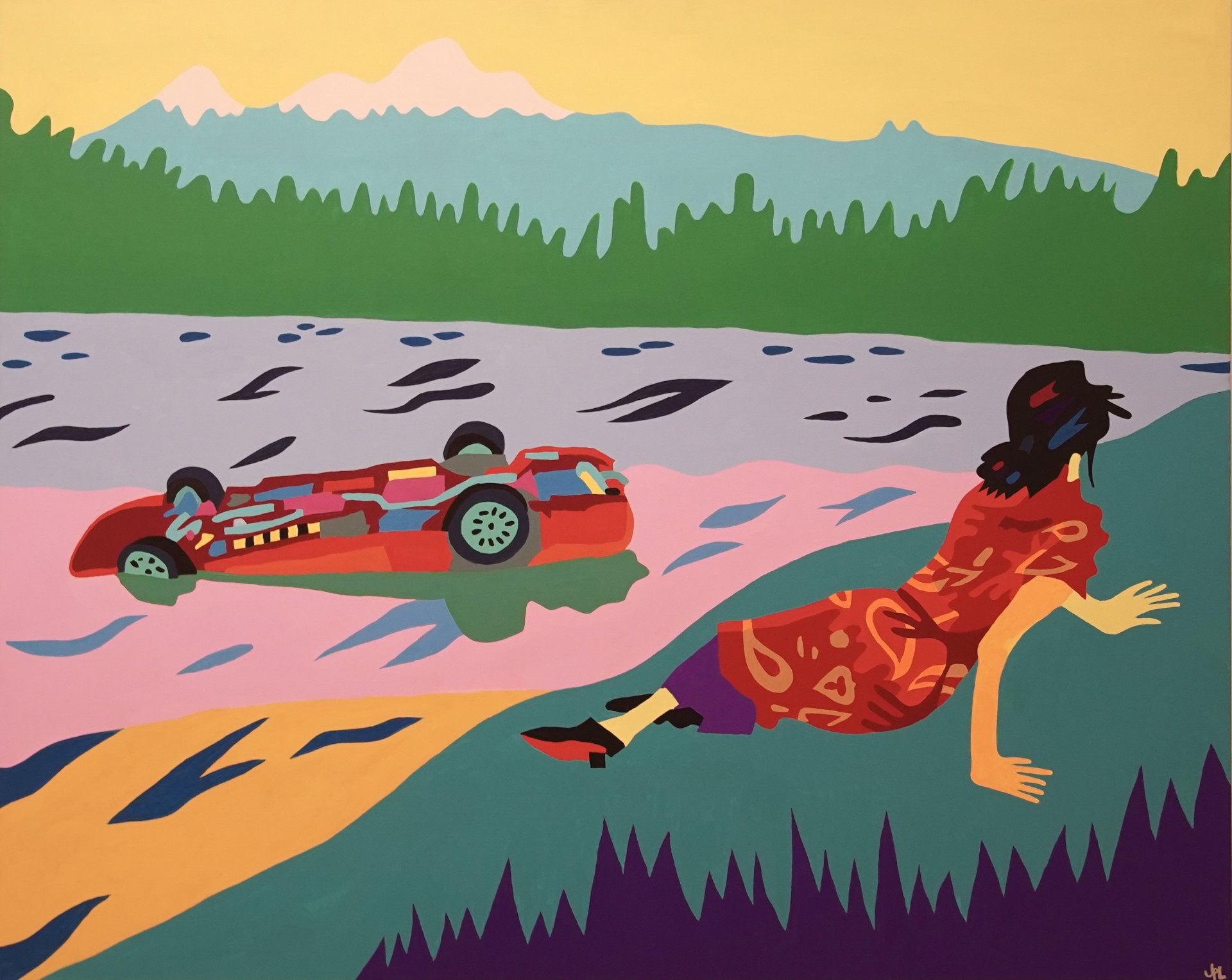
His painting “The Anniversary”, which is secretly titled "The Night Uncle Vern drowned', is about a family tragedy. While driving through the Rockies at night on the way back to Calgary for his grandparents’ anniversary, Uncle Vern, Auntie Marie and her husband Harold hit black ice and skidded into a lake. Vern swam around to find Marie and take her on to shore and then went back to find Harold, who had already walked up to the road to flag down help. Vern swam around in the freezing water until he drowned.
The woman in this work is appropriated from the painting titled ”Christina's World” by Andrew Wyeth, said Langlois.
Langlois was fascinated by the Planet of the Apes movies, and in paintings he has cast his mother as Zira, “because she sort of looks like her in one of those movies,” Langlois said. “And my dad, I cast him as ‘spaghetti Western’ actor Bud Spencer.”
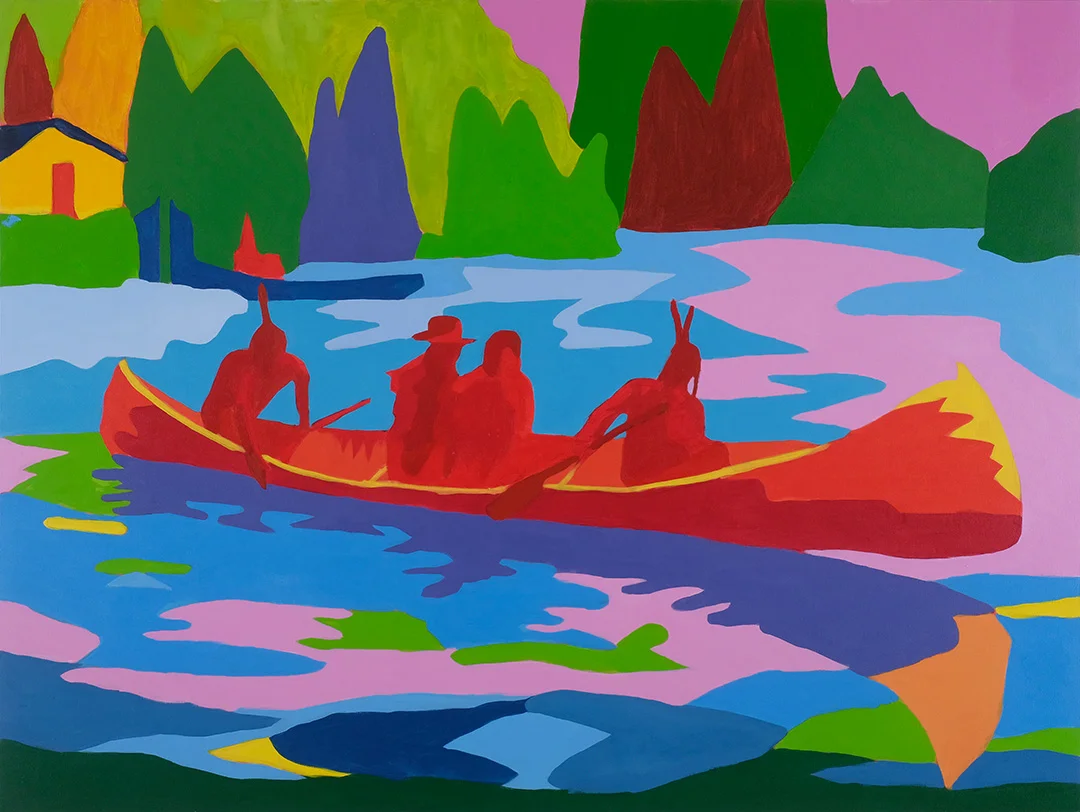
Langlois grew up hearing one of his mother’s stories from the years before he was born. She always described a trip they made to visit his dad’s uncle Emerson and his wife Bertha, who were homesteading in northern Alberta. She called it Spirit River. “It was actually the Little Smoky,” Langlois said.
According to his mother’s version of the trip, they had to cross a river in a canoe, and then, as she put it, “little Indian kids” ferried them over to a tiny shack. Inside, their hosts offered coffee or beer. As she didn’t drink either, she asked for water.
“They were like, ‘Water? No one drinks water here’. So they took her back to a pond and skimmed off the pond scum and then gave her a glass of dirty water.” As her own mother had been a public health nurse, Langlois’ mother "was like, ‘oh my God, if my mother could see me now', and she guzzled the water back anyway.”
Langlois heard this story his whole life, and as he painted it, he realized she wasn’t remembering the moment itself anymore, she was remembering the storytelling.
“She just remembers the talking points – ding,” Langlois said.
Langlois told the story through seven paintings, which became the formative series Return to Spirit River. “And it was kind of a revelation for me and kind of changed the way I did things and the way I worked. And then a couple of years later, I decided, I got in touch with my cousin Terry, who was one of those little kids.”
Visiting the real homestead with cousins, he was surprised by how much of his mother’s remembered version was true.
“Now my mom has vascular dementia and Alzheimer's, so now the memories are way less and less,” so these paintings have become a way to hold onto their shared history.
The personal, the political, and the funny
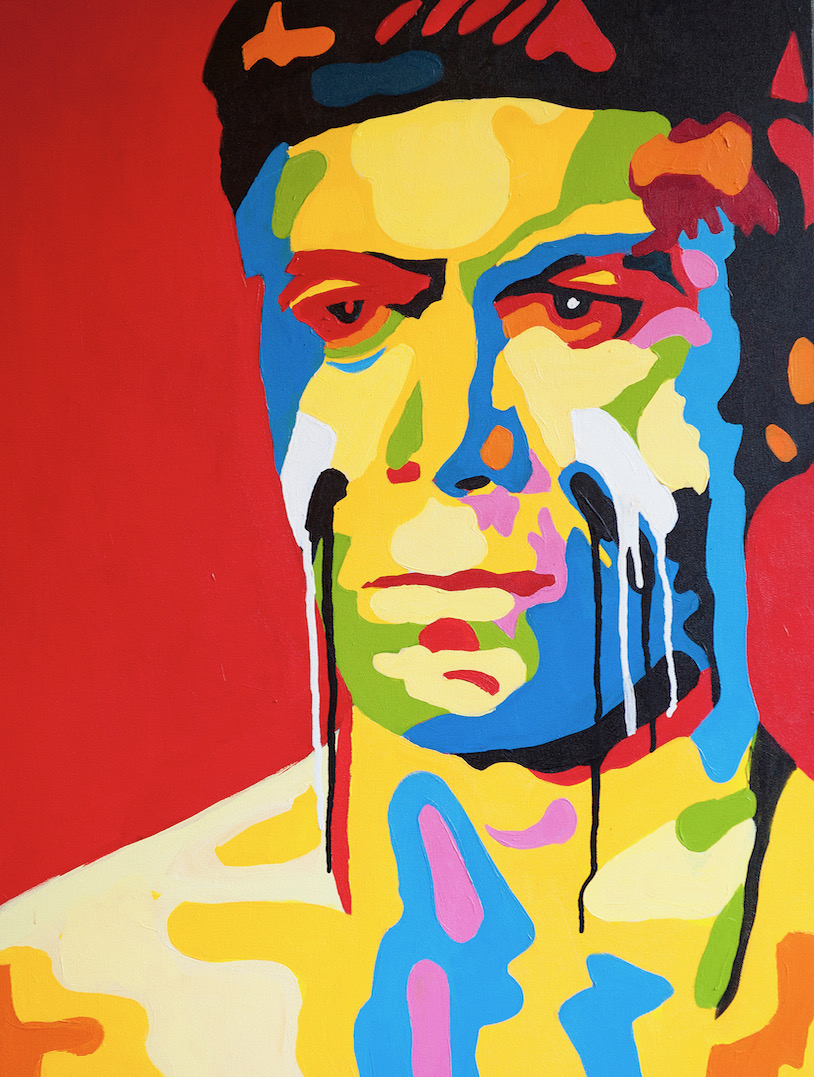
Fake Indians is an ongoing series, documenting films and TV shows using white actors to play roles as Indians. Not just extras or background but well-known actors playing characters that were inaccurate, racist stereotypes. “The more I began to look for it, I realized how pervasive this casting was.
“I could find a Fake Indian in almost every TV series or movie I watched. Western serials, spaghetti Westerns, sitcoms, Disney films, everywhere. Big name actors and actresses too, from Lucille Ball and Desi Arnaz to Don Adams and Burt Reynolds.”
While examining the racism of media stereotypes, Langlois also explores his feelings of disconnection, despite being a card-carrying Métis.
Langlois describes his father as fascinating, complicated, and full of unintentional comedy.
He tells one story about his father building trout ponds on his dream property. “Because he grew up so poor and then got some money, he sort of got these really wacky ideas about affluence.
“He thought, ‘Well, a rich man should be able to just go with a rod at lunchtime and catch a trout for dinner. That's what a rich guy would have’.”
So he would spend money stocking his trout ponds and they would go feed the trout all the time. After stocking them twice, and losing 50 trout, his father camped out to discover a blue heron was eating all the fish.
“So, then he needed to get a gun, but he didn't have a gun license, so he went to go get the family gun from my grand-dad, which is the decrepit old farm gun that's like a shotgun on the bottom and a .22 on the top and, you know, more likely to blow your head off than actually shoot anything. I want to paint granddad handing him the gun.”
Langlois’ family stories shift between tenderness and critique, revealing the way class, trauma and aspiration intersect across generations.
Langlois believes everyone should be making a little art, and that personal stories are inherently political.
“It’s also about being an example of doing work you passionately believe in.
“You’d do it whether it was worthless. You’ll do it 'til the day you die,” he said. “In some ways it’s the most spiritual work there is.”
After the exhibition at Fazakas Gallery closes, Langlois will travel for a retreat in Spain and England to immerse himself in artworks of all kinds.
The project currently occupying his thoughts is of a fictional prairie town in the 1970s and its Half Breed Film Festival. Indigenous youth form a political movement inspired by old Western films and the “half breed” trope.
“I’m hoping to turn it into an actual film festival someday,” he said. “One step at a time.”