
Image
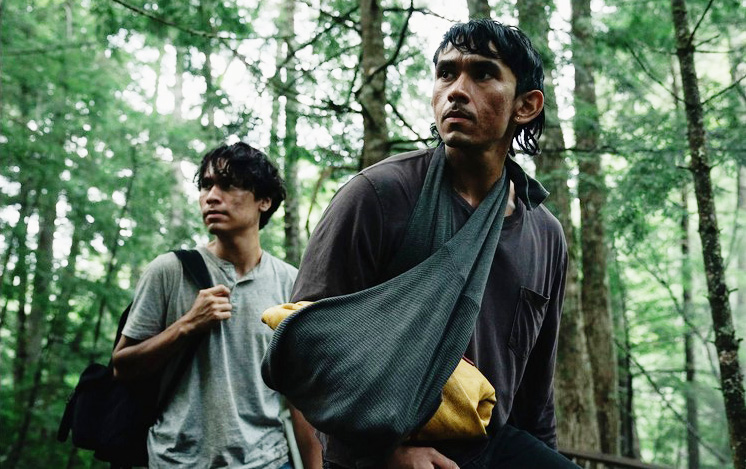
Image Caption
Local Journalism Initiative Reporter
Windspeaker.com
Acclaimed two-spirit L'nu filmmaker Bretten Hannam's third feature, Sk+te’kmujue’katik (At the Place of Ghosts), is an immersive journey into the dark forest of trauma.
Named one of Canada's Top 10 at the Toronto International Film Festival, the film will be released theatrically across Canada on May 8.
“It's weaving a tapestry of the history that we share, the experiences on and of the land, the things the land provides, and then these traumatic events that have been buried and one day have to be faced,” said Hannam.
The haunting drama tells the story of two estranged brothers, Mise’l (Blake Alec Miranda) and Antle (Forrest Goodluck), who venture into a mysterious forest to reconcile an event from their traumatic past. This is a land alive with ancestral spirits and colonial ghosts, where time becomes unfixed to illuminate the brothers' past and future.
Similarly to Hannam's previous films North Mountain (2015) and Wildhood (2021), Sk+te’kmujue’katik explores two-spirit and Mi’kmaw identity in Kespukwitk, L’nuekati (Nova Scotia). It's an artistic leap forward, genre-bending elements of horror, fantasy and family drama to arrive at a world of its own.
“If my expectations can be twisted then I tend to get more engaged with the story,” said Hannam.“Sk+te’kmujue’katik is an actual place name that exists within the territory. It's more accurate to say 'a place of spirits'. It's related to the Milky Way. There are stories and teachings associated with it within the community.”
In Mi’kmaw culture, the spirit world is said to be interconnected with the physical, with ancestors surrounding the living to provide constant guidance, protection and connection. Mi'kmaq ethnologist Ruth Whitehead described stories of the spirit world where "strange events and interactions with supernatural creatures often happen in the forest” and “things are stranger the deeper one goes."
This mythology provides an intriguing premise for Indigenous books, comics and films. Hannam cited the late Mi'kmaq director Jeff Barnaby as an influence and had recently obtained a copy of Barnaby's 2019 horror film Blood Quantum. Sk+te’kmujue’katik takes a more meditative approach to integrating the supernatural elements with real-world themes.
“There are lots of sayings that you're here because your ancestors survived and they're behind you or surround you,” explained Hannam. “This story it taking that in a very literal way. How powerful would it be if there was a place you could experience that first hand, to see all the people that came before you and that they're all moving through you, guiding and supporting you?”
Miranda and Goodluck worked with language experts to develop the correct pronunciation and usage, delivering moving performances as they confront their unresolved issues with a sense of duty. The protagonists encounter their past selves and even manifestations of colonial disruption, impacts that Hannam asserts the land is still feeling.
The film's story was shaped over 11 years through many discussions with family and community members. From the violent incident that's the source of the brothers' trauma, Hannam kept returning to the characters for different short film ideas, eventually realizing the pieces connected together.
“Genre adjacent films can be used as a tool to begin to talk about these heavy or difficult things,” Hannam said. “The dark spirit is very much based on the connection of the characters with the land. The forest is giving a path from this trauma. When they heal, then they can begin to heal the land.”
Appearing like the wind and scattering like leaves, the malevolent spirit is a unique creation that fits seamlessly with the film's eerie environment. The vast forest's beauty and spooky secrets are gorgeously captured by cinematographer Guy Godfree, who Hannam also worked with on Wildhood.
While their previous collaboration thrived on hand-held camera energy, Hannam wanted this project to present much smoother visuals. The hypnotic cinematography lulls viewers into a sort of dream state, where the surreal elements arrive naturally rather than a series of jump scares.
“Guy has such a good eye and a good feeling for things that I knew he'd get this magic that was going to happen,” praised Hannam. “When you have to start and stop it takes the wind out of your sails. There's a lot of implicit trust there.”
The suspense and magic is further elevated by award-winning Wolastoqiyik musician Jeremy Dutcher's first film score, who Hannam was keen to work with after using one of his songs for the end of Wildhood. To match the film's action, Dutcher would respond to clips sent from Belgium, where Hannam was editing with sound designer Paul Heymans.
The organic instrumentation aligns with the film's forest imagery, with strings evoking a character's tension and Naomi McCarroll-Butler's custom-made flutes creating an ominous drone sound. The shimmering sound of Mise’l and Antle crossing a river to their ancestral lands was made by striking a cymbal as it was dipped in and out of water.
Demonstrating an ambitious vision and deftly blending complex themes, Sk+te’kmujue’katik seems destined to exceed even the festival and awards success of Wildhood. Hannam hopes the film stirs up questions about the relationships that viewers have with their own family members or with the land and communities around them.
“I just want people to be thinking about relationships holistically instead of compartmentalizing everything,” Hannam said. “Film is like catching lightning in a jar, so I think we got a tiny little jolt in them. I'm super proud of it but it's so weird—in a good way.”