
Image
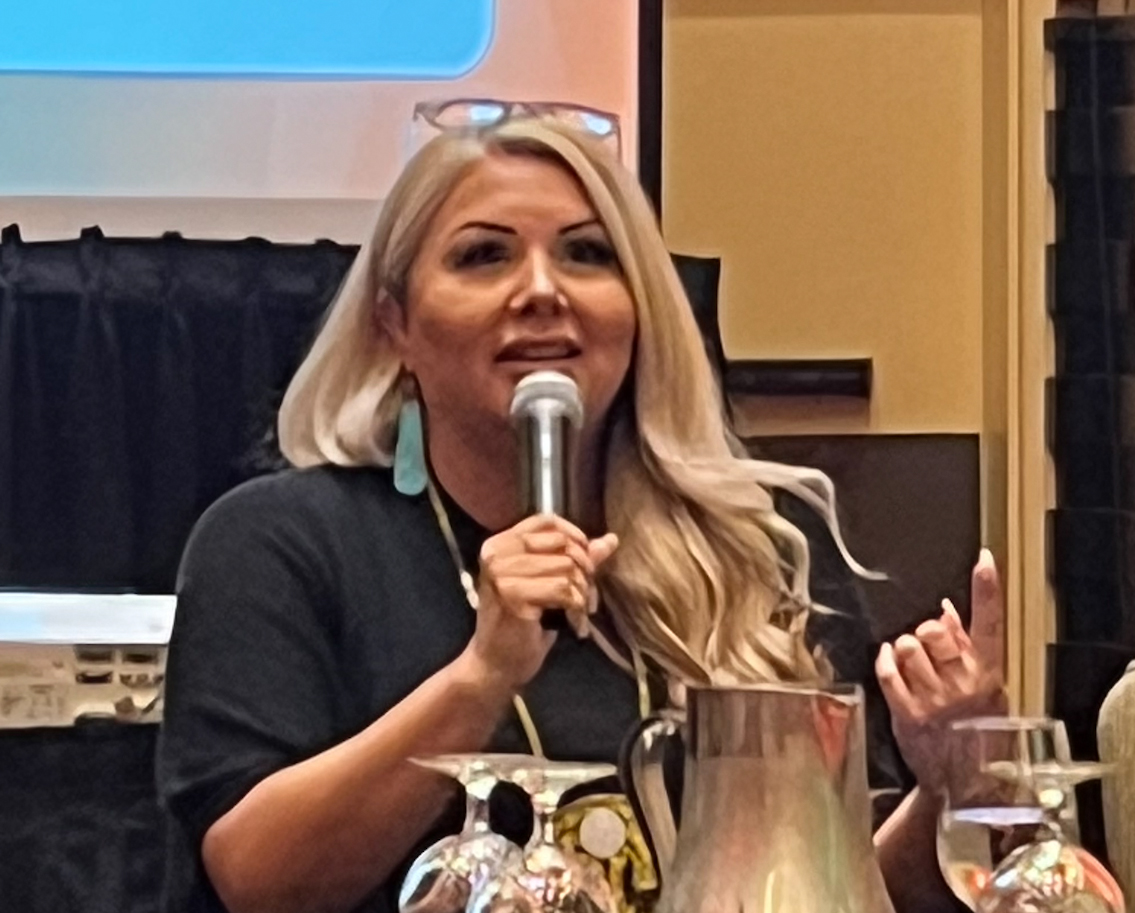
Image Caption
Local Journalism Initiative Reporter
Windspeaker.com
When companies look to do any work on First Nations’ land, they have to remember some simple truths, said Chief Jennifer Constant of Mattagami First Nation in northern Ontario.
"It's our land. It's our resources. It's our backyard. It's our space,” said Constant during a panel discussion at the Forward Summit on Oct. 8.
“And from our perspective, the advocacy for inclusion stems from that. I'm certain if any of you have someone show up in your backyard… you'd be asking 'Who are you and what are you doing in my yard?'"
Constant spoke on a panel titled Forestry and Mining—Returning to the Land; The Interconnection Between Indigenous Communities and The Natural Resource Sector. Tim Harvey, the CEO of Mattagami Aki, the economic arm of Mattagami First Nation, was the other panelist. The session was moderated by Tara Shea, vice-president of regulatory and Indigenous affairs for the Mining Association of Canada.
The two-day Forward Summit, which aims to advance Indigenous prosperity, was held at the Casino Rama Resort located on Chippewas of Rama First Nation in Ontario.
Constant began her political career in 2003 when she became a Mattagami councillor. She served nine terms as a council member and has been chief since 2023.
"We had development in our territory for a very, very long time," Constant said. "We were displaced quite often in our territory… And for a long time, we stood on the sidelines."
In the past, members of her First Nation weren't allowed to ask what was happening on their land and how things, including the environment and species, were being impacted, said Constant. "At the time, nobody cared. We were not considered people in the eyes of Canada and, as a result, we were shut out." That was not due to lack of effort to engage.
"In our community, we understand our role in our territory as stewards of the land and as protectors of our resources," she said. "We understand that. It's just in us. We speak about it. Our Elders speak about it. We hear it as a regular dialogue that occurs. And I think that the same is true for every (Indigenous) community across Canada because that is our responsibility."
But companies did not take consultation seriously.
"It was kind of a free-for-all for exploration companies coming," she said. The First Nation-settler relationship was not in balance.
"Every opportunity we could, we would have conversations," Constant said. "We would try to sit with people. We would try to do whatever we could to make sure that we had a seat at the table so that we could talk about accountability, we could talk about responsibility, we could talk about sustainability. And we could talk about making sure that we were taking care of the land the way that we were supposed to. That took a long time to be able to get to that point."
Constant said Mattagmi First Nation now has many agreements with companies working on Mattagami lands.
"Some don't have the best of relationship foundation as others," she said. "But they're pretty good agreements over-all."
Harvey said the agreements focus on a number of benefits to the nation and its members, including employment training. Mattagami representatives are always keen bring partners into the community to meet members to discuss employment opportunities.
Harvey said Mattagami officials also look to provide members with chances to sub-contract.
"This is something that has been a struggle," he said. "We have a lot of small and medium-sized businesses that don't get a fair shake when it comes to a lot of these resource extraction projects."
But this is changing.
"A lot of our partners today, that's why they are partners," he said. "They have the room to allow our small or medium or even large local businesses to work alongside them on their projects. If they can't get on the first initial project, they do a lot of other work. We have had very much success with that.”