
Image
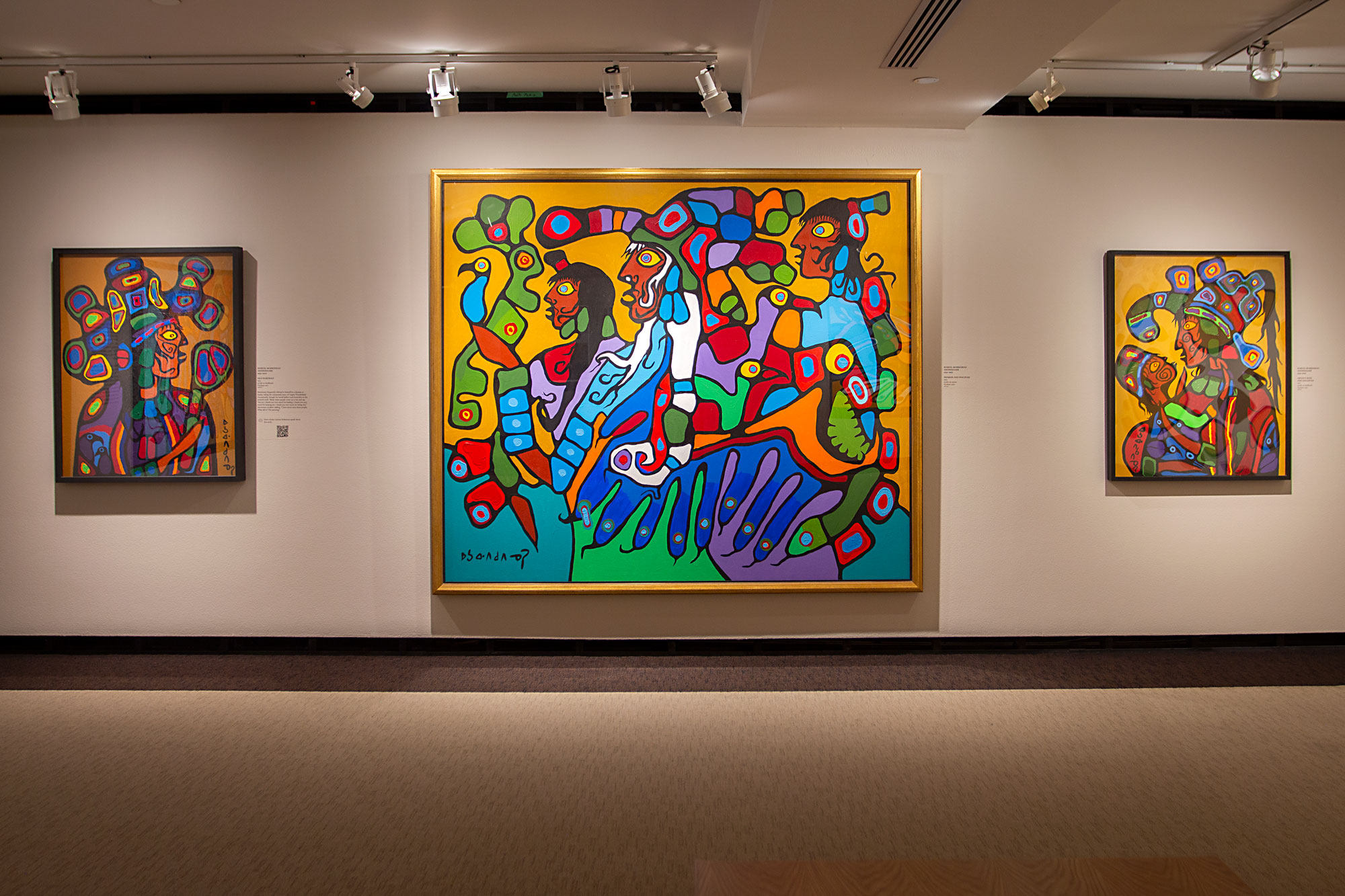
Image Caption
Local Journalism Initiative Reporter
Windspeaker.com
Some new works that have never been displayed are included in an Indigenous-themed exhibit that has opened at the McMichael Canadian Art Collection.
But this isn't the first time the exhibit, titled Early Days: Indigenous Art at the McMichael, has been on display at the prestigious museum located in Kleinburg, Ont., a village just north of Toronto.
McMichael first hosted the exhibit, which includes Indigenous art from the past 200 years, from November of 2020 through August of 2021. But due to various lengthy closures during the COVID pandemic, many were prevented from visiting in person.
Since then the exhibit has travelled to the Heard Museum in Arizona, New Mexico's Albuquerque Museum, Virginia's Chrysler Museum and the Musée national des beaux-arts du Québec in Quebec City.
And now it is back at the McMichael. As part of its launch, a curatorial talk was held on Sept. 28 at the museum to talk about some of the works, including pieces from artists Norval Morrisseau, Robert Houle, Alex Janvier, Rebecca Belmore and Kent Monkman.
Bonnie Devine, a member of Serpent River First Nation in northern Ontario, led the curatorial talk. She was among those who helped select which pieces of art would be included in the exhibit.
Early on during the pandemic, Devine, an associate professor at OCAD University in Toronto, was among those invited to McMichael to plan the Early Days exhibit.
"There was a table laid out," she said. "It was covered in an immaculate white tablecloth. And displayed on that table were some customary objects. These objects had come into the McMichael without provenance." When a piece is acquired by an institution it has a history.
"These pieces came with very, very scant information about where they were made, when they were made, most importantly who made them, but also how they were acquired."
Details also usually include if a piece was a gift or paid for.
"All of this information is incredibly important to maintain a history of the piece," she said.
Devine and others worked on the exhibit, which continues at McMichael until March 29, 2026.
"We saw them not as works of art, not as objects of material culture, but as beings," Devine said. "And this is how we addressed them."
Barry Ace, a member of M'Chigeeng First Nation on Manitoulin Island, Ont., was one of the panelists for the talk.
He discussed some of his work in the exhibit, including his 2016 mixed media piece titled “Fox Tail Moccasins.”
"I'm always looking for evidence of our material culture and how I can engage with it," he said. "And what I do with my work is that I bring it into a contemporary context.”
Ace said his work not only incorporates beadwork, but it also includes electronic components. In Anishinaabe art there is an energy within, he said, because when one stitches beads together, actually energy is being stitched.
"Both can soar and transform and transfer energy," he said. "So, when you go to a gathering and you see floral beadwork and people are dancing, those that are witnessing it are being healed with that power and the energy and the healing plants and the medicines that are represented are spread out."
Another panelist was Shelley Niro, a member of Six Nations of the Grand River in Ontario. One of the pieces of art she talked about was her 1995 creation titled “Erratic Love.”
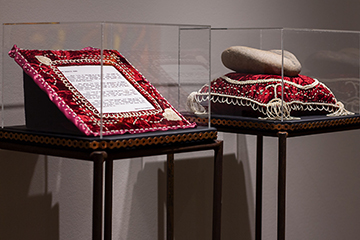
"It was a new idea talking about Native love because nobody really talked about that kind of love in a Native format," she said. "I thought it was a really exciting and interesting idea."
“Erratic Love” is a sculptured piece, including a poem placed on a rock that Niro found in the Grand River in her community.
“Erratic Love” also includes beadwork.
"Beadwork is an important element that I like to incorporate in a lot of my work because for years beadwork was kind of looked at as trinkets," she said, adding she believes it is an important aspect of Indigenous life.
More info on the exhibit is available at https://mcmichael.com/event/early-days-indigenous-art-at-the-mcmichael/