
Image
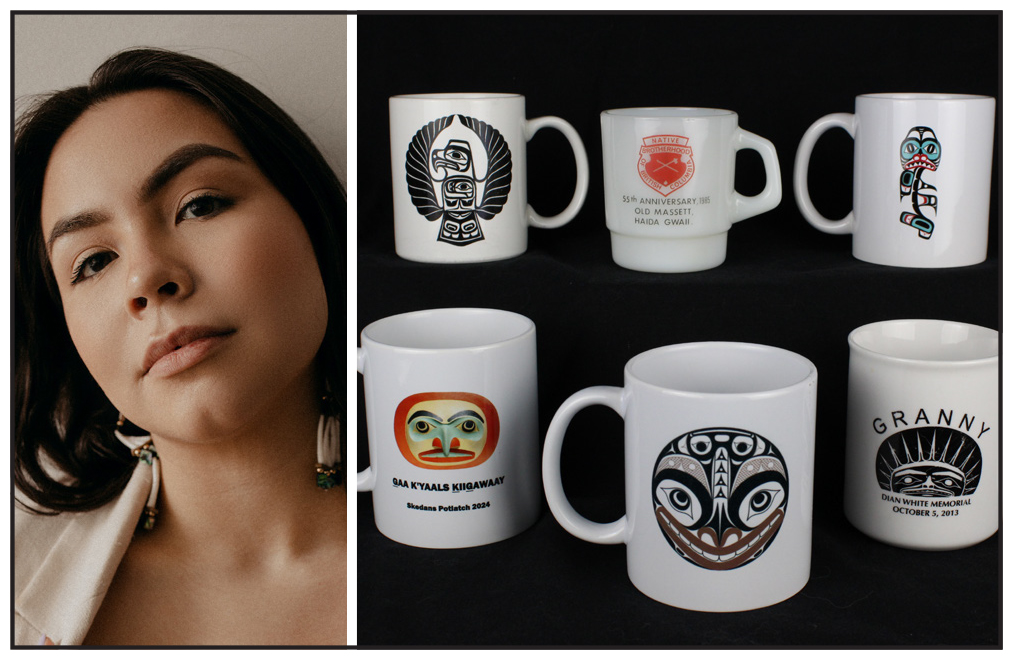
Image Caption
Local Journalism Initiative Reporter
Windspeaker.com
The Bill Reid Gallery of Northwest Coast Art has launched an exhibit titled NDN Giver that will run until Feb. 22, 2026.
It is curated by Amelia Rea, who is the assistant curator at the gallery in Vancouver, and who is a Tsiits Git’anee clan member from Old Massett, Haida Gwaii, a group of islands off the northwest coast of British Columbia. NDN Giver explores the meaning and practice of First Nations gift giving.
“NDN Giver was inspired by a mug,” Rea explained. “I’m probably one of a very few curators who would look at a mug and think ‘I’m going to turn that into an exhibition’.”
Rae said she was at her auntie’s house and opened a kitchen cabinet and what she saw gave her the idea.
“They’re very tall cabinets and it’s something I’d done many times before in my life at her house and ended up kind of stopping and looking at these, you know, hundreds of mugs that probably had all been gifted at potlatches,” Rae said. “And when you accept a gift at a potlach, you’re accepting the responsibility to carry that forward. You’re now also accountable to the host. It’s about relationships and holding each other accountable, and also agreeing, affirming agreement with whatever took place.”
Rae then began looking deeper into potlach ceremonies and how the gifts given become living pieces of law and relationships.
Potlach ceremonies are a practice of the communities along the Pacific Northwest Coast, including the Haida, Kwakwaka’wakw, Tlingit, Coast Salish and Nuu-chah-nulth communities, among others.
“In historical potlaches, a person would accumulate gifts by trading with people. Sometimes these things have been given at potlaches over and over again because that’s keeping it in circulation,” Rae said.
The title of the exhibit is an effort to reclaim the phrase rooted in colonialism that stems from a misunderstanding and clash of cultural values about reciprocity and gift giving.
“She’s kind of flipping it around because she’s talking about the generosity of community rather than taking things from people,” said Aliya Boubard, gallery head curator.
The phrase was used by settlers who accused Indigenous people of giving gifts and then taking them back. However, culturally, First Nations communities practice the act of giving gifts as part of an ongoing cycle of exchange. It is not a one-time transaction.
Potlach ceremonies are held to commemorate life events, including births, marriages, name-giving, funerals or the inheritance of titles and rights.
During these ceremonies there are speeches, songs, dances, feasts and gift giving ceremonies where the hosts provide guests with gifts.
These gifts can be lavish or humble depending on the wealth of the hosting family; however, they are honoured by the recipients.
At future potlach ceremonies, gifts received at one ceremony can be given away at another.
Settlers who viewed ownership as more of an individual event or in a more permanent way misinterpreted this practice and used the slur NDN giver as a derogatory expression used to insult someone who takes back a gift.
Potlaches were banned by the Canadian government from 1885 to 1951 under the Indian Act.
The exhibit opens with the recreation of the kitchen cabinets that sparked the idea for Rae and then travels into the featured artists’ contributions, including work that shows potlaches were not about the objects alone but rather the stories carried by them.
There are three artists’ work included in the exhibit, including Skil Jaadee White from the Yahgu Janaas clan of the Haida Nation, K.C. Hall, who is a Heiltsuk artist from Bella Bella, and Glathba Charlie Brown who is also Heiltsuk.
“We had many conversations on what they (Hall and Brown) could do for this show and decided on a Bentwood box, or a box of treasures, as a box of treasures is often the kind of centre point of a potlach,” Rae said. “A clan, a chief, would open their box of treasures and share both intangible and tangible wealth that are contained within this box.”
This could have included items such as masks and regalia, but could also be songs, ceremonies and stories.
White contributed a painting titled 3 a.m.
“It shows what would happen at 3 a.m. at the potlach, which is usually when the events kind of close in the wee hours of the morning and it shows all this material wealth surrounding the fire waiting to be given to the witnesses that were present,” Rae said.
This being Rae’s first solo curated show, she really wanted to be respectful and responsible to her community.
“I really feel that weight on my chest to do that. I felt a lot of pressure because I knew my community was watching me and I wanted to make sure I was doing right by them and, thankfully, they seemed very pleased,” she said. “And it really just felt really right to showcase and curate at a gallery that is representing such a pillar (Bill Reid) for not just northwest coast art but for Haida art as a young Haida person.”
Bill Reid (1920-1998) was one of Canada’s most well-known artists. He aided in the revitalization of Haida art and culture. His work blended traditional Haida designs with contemporary expression.
Rae hopes individuals who attend the exhibit will walk away with a new perspective of potlach ceremony and the act of giving.
“You know, you’re richer for giving everything you have away rather than keeping everything for yourself. To share with community and your people, that makes you wealthy,” she said.
For more information on the NDN Giver exhibit visit the Bill Reid Gallery of Northwest Coast Art.