
Image
Local Journalism Initiative Reporter
Windspeaker.com
With Northwestern Ontario's official adoption of permanent daylight saving time, First Nations and towns in the region will no longer require the twice-annual clock changes to fall back and spring forward.
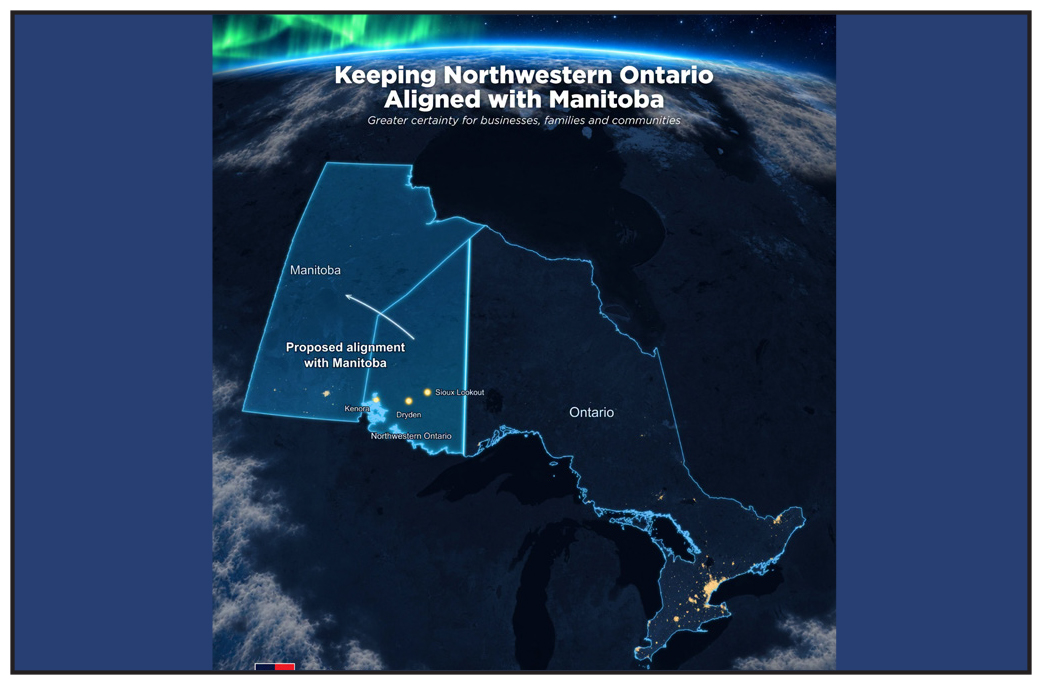
After Manitoba Premier Wab Kinew announced on Sept. 17 that his province would remain on permanent daylight saving time, leaders across Ontario's northwest rapidly mobilized to consult with community members to determine a common solution. Within weeks, there was a nearly unanimous consensus to align with Manitoba.
“In my riding, there are a lot of flights and if we have different times with Winnipeg, it wouldn't make sense,” said Sol Mamakwa, MPP of Kiiwetinoong and deputy leader of the Ontario NDP. “We met with chiefs and with mayors across Kiiwetinoong. Municipalities did their own polls and overwhelmingly it was 91-95 per cent to align with Manitoba.”
Mamakwa's Kiiwetinoong riding is home to the majority of the province's remote, fly-in First Nations. He realized that Kinew's announcement would have made the area of Ontario west of the 90th meridian an island of central standard time in winter. Manitoba and Northwest Ontario communities are in the Central Time Zone, while the rest of Ontario is in the Eastern Time Zone. By remaining on daylight saving time, all of Ontario and Manitoba would align with the Eastern Time Zone time.
For northwestern Ontario communities, as the town of Red Lake noted, “connections with Manitoba are significant, from healthcare and travel to business, family, recreation and everyday life.”
Ontario's Indigenous Affairs Minister Greg Rickford said Northwest Ontario had three options. To shift to eastern time and align with the rest of the province, to continue with time changes and become out of step with the rest of Ontario and Manitoba, or the chosen option: stop changing clocks and go with what Rickford called “Wab Kinew time”.
After Rickford called Mamakwa saying they had to do something, Mamakwa touched base with tribal council leaders and First Nations he works with seeking position statements resulting from their own consultations. Mamakwa's office also conducted an informal survey of his constituents, with 91 per cent of 1,085 people surveyed approving the change.
Respondents often cited concerned about coordinating with bigger northwestern Ontario towns Kenora and Fort Frances. As Treaty #3 territory spans both provinces, the region’s Anishinaabe communities formally supported the move by resolution.
“Manitoba’s decision to adopt permanent daylight saving time raised concerns about the potential division of the territory into multiple time zones,” said Grand Council Treaty #3. “Such a change would create unnecessary challenges for Treaty #3 citizens who rely on access to essential services, programs and resources across provincial boundaries.”
“Through this resolution, the Chiefs-in-Assembly reaffirmed the importance of maintaining consistency across the territory while ensuring that decisions affecting the Anishinaabe Nation in Treaty #3 recognize the interconnectedness of its communities and respect the needs of its citizens.”
The Ontario government made the regulatory change on Oct. 13. Attorney General Doug Downey said the move provided certainty and predictability, ensuring economic stability and avoiding unnecessary disruptions.
“Through the collective efforts of communities and First Nations across the northwest, we’ve led a process to build consensus the right way, with detailed and nuanced considerations,” said Rickford, who is also the Kenora Rainy River MPP. “Our engagement was robust. Everybody had a chance to chime in on where this should go, and the results were crystal clear.”
Fort Frances Mayor Andrew Hallikas commended the decision, declaring “you don’t get more grassroots democracy than this.” With no more clock changing, the region will benefit from sharing the same time as northern hub Thunder Bay and the rest of the province between Nov. 1 and March 14.
“The sooner it happened, the better. It would give opportunity for organizations to start planning for that transition,” Mamakwa explained. “It's something the airlines have to get ready for. Also hospitals. Businesses, of course. Most of all, schools and families. It gives them time to prepare.”
It follows a growing trend throughout Canada that now covers half the country. British Columbia, Alberta and the Northwest Territories have all adopted their versions of permanent daylight saving time this year, joining the Yukon, which switched in 2020. Most of Saskatchewan has stayed on central standard time since 1966.
In 2020, Ontario passed legislation to make daylight saving time permanent, but the decision was provisional on neighbouring Quebec and New York doing the same. That goal might be getting closer with the Parti Québécois announcement on Oct. 28, expressing its intention for this to be the last year that the province changes its clocks.
Daylight saving time ends Sunday, Nov. 1 at 2 a.m. Clocks then are turned backward 1 hour to 1 a.m., local standard time.
While public opinion polls heavily favour having an extra hour of light in the evening, researchers have cautioned that the resulting darker mornings could disrupt the body's circadian rhythms, with some studies pointing to higher rates of diabetes, obesity and heart disease.
Adolescents and those with sleep disorders are most at-risk, with workers on early shifts losing their morning exposure to sunlight. Where sunrise comes later, researchers have found drops in school attendance and productivity. Poor visibility and icy roads are a safety concern for morning commuters.
In the 1970s, the United States experimented with permanent daylight time but it proved so unpopular that it reverted to the previous system after only a year. Most sleep researchers suggest permanent standard time is better aligned with the body's internal clock than daylight saving time.
A recently published paper in the Canadian Medical Association Journal noted that stopping clock changes “may eliminate transition harms that last a few weeks” but warned that permanent daylight time is likely to result in “chronic” health impacts.
The paper's authors suggested countermeasures such as better pedestrian infrastructure for safer morning travel, shifting school start times and creating an awareness campaign about healthy sleep habits. Some ski resorts have already moved back their opening times.
Indigenous scholar Dr. Rachelle Wilson Tollemar has asserted that daylight saving time is an artificial construct that ignores our natural “biological presets” and traditional worldviews where “time correlates with terrestrial and celestial changes.”
Indigenous peoples have long measured time by the sun's rising and setting, the moon's phases and the changing of the seasons. According to an old saying often attributed to Indigenous sources, “only the government would believe that you could cut off the top of a blanket, sew it to the bottom and have a longer blanket.”
In northwestern Ontario, Pickle Lake Township, Atikokan and Mishkeegogamang First Nation stopped observing time changes long ago. MPP Mamakwa highlighted that a benefit of adopting permanent daylight saving time will be simplifying coordination with these communities.
“As far as I remember, they've never moved their time, so we're finally aligned with those three First Nations,” said Mamakwa. “It would get confusing for me whether it was summer or wintertime. I would always ask 'What time zone are you guys at?'”