
Image
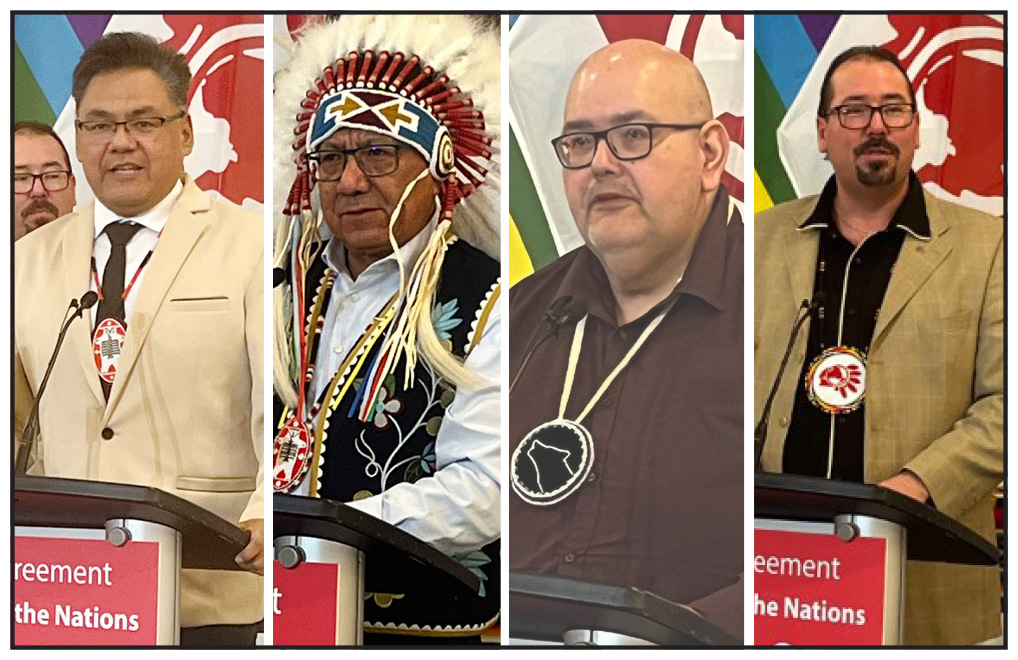
Image Caption
Correction made to the date of press conference, held March 30, not March 29 as previously reported.
First Nations leaders from across Ontario were in Toronto March 30 to celebrate a plan for the long-term reform of First Nations Child and Family Services in the province.
The Ontario Final Agreement (OFA), negotiated between First Nations and the federal government, was finally approved by the Canadian Human Rights Tribunal (CHRT) and confirms that the OFA fulfills the many orders of CHRT to end systemic racial discrimination in the child welfare program.
The decision also affirms the inherent right of First Nations to care for their own children and to design services based on First Nations’ laws, traditions and priorities, said representatives of the Nishnawbe Aski Nation in a prepared statement.
“It's a historic moment today; something that we all celebrate,” said Regional Chief for the Chiefs of Ontario Abram Benedict. He said the agreement was a long time coming, explaining that it was in 2016 that the CHRT ruled Canada must end its discriminatory funding practices against First Nations’ child welfare services.
The tribunal affirmed that First Nations are “appropriately in the seat of authority” and “has acknowledged that the First Nations must lead to way,” said Benedict, adding it’s a true step towards reconciliation.
“We have known that for a long time,” Benedict said. “And today, while we're talking about the child welfare program, the discrimination continues in so many other areas. Our leadership, in this room, across this region, are charged of ensuring that discrimination ends.”
Benedict acknowledged that First Nations efforts to reach the reform agreement were met with pushback, but said “had it not been for opposition, we may not have seen those other areas that needed improvement.” But for today, it was a “good moment. It’s a proud moment.”
Implementing the OFA will take some time. “There's a lot of work to do,” Benedict said.
Implementation will be aided by $8.5 billion in federal funding. In committing the funds, Mandy Gull-Masty, federal minister of Indigenous Services Canada, said First Nations children and families in Ontario will have access to fair, culturally-grounded community-led services.
Alvin Fiddler, grand chief of the Nishnawbe Aski Nation, a political organization that represents 51 First Nations in northern Ontario, also spoke highly of the agreement. “Today is a great day for children.”
Fiddler said First Nations’ leadership were given a mandate to negotiate with federal officials on this child services file numerous years ago.
“They acknowledged and they recognized that the current child welfare system, as it is being currently designed and administered to our communities and especially to our children, is very vulnerable,” he said.
Fiddler said he respected the fact the tribunal determined that chiefs have the authority to look after their children from their own First Nations and in ways that are in their best interests.
“I am so full of gratitude to all those that worked so hard to get where we are today,” he said.
“I know that the resources that are contained in this agreement will allow our families, our communities, to look after their own children—to love them, to nurture them, to raise them in our communities. And our children deserve to be home.”
Joel Abram, grand chief of the Association of Iroquois and Allied Indians, an organization that represents about 20,000 members from eight communities in Ontario, is among those who has long fought for reform to the child welfare program.
“For generations we've advocated to keep our kids safe, connected to their families and rooted in their cultures,” he said. “We have always known what's best for our kids. And we're best positioned to determine how to support future generations.”
Abram believes the agreement approved on March 30 is a step in the right direction.
“We're finally turning a page on a discriminatory funding model,” he said, adding First Nations children are the most overrepresented in the child welfare system today.
Abram said the previous program funding was restrictive.
“We've replaced it with a sustainable flexible model that empowers communities to prioritize well-being over bureaucracy,” he said. “This agreement is designed to prioritize prevention focused services. This gives First Nations the flexibility to allocate resources, to keep families together and prevent children from entering the system unnecessarily.”
Abram said the agreement also provides support for young adults as they transition to independence.
“That's one of the things not covered by a tribunal order,” he said. “And so, this ensures they're not left without help when they age out.”
Like other leaders who attended the news conference, Abram realizes things will not change overnight.
“While we celebrate this approval, the work of implementation is just beginning,” he said. “We’re moving from a system of crisis to a system of care.”
Though pleased an agreement has been reached, Nishnawbe Aski Nation Deputy Grand Chief Bobby Narcisse believes “it’s not a perfect agreement.” And he said challenges and gaps still need to be sorted out. First Nations across the province have different needs.
“For our communities across Nishnawbe Aski Nation, remoteness means higher costs, limited access and significant, typically, greater need,” he said. “For far too long, funding approaches did not reflect reality.”
As a result, officials created the Remoteness Quotient.
“This was not just theoretical,” Narcisse said. “It was grounded in real data that came from the cost of living, the cost of doing services within our First Nation communities. It brings together two key realities, the true cost of delivering services in remote communities, including transportation, staffing and infrastructure, and also the level of need, including population pressures, socio-economic conditions and service gaps across the remote north.”
The landscape changes when these factors are considered, he said.
“Delivering the same service in a remote First Nation can cost significantly more, sometimes double or more, than in non-remote areas,” Narcisse said.