
Image
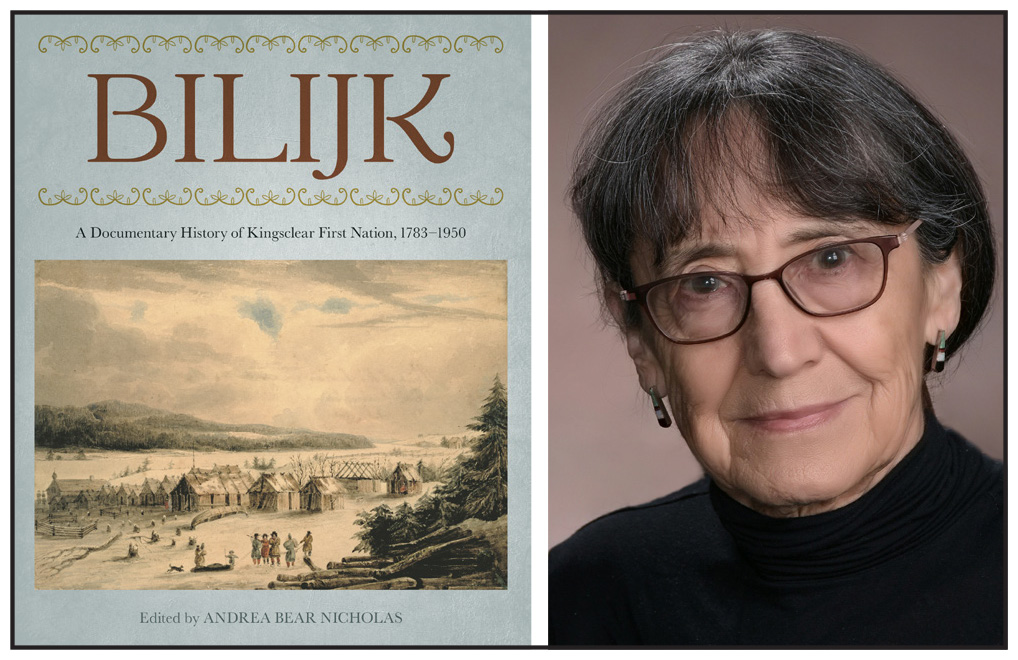
Image Caption
Windspeaker.com Books Feature Writer
Local Journalism Initiative Reporter
More than 20 years of work, which included a period of great personal loss, has culminated in the publishing of the English version of Bilijk: A Documentary History of Kingsclear First Nation, 1783-1950, which was released in late March.
“It's kind of strange,” said editor and scholar Andrea Bear Nicholas. “My husband passed away (in 2025)…and the day the book came, I was suddenly overwhelmed with sadness that he wasn't around…because he was really my sidekick and everything…He was kind of the motivator and the enabler for the book to get done.”
Darryl Nicholas had taught Wəlastəkwey (Maliseet) at St. Thomas University in Fredericton, N.B. His fluency allowed him to do the majority of the translation for the Indigenous version of the book, which will be titled Pilick: Kekw Kisowikhasik ’ciw Pilick təkkiw 1950. It is scheduled to be published in August, but Bear Nicholas says there is still a small amount of translation remaining. She’s working with a 96-year-old Maliseet-speaking woman to complete it.
Having the book in Maliseet is paramount, Bear Nicholas says. She developed the Native Language Immersion Teacher Training Program at St. Thomas, the first such program to be offered at a university. She held the Chair in Native Studies for 20 years at St. Thomas.
“Our language is really struggling, and I came to the realization that if our language died, that would be our history too,” she said.
Kingsclear isn’t the First Nation of Bear Nicholas or her husband; they are members of the Tobique First Nation (Nekwətkok). However, working at St. Thomas University, they lived close to Kingsclear and, noted Bear Nicholas, “It's the oldest established reserve in this province and…in the early days, it included people who eventually lived in all the other communities…so it was like the start of every community in a way.”
Bilijk weaves together a treasure trove of documents, including Canadian Land Survey Records, federal and provincial records, federal and provincial statutes and laws, Roman Catholic church records, a variety of museum documents, newspaper accounts, and National Map Collection materials.
During her research, Bear Nicholas says there was “so much” that surprised her that it strengthened her resolve to share the documents. An archival search in France turned up a writing from a priest that explained why Kingsclear First Nation is where it is now located.
“Until I found the priest's writings at an archive in Paris, nobody knew exactly why that group of our people ended up being established there. So that was quite an important discovery,” said Bear Nicholas.
In the book’s marketing information, the publisher explains that 11,000 Loyalists had invaded unceded Wəlastəkwey territory after the American Revolution and an influential judge purchased their lands in a highly questionable dealing that dispossessed the First Nation people. Some Wəlastəkokewiyik were forced to settle a few miles upriver at Kingsclear, establishing the community there in the late 18th century.
Bear Nicholas said the purchase involved a “lot of wheeling and dealing,” the church stealing money from the Maliseet members and wrongfully claiming land, and the chief at the time quitting and moving to a related community in Maine.
The Kingsclear Nation’s history is ordered chronologically instead of by subject matter.
“If you don't have a sense of the chronology of some of these issues and the development and what's going on around them, it sort of makes them just dry information. I just felt that (chronologically) was probably the best way,” said Bear Nicholas.
Her biggest struggle came in whether to include the racist remarks and comments that showed up in numerous documents.
“I had a hard time dealing with the racism...But I finally decided that I wasn't going to clean it up. That people, that our people especially, and everybody, needed to know exactly what people were thinking of us,” she said.
To counter the racism, as well as to clarify context and deliver explanations, Bear Nicholas includes editor notes on the bottom of a majority of the pages.
“I didn't want people to think that I'm basically supporting everything that is in every document. I wanted people to understand what some of the issues were,” she said.
In one note, Bear Nicholas writes, “This passage has many examples of European biases and racism.”
Editor notes also detail the lineage of Maliseet members.
“Definitely I wanted people to be identified. There’s a lot of interest, of course, in genealogy these days, and so people want to know what their ancestors were doing in each community,” she said.
“I would think that there'll be a lot of people who take some kind of pride and also realization of the roles that their ancestors played in the history of the community. None of that has been out anywhere.” She said that she found some of her own cousins in the church records.
It is Bear Nicholas’s hope to also share the material she gathered on the First Nations of Woodstock, St. Mary and Oromocto, all part of the Maliseet Nation. And she also has 10 boxes of information for Tobique First Nation.
“I'm toying with various options but I'm not sure we'll do an entire book in just Maliseet for them, partly because we're running out of expert speakers,” she said. “I'm actually thinking of trying to get some funding to be able to start several of these projects together at the same time so that we can get them done. I'm not getting any younger.”
Bilijk: A Documentary History of Kingsclear First Nation, 1783-1950 is published by Goose Lane Editions. It can be ordered at https://gooselane.com/products/bilijk?srsltid=AfmBOopzTu71OBMq7X1hrLYpmQ_5R1yYrpO3G8gQOppnpjbbDx-Ef8eI