
Image
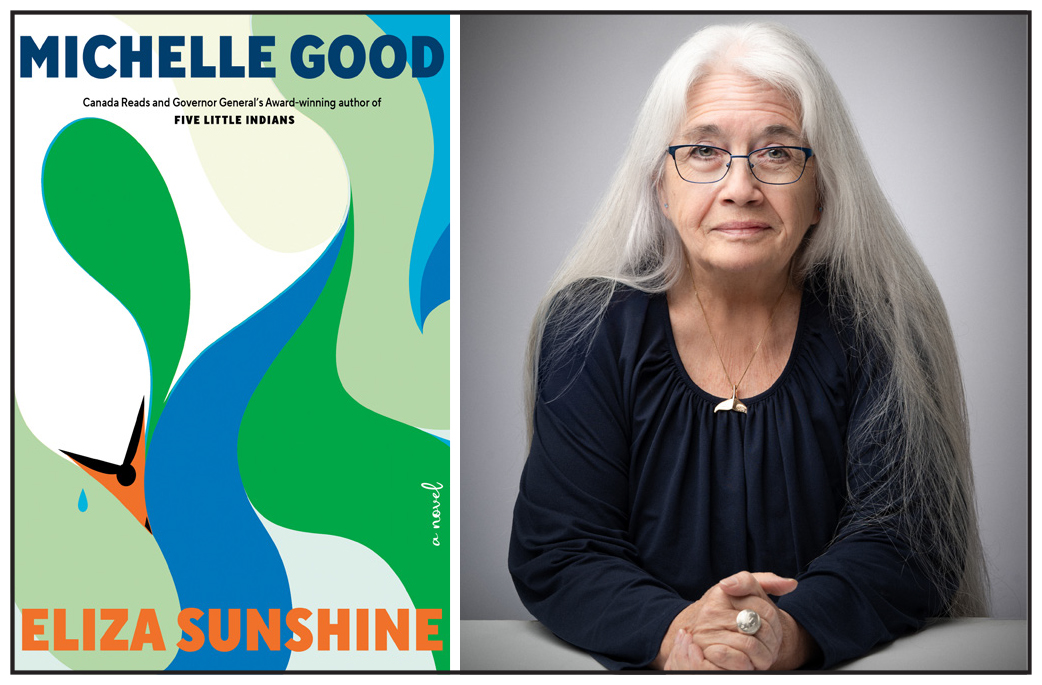
Image Caption
Windspeaker.com Books Feature Writer
Local Journalism Initiative Reporter
Eliza Sunshine is the powerful new novel from Governor General’s Award-winning author Michelle Good.
It is based on the life of her mother Martha Eliza Soonias Stiff.
“It was 1999 when that strange little conversation that was sort of between (my mother and me) but not between us happened,” said Good, who is a member of the Red Pheasant Cree Nation in Saskatchewan. “And I felt an obligation ever since then. Not only an obligation, but a real desire to tell that story because it's so unique.”
Good, however, takes the story beyond her mother, who the character Eliza Sunshine is based on.
“My first challenge was what is the structure of this? How do I tell this story? And it came to me that you have to tell that story with context. It can't just be hanging in the air,” said Good. “It has to have a context because the history and the future are so critical to understanding the meaning and the importance of that story.”
Eliza Sunshine begins with Eliza’s mother, Swan, recounting her childhood and speaking of her own mother Sweet Medicine. Swan tells the story of her past to Eliza, who has just returned from her first year at Indian residential school and is a shadow of the girl she once was. Swan takes Eliza out on the land to help her heal.
The book then moves into Eliza telling her story to her daughter Ella, who has embraced being First Nations in the same way Eliza ran from it.
“I looked at my girl and it was as though the floodgates burst. I’d always been so thankful that marrying her father had kept her out of the clutches of the ones who had stolen me away from my family. And now here she was wanting to step back into that world I’d fought so hard to leave behind. It was time she knew the truth of what it means to be an Indian in this country,” Good writes in Eliza’s story.
The book concludes with Ella’s story and the final line she speaks to her daughter, “Âstam, my girl. I’ve got a story for you.” (Âstam means “come here” in Plains Cree.)
This is the vehicle Good uses to tell both a personal and factual story.
“All of those things actually happened…(It’s a) challenge to walk into that history and not be completely flattened by it…completely broken down by it,” said Good.
For those immersed in First Nations history in the West and contemporary life, little of what’s offered in the facts of Eliza Sunshine will be new. However, the women’s stories breathe life into those facts.
Sweet Medicine’s story includes the arrival of the railroad and the slaughter of the buffalo by the newcomers. Swan lives in the time of the creation of reserves. Eliza attends residential school and is committed to a tuberculosis sanitarium. Ella’s work results in the uncovering of the “pig farmer” murders.
“When you create characters and you demonstrate the impact of those facts on actual lives, then it's an entirely different approach to the story. It's a human approach to the story versus a sort of cold, detached historical perspective of the story. And I think that's one of the things that makes it difficult for people, Canadians generally, to consider the depth of the genocide that happened in this country. It's because it's not personalized for them,” said Good.
“It's been...presented educationally as something that happened in the distant past…But when you write like this, when you tell stories like this, this is in my living memory. This is based on my great-grandmother (Swan). So that's not 500 years ago.”
Good also personalized the Indian residential school experience in her Governor General award-winning 2021 novel Five Little Indians.
Good’s mother’s story—like all the women in Eliza Sunshine—is one of courage. Martha Eliza Soonias Stiff left for New Zealand in the 1940s to attend a maternity nurse training program. This was in a time in Canada when Indigenous children were not educated beyond Grade 9.
“Her experience was extraordinary and it was recognized as extraordinary. When she came back, there was just a huge, huge cry about how fabulous and progressive she was. And I felt that was an important story to tell, not only because it's based on my mother, but because of why that would be so extraordinary in an historical context,” said Good.
That context also includes, she points out, Indigenous people passing themselves off as white.
“To delve into that really sad and unfortunate reality of that generation where there were so many people that, if they could pass, they would, because it was horrifying and terrifying and life-threatening to be Indigenous in Canada,” said Good.
She admits that aspect is difficult to tell and it needs to be done in a way that’s not judgemental.
Violence, particularly against women, is a thread that runs throughout Eliza Sunshine.
“We are still experiencing the kinds of violence that finds its roots in Swan's story. And that violence doesn't change. It's the same form. But as we evolve and grow … (in) the present world, that violence begins to take different forms, as well, in terms of the challenges that we face in reaching for professional careers,” said Good.
She points to her own experiences in becoming a lawyer and the racism she faced in academia in trying “to be forward moving and to be a change maker, to try to create space for Indigenous people generally or to improve the lives of Indigenous people generally.”
In a letter to the reader that accompanies Eliza Sunshine, Good writes, “How did Indigenous women become disposable, and why do they remain that way? How is it that Indigenous women are still ending up in garbage dumps? How and when will this brutality end? Those are the urgent questions that haunt this book…”
Good hopes that with Swan’s story readers will understand the inherent impact of the violence of colonialism and how Indigenous women were made powerless.
“I'm hoping that people can see that transition from (Swan) having a whole and complete and untrampled life and then the impact of colonialism. And that's where the violence comes from because colonialism in and of itself is a violent thing. It is a process of taking over somebody else's space so that you can exploit it for profit. That is in effect the definition of colonialism,” said Good.
She points to Eliza, who after returning from New Zealand, being praised and lauded, she is unable to get a job. Ella’s story centres on the missing and murdered Indigenous women and girls and the lack of action by law enforcement and mainstream media.
Although the stories each woman tells are painful, Good says Eliza Sunshine is a hopeful book.
“Hope is inherent, I think, in the fabric of the story, because each generation has enough hope. They have enough will to continue to survive, to thrive, as expressed by taking action in the form of preparing the next generation… giving them a context for what's happening to them… so that they can survive and thrive. And that's the fundamental of hope,” said Good.
As for the hope Good holds for Eliza Sunshine: “I hope that it inspires people to reconsider what they think they know and to reconsider Canadian history…through the lens of Indigenous experience.”
Eliza Sunshine is published by Penguin Random House and will be released Aug. 18. It can be purchased at https://www.penguinrandomhouse.ca/books/812994/eliza-sunshine-by-michelle-good/9781039011434