
Image
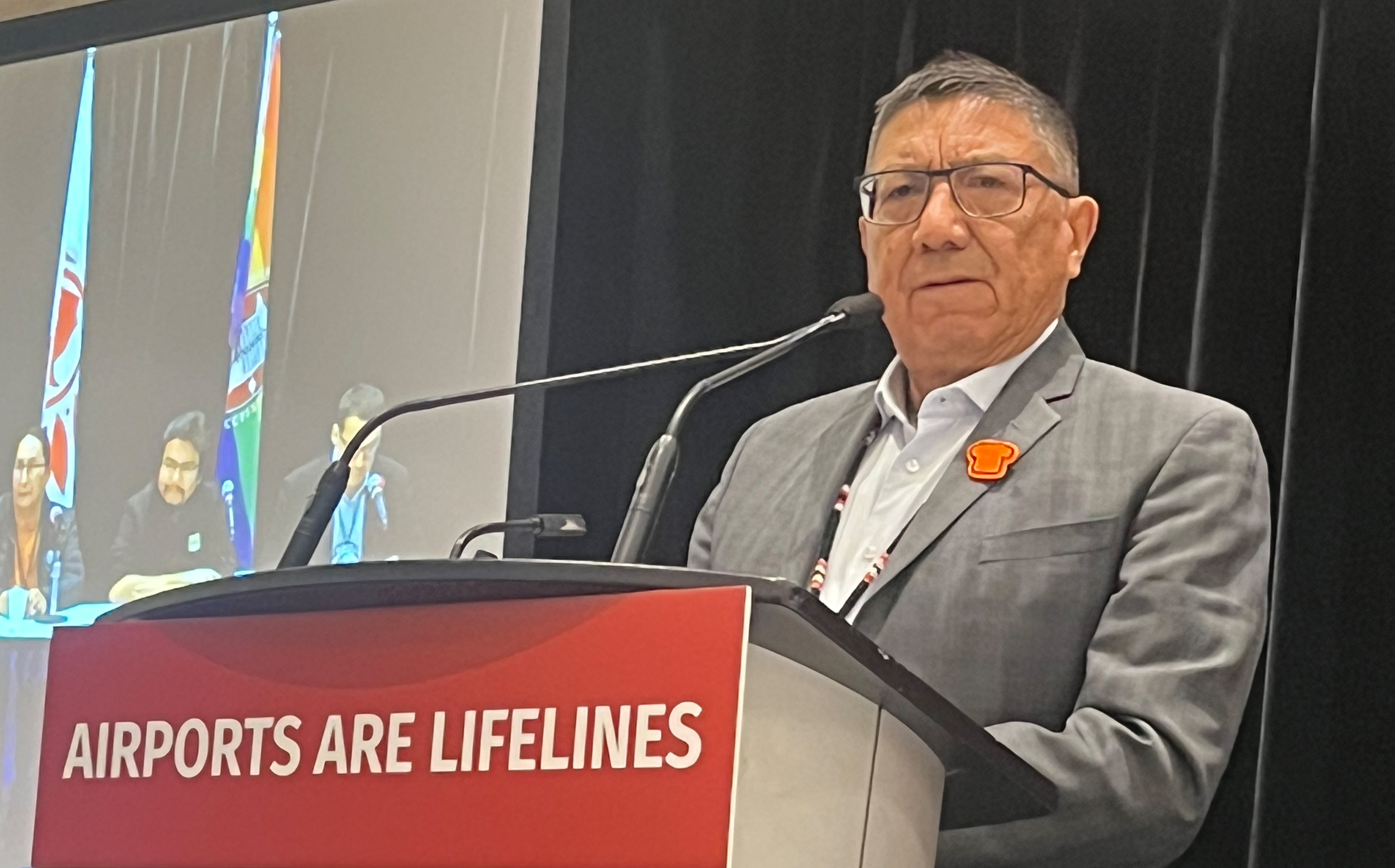
Image Caption
Local Journalism Initiative Reporter
Windspeaker.com
First Nations leaders from across Ontario held a news conference on Oct. 28 to call on the provincial and federal governments to provide funding for an airport infrastructure crisis.
The Chiefs of Ontario (COO) and Nishnawbe Aski Nation (NAN) held their event at the Sheraton Toronto Airport Hotel.
There are 29 remote airports in northern Ontario and 27 of those directly service First Nations.
“Many of them were built 40 years ago or 50 years ago,” said NAN Grand Chief Alvin Fiddler. “Over the course of their lifetime there’s been very little or no effort made to improve those airports. And here we are in 2026 to give notice again to Ontario and Canada that we need resources to improve the safety of these runways.”
A 2025 NAN needs assessment conducted by the Northern Ontario Aviation Committee estimates an investment of nearly $1.5 billion is required to address infrastructure deficiencies at the northern airports.
Fiddler said many of the airports require better lightning, improved navigational aids, paved runways and longer runways to accommodate larger aircraft.
“And we need staffing to operate these airports 24/7,” Fiddler said. “They should not just be open from certain hours in a day or certain days.”
Fiddler also had a message for provincial politicians.
“We cannot keep meeting with you or we cannot keep writing letters to you,” he said. “You need to act. Same with Canada. The legislation that you pass on transportation does not meet the conditions on the ground in our communities. So, we need to work together.”
Abram Benedict, the Ontario regional chief for the COO, said northern Ontario airports are in areas where the government is working hard to extract resources to secure the economy.
“The fact they don’t have adequate airports, they don’t have adequate equipment in this day and age, is unacceptable,” he said. “So, our leadership is going to continue to talk about that. We want to bring awareness to Ontario (and) Canada.
“These airports, the Nations that they serve, deserve the investments to be made in those communities to make it safe and ensure that they have new technology that many airports are required to have.”
Benedict said he is worried about the future of some of the airports if they are not upgraded soon.
“If there is no investments made in these airports, the federal government will legislate these airports out of existence, which is not an option for our Nations,” he said.
Matthias Anderson, chief of Kasabonika Lake First Nation, provided details on why his community needs an upgraded runway.
“I believe it was three winters ago that our deputy chief was on a small aircraft,” Anderson said. “He just landed and went past the runway. And beyond that runway was the lake. We were just lucky he didn’t perish that day.”
A 27-minute documentary titled Holding Pattern, jointly produced by the COO and NAN and released prior to the press conference, reports people have died because of the airport infrastructure crisis.
In the opening minutes of the movie, a member of Attawapiskat First Nation provides details of how his daughter died earlier this year as inclement weather prevented an air ambulance from landing in the community.
Fiddler said that data collected between January 2020 and September of this year, shows that Ornge, the regional emergency transportation provider, received 33,000 calls from 27 remote airports.
“Over 2,300 of these calls they couldn’t land,” he said. “So, they couldn’t get there to retrieve a patient.”
Fiddler said airport deficiencies have major impacts on peoples’ lives. Delays can have dire consequences.
“It means your health is compromised and/or even you will die,” Fiddler said. “That’s the reality.”
Russell Wesley, chief of Cat Lake First Nation, shared details of the impacts in his community when issues prevent planes from departing or arriving. In one week alone, members of his First Nation had 88 missed appointments, he said.
“At least five or six of those were specialist appointments,” Wesley said. “As you know it takes up to nine months to get a specialist appointment. And that’s what happens in my community.”
Archie Wabasse, chief of Wunnumim Lake First Nation, located about 500 kilometres north of Thunder Bay, said his fly-in community has been talking about the need for better airport infrastructure for almost 40 years.
Wabasse said community members need to fly in and out whenever they require essential services.
“We want an airport that is modern.” The provincial government has frequently been asked for investments but there have been no improvements, he said.
“We’re not being heard.”
This, in part, explains why the northern First Nations are keen to get their message out. They are asking the general public for assistance to lobby politicians for changes.
“I need your help to voice on our behalf,” Wabasse said. “We love being in these communities. This is where our Elders, our ancestors were. We want to be there. We love the land. And we want to improve our depleting airport infrastructure.”
Bruce Achneepineskum, chief of Marten Falls First Nation, talked about the gravel runway in his community.
“It needs constant repair every year,” he said.
Achneepineskum also talked about a recent incident when a 32-seat plane hit the side of the Ministry of Transportation Ontario building.
“It grounded that plane for a few days until inspectors could come and deem it safe to fly,” he said.
Robert Nakogee, chief of Fort Albany First Nation, also believes urgent action is required.
“Infrastructure must be made with First Nations, not for First Nations,” he said. “So, that’s something we need to be involved in immediately.”
Nakogee said First Nations have long been advocating to governments for improvements. He said the documentary is part of the latest advocacy campaign.
“Our communities need to have access to the same services that all Ontarians and all Canadians have access to,” Nakogee said. “And the investments need to be made today.”