
Image
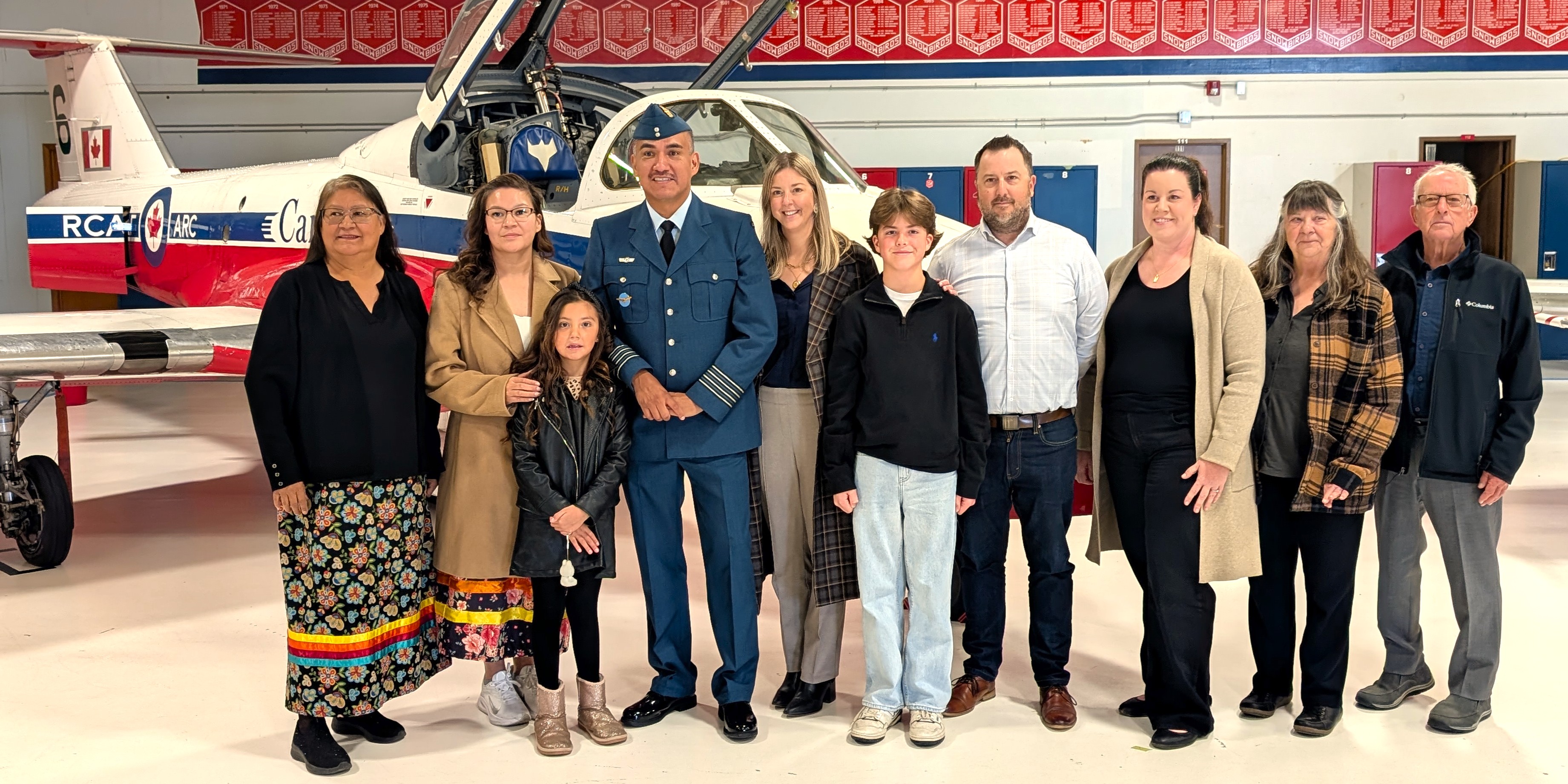
Image Caption
Local Journalism Initiative Reporter
Windspeaker.com
Chief Evan B.G. Taypotat of Kahkewistahaw First Nation was formally invested on Oct. 17 as Honorary Colonel of 431 Air Demonstration Squadron, better known as the Canadian Forces Snowbirds.
Based at 15 Wing Moose Jaw in Saskatchewan, the aerobatic team’s mission for the past five decades has been to showcase Canada’s military precision, skill and teamwork through public performances.
The appointment of the honorary colonel title marks a first. Taypotat, a former Canadian Army captain, educator, and leader from Treaty 4 territory, is the first Indigenous person to hold the position with the Snowbirds. It’s a step that he and military leaders say reflects an evolving understanding of reconciliation within the Canadian Armed Forces.
Standing inside Hangar 7 where the Snowbirds’ red-and-white Tutor jets are housed, Taypotat shared a childhood moment that came full circle.
“You know, to be in this position feels really, really cool,” he said following the ceremony. “Growing up on the First Nation of Kahkewistahaw, we don’t really do any of these things. We were poor. Growing up, we didn’t know we were poor, but we’d see the fighter jets flying over our First Nation back in the day. We stood there and watched them, and now to be here today, 40 years later in this role … it’s really cool.”
The journey to that moment began nearly two years ago when Colonel Daniel Coutts, former commander of 15 Wing, reached out to Kahkewistahaw First Nation as part of the Air Force’s reconciliation outreach. Taypotat hosted the visit and gave a tour of the community’s school.
“I remember one of the kids asking him what he flew, and he said, ‘A Griffon’,” Taypotat said. “That visit set the relationship in motion and it gradually came to this about 18 or 19 months later.”
Born in Grenfell, Sask., Taypotat’s path combined discipline, service, and education. An official military biography explained that he joined the Canadian Armed Forces in 1998 through the Bold Eagle program, an initiative that provides Indigenous youth with military training while grounding them in their cultures and communities.
Graduating at the top of his class, Taypotat went on to serve with Princess Patricia’s Canadian Light Infantry, deploying to Afghanistan in 2011 before retiring with the rank of captain.
He later returned to Kahkewistahaw First Nation to teach and become principal of the community’s school. In 2017 he was elected chief, and he continues to advocate for sovereignty, self-sufficiency, and education rooted in Indigenous identity, according to the Nation’s website.
Today, he holds a master’s in educational administration from the University of Regina and an executive master’s in Indigenous business leadership from Simon Fraser University.
As Taypotat explained, the honorary colonel role is not just ceremonial. It is an opportunity to build understanding between Indigenous and non-Indigenous Canadians through direct, personal connection.
“I think the goal would be to help CFB Moose Jaw, and maybe the Canadian Air Force, understand what reconciliation is,” he said. “Everybody concentrates on September (for the National Day for Truth and Reconciliation) and we always wear orange shirts, but it’s more than that. It’s got to be every month, weekly. We as First Nations people don’t want it (as the focus) every day … but we certainly don’t want the atrocities swept to the side.
“We want to make sure … that people are educated about it, because if people are educated about it, it becomes a better Saskatchewan.”
That sense of learning and reflection is precisely what military leaders said the honorary colonel program is designed to foster. Lieutenant-Colonel Guillaume Paquet, commanding officer of the Snowbirds, described the appointment as “a proud and historic moment” for the squadron and the Canadian Armed Forces.
“This is the first time that we actually have an honorary colonel who comes from a First Nation. This is truly a step in the right direction (given) our dark past, (and) it’s a step forward towards reconciling the future,” Paquet said.
He explained that honorary colonels serve as advisors and community ambassadors.
“(The role) helps us bridge the gap between military service and the community — the people we serve,” he said. “In this particular case, for example, it’s about better understanding the First Nations community, but it’s also for them to understand our life.”
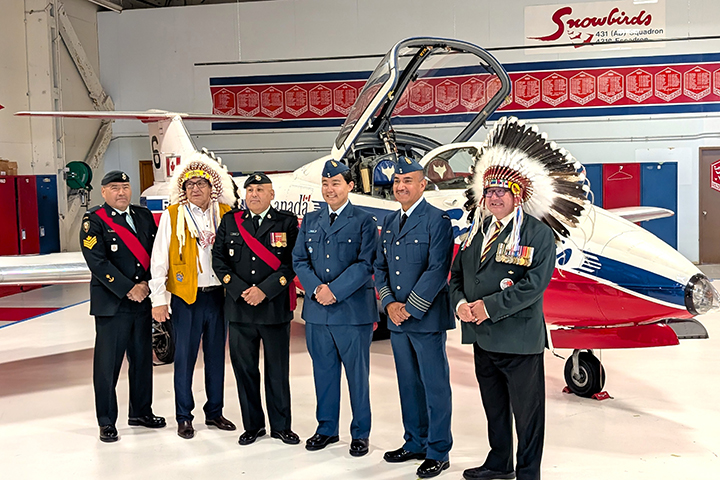
For Taypotat, the role carries a deep symbolism extending far beyond the walls of Hangar 7.
“There are a lot of younger people … Indigenous kids … who can now say, ‘Hey, maybe we can be honorary colonels’,” he said. “I want them to know that this is a viable path for us.”
He said representation at that level is more than recognition. It’s a tangible example that inclusion and leadership within national institutions can coexist with Indigenous identity.
“As First Nations people, we’ve worn uniforms before. We’ve served, but now, we can also help guide,” Taypotat said. “That’s part of reconciliation, being at the table where decisions and traditions are shared.”
The Snowbirds’ history stretches back to the Second World War, when 431 (Iroquois) Squadron flew Halifax and Lancaster bombers as part of the Royal Canadian Air Force’s contribution to the Allied campaign. Re-formed in 1978 as the Air Demonstration Squadron based in Moose Jaw, the Snowbirds have since become a national emblem of power and pride in the Canadian armed forces, “while serving to inspire the best in all Canadians,” reads an official statement from 2024.
“There are two reasons why I did the role," Taypotat said. "To help move the Air Force forward in their reconciliation, one, and the second thing is to pave the way, because there are a lot of younger people coming in now,” he said.
“When I was five years old, I saw those fighter jets over my First Nation. If I could go back in time and tell my môsôm (grandfather) Albert, who was with me that day when we pulled over on the side of the road … that one day we’re going to help those people, I think that would be a really cool thing. It’s a beautiful day and I’m honoured to be the honorary colonel.”