
Image
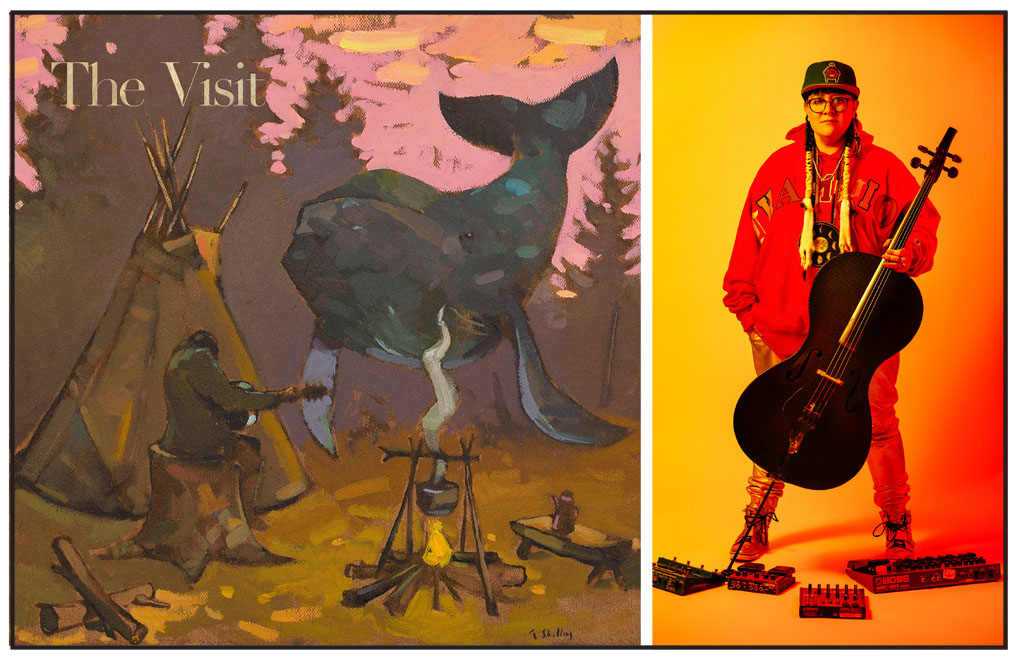
Image Caption
Local Journalism Initiative Reporter
Windspeaker.com
Juno-nominated Indigenous cellist and composer Cris Derksen has released The Visit, her first studio album in 10 years.
Derksen, (Mennonite/Cree), is known for genre-defying music that weaves the traditional with contemporary composition and instruments.
“It fits into no categories, but fits into all of the categories at once,” said Derksen about her newest album. “It’s like a journey. It’s classical. It’s electronic. There’s singing, there’s some throat singing, some speaking. It’s really art, more art than I think most folks are doing these days and it’s an 11-song album that’s 47 minutes long.”
She has released four studio albums— The Cusp (2010), The Collapse (2013), Orchestral Powwow (2015) and The Visit (2025).
“My first two albums were very much electronic cello, and they really solidified my sound using guitar tracks on a cello,” Derksen said. “Orchestral Powwow was exactly how it sounds... I kept these traditional powwow songs in full and wrote symphonic music around them.”
During the past 10 years Derksen has performed with many symphonies and chamber orchestras throughout Canada and has been commissioned by such groups as the Calgary Philharmonic Orchestra, the Toronto Symphony Orchestra, the Thunder Bay Symphony, and Orchestre Métropolitain under Yannick Nézet-Séguin.
In 2022, she composed for the Canadian Pavilion at the World Expo in Dubai. Her work was included on the podcast Stolen: Surviving St. Michael's by Connie Walker and Gimlet Media, which earned both a Pulitzer Prize and a Peabody Award.
In 2024 she performed at Carnegie Hall and collaborated with the Royal Winnipeg Ballet and the Winnipeg Symphony Orchestra.
“I’ve really done it all,” Derksen said. “I wanted to make an album that kind of showcased what I’ve been doing in the last 10 years, that’s why it’s so diverse.”
She described The Visit as a gentle weave of pure symphonic swells and symphonic sounds with super elctro effects.
The idea behind the title is to bring listeners back to where people—friends—would visit each other and share stories and memories.
“I feel in 2025 we don’t visit each other the same way we used to,” Derksen said. “So, each of these songs is like a visit, a little memory, a little moment together. I think it’s about spending time with each other and spending time listening.”
“Also, nowadays, rarely do full, long albums come out. Our attention span is so short and everything is so quick. I wanted to kind of rebel against that and write a really long, full album that does relate to itself, even if it doesn’t fully relate to anything,” she said.
Featured on The Visit are contributions from friends and fellow artists.
“My best friend, Laakkuluk Williamson, is on “New Heya”, and the album starts and ends with a really good friend and collaborator Jennifer Kreisberg. She is a member of Ulali,” said Derksen, an Indigenous women’s vocal group formed in 1987.
From the 11-song playlist, the first and last songs are titled “White Gladis” one and two, which share a story about a whale who has been kind of destroying the yachts in the Iberian Peninsula.
“So it’s a little bit of reclamation and, I guess, beautiful rebellion,” Derksen said.
“We’re friends and we’ve been so lucky to collaborate on many different kinds of projects over the years, from live performances to art films,” said Williamson. “When she asked me to contribute to one of her tracks it was an ‘of course’.”
The Inuit throat singer began her journey 20 years ago amid a cultural resurgence as Inuit communities reclaimed traditions long suppressed.
“It was a practice that was not allowed by mostly missionaries, by Christian missionaries. It was thought to have been a non-Christian practice. But in the late 1990s, early 2000s, the Inuit women all across northern Canada reclaimed it,” said Williamson.
Her practice includes mostly Greenlandic mask dancing, which incorporates dance, storytelling, music, humour and social teachings.
Derksen said combining tradition and contemporary elements in The Visit mimics how she herself creates music.
“I’ve always been about braiding the past and the present together,” said Derksen. “I use a lot of guitar pedals on my cello so I can expand the palette of what a traditional instrument can be, and, you know, I use drum machines and a lot of different tools that make the music more modern; like make the music more of today and more contemporary while also using very traditional tools like symphonic writing. It’s always been about braiding the past and the present together to create a future.”
The Visit can be downloaded from any of the music streaming platforms or from Derksen’s website MUSIC | Cris Derksen