
Image
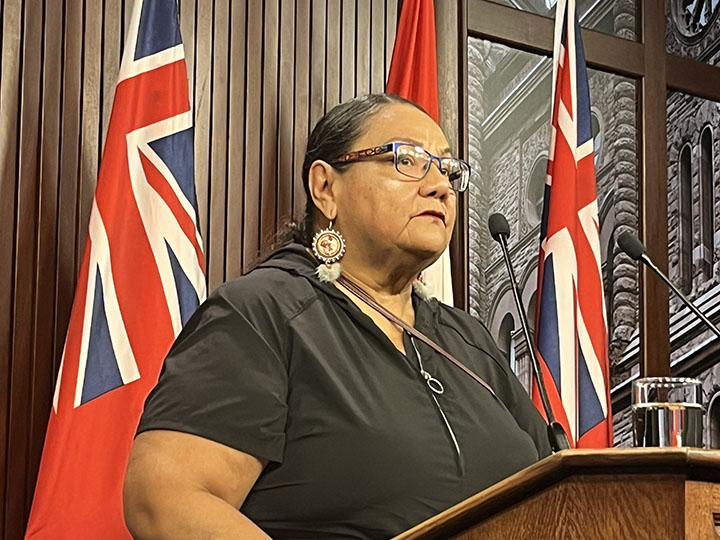
Image Caption
Local Journalism Initiative Reporter
Windspeaker.com
Four First Nations chiefs made their way to Queen’s Park in Toronto on July 16 to voice their displeasure and explain why they have joined fast-track litigation against the Ontario and federal governments.
A total of nine First Nations in the province have commenced legal proceedings in court in an effort to kill the recently passed Bill 5, the Protect Ontario by Unleashing our Economy Act, 2025, as well as the federal Bill C-5, known as the One Canadian Economy Act, which encompasses the Building Canada Act.
First Nations leaders say both bills, which are intended to speed up major project development, were created without First Nations input, without consultation with them and without free, prior and informed consent. The bills greatly threaten their rights to self-determine their ways on their land, the chiefs said. They also have many environmental and human rights concerns.
The legal challenge was filed in Ontario Superior Court on July 14.
The First Nations’ lawyer is Kate Kempton, who is senior counsel for Woodward & Company LLP.
Kempton said she’s in the process of determining which lawyers have been assigned to represent Ontario and Canada in the case.
“This is a fast-track case application and I can't tell you exactly how long it will take because it depends on what the two other parties do,” Kempton said.
She added if governments opt to proceed with each bill as is, “there's a good chance we'll end up in court seeking an injunction.”
Provincial and federal officials claim Indigenous people will be consulted prior to projects proceeding on their lands. But Indigenous leaders are furious consultation was not done prior to the bills being rammed through into law.
Chief June Black of Apitipi Anicinapek Nation was emotional and appeared to be fighting back tears as she spoke at the Queen’s Park press conference.
“What’s about to happen is going to be very harmful,” Black said. “Bill 5 and Bill C-5 are pieces of legislation that attempt to bulldoze over our First Nation rights and lands with no respect for our decision-making and jurisdiction. Ontario and Canada should be working together with us on decisions that are made on our lands.”
Black said federal and provincial governments should not be making unilateral decisions about development and major projects.
“We will not and do not tolerate Crown governments taking over our lands in whatever way they want,” she said. “Crown governments are required to act honourably with respect to all decisions and dealings with First Nations. Speeding through projects and exempting projects from authorizations and approvals is far from honourable. Approving projects without the consent of First Nation peoples, who have been on this land forever, is even less honourable.”
Alderville First Nation Chief Taynar Simpson talked about the longevity of First Nations people on the lands.
“We have lived here for at least 10,000 years nonstop,” he said. “We're the only people that have been here for 10,000 years straight. And we're always going to be here. It is our duty to ensure that our lands are protected, that our nature is protected, that our ancestors who are buried all over this territory are protected.”
Simpson said First Nations citizens gave their leaders a mandate to stop Bill 5 when news of it first broke. He said he has spoken to Ontario Premier Doug Ford to express his displeasure.
“And it doesn't seem that our message is getting through,” Simpson said. “People don't quite understand why we are against Bill 5.”
Simpson said the bill overrides other existing legislation that First Nations had fought for to protect their lands.
“The problem is that the governments aren't coming and sitting down with us,” Simpson said. “They're not consulting with us like they're supposed to. So, often they'll say “We'll consult with you after the fact.’ And that's not consultation.”
Ginoogaming First Nation Chief Sheri Taylor said she doesn’t believe provincial and federal politicians about why they fast-tracked bills, apparently in response to actions taken by the current U.S. administration.
“Ontario and Canada are supposedly worried about President Trump and are using this as an excuse to further erode and degrade First Nations involvement, engagement and consent and decision making,” she said. “Crown governments are showing they are more concerned with the threats of our neighbouring president than the threats that First Nations have been facing for centuries.”
Taylor asserted that First Nations are not against development.
“It's not about stopping progress or things that we can do together economically,” she said. “But we need to be at those tables.”
Oneida Nation of the Thames Chief Todd Cornelius offered his thoughts on what Bill 5 and Bill C-5 have accomplished.
“What it has done, it's woken up our youth,” he said. “They have come to the two rallies here now at Queen's Park here.”
Cornelius echoed the sentiment that First Nations are not against development.
“Many First Nations are interested in development,” he said. “We are against our lands being taken from us and used in ways we do not agree with. We are interested in development that is done the right way. The right way means protecting and conserving the environment, lands, waters and species. The right way also means full participation in decision making of First Nations who have the rights on our lands.”
Cornelius said provincial and federal bills have not been handled properly.
“We have no choice but to take Ontario and Canada to court for this approach,” he said.
The others involved in the litigation process are Fort Albany First Nation, Kitchenuhmaykoosib Inninuwug First Nation, Wabauskang First Nation, Attawapiskat First Nation and Aroland First Nation.