
Image
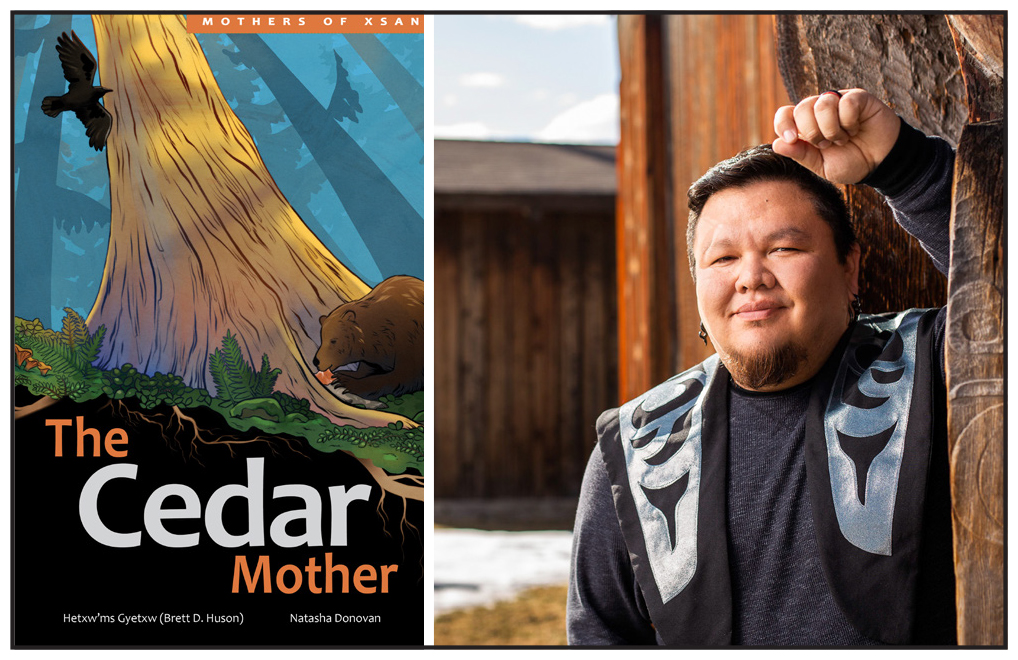
Image Caption
Windspeaker.com Books Feature Writer
Local Journalism Initiative Reporter
The Cedar Mother is the newest offering in Brett D. Huson’s award-winning Mother of Xsan series, which now consists of eight beautifully illustrated books that share his Gitxsan culture, nature and knowledge.
The story of The Cedar Mother emphasizes her “importance to the surrounding ecosystem…Nox Sim Gan provides for those who need her,” writes Huson. Her bark allowed the Gitxsan to create clothing; her trunk was used to build homes and craft tools; her roots became ropes; and her sapling made teas and medicines.
Huson points out that the Gitxsan Nation in British Columbia’s northwest interior is a matrilineal society. He felt it was important to focus on that concept through the Mother of Xsan series while also breaking down the “oppressive patriarchy” of the Western world.
While the books are written for children nine to 12 years of age, Huson notes that adults have bought the books just for themselves.
“They're getting a better grasp of how the world around them actually works, because there's so many people who just don't know…about ecology, life cycles and animals,” he said. That lack of knowledge is a comment on how the public education system has failed, he added.
“We've created a little human bubble,” said the author and climate researcher, whose traditional name is Hetxw’ms Gyetxw. “So I think part of why I really wanted these series (of books) to be here for young people is because this is something that…Gitxsan people learn when you're a kid, when you spend time out on the land. I wanted to try to bring some of that to the public.”
Huson’s work is bringing some of that knowledge into the classroom with teachers using his books as resources.
“I think it's great,” he said. “A lot of my work is connecting Indigenous ways of knowing, our pedagogies and our epistemologies, into the Western world, into the context of how people are disseminating information, how people are learning and teaching in this country.”
The Cedar Mother emphasizes Gitxsan words.
“Language holds a lot of information that benefits everybody, not just the public, but all of those who do research, who work on the land, who want to know more about it. It's a way to connect everyone to these lands that they're living on,” he said.
The story is also conveyed through formline art, which Huson himself has drawn.
“Formline was our way to disseminate information. It wasn't a form of entertainment and beauty, which…it's considered now. It was a way for us to tell the world about the knowledges of the land and very rudimentary understandings of the building blocks of life. Each of those shapes, they kept information. It was important to show some of that work in the books,” he said.
Huson’s formline art is balanced by Métis illustrator Natasha Donovan’s rich illustrations.
“Some people have intellectual minds who can... think only in data, think in science, think in research, but then there are other people who don't have that kind of capacity. But if you want to be able to communicate to everyone on the same level, to be inclusive in everything that you do, it has to be done through art,” said Huson.
Understanding that everything is interconnected and interdependent is important, particularly at this time, he adds, because of climate change.
“We're past the point of fixing anything… We have to understand the world around us best if we are going to adapt to it. And if we don't understand the world around us and we keep trying to depend solely on technological advancements, we're not going to survive very long as a species,” said Huson. “And I'm not talking far future. I'm talking about the future of my kids and grandkids.”
Indigenous people know how to adapt, he says. After all, they’ve been adapting for 150 years as Canada took shape on Indigenous lands.
“We can show people how to adapt. If they can just open their minds, listen and realize that, obviously, what has been happening for the past 100 years from the Western civilizations is not actually benefiting the world. It only is making things worse. And the only way that we can make things better is if we just really know that there's a whole pluriverse of perspectives in this world, and each of the people that are connected to their lands have the ability to show the world how to better adapt,” said Huson.
Goalposts keep moving, he said, but that doesn’t change the reality: The world is burning.
“I'm not against technology. I'm just against a world that ignores truth. And truth comes out through listening to all the people around us and knowing that. Knowing and bringing in more information and more ways of knowing doesn't harm any scientific process. Scientific process is what it is no matter what. As we go through any type of research, we just have to understand that the hope will only be there if we are inclusive in society,” said Huson.
Through The Cedar Mother, Huson wants Indigenous readers to realize that their “people had understandings of the land like this in their Nations.” He encourages them to reconnect with their knowledge carriers and to “bring this knowledge forward again.”
As for non-Indigenous readers, Huson says the direction the world is heading shows that systems need to be reformed.
“It's as simple as looking to storytellers, looking to knowledge carriers, looking to researchers, because there are so many Indigenous people who are academics both in their own societies and through their Western institutions and universities,” he said. “Just start looking to the storytellers and the artists and really know that what we're trying to do is bring community back to everybody.”
The Cedar Mother is published by Highwater Press. It will be released Feb. 24 and can be pre-ordered at https://www.indigo.ca/en-ca/the-cedar-mother/9781774921586.html