
Image
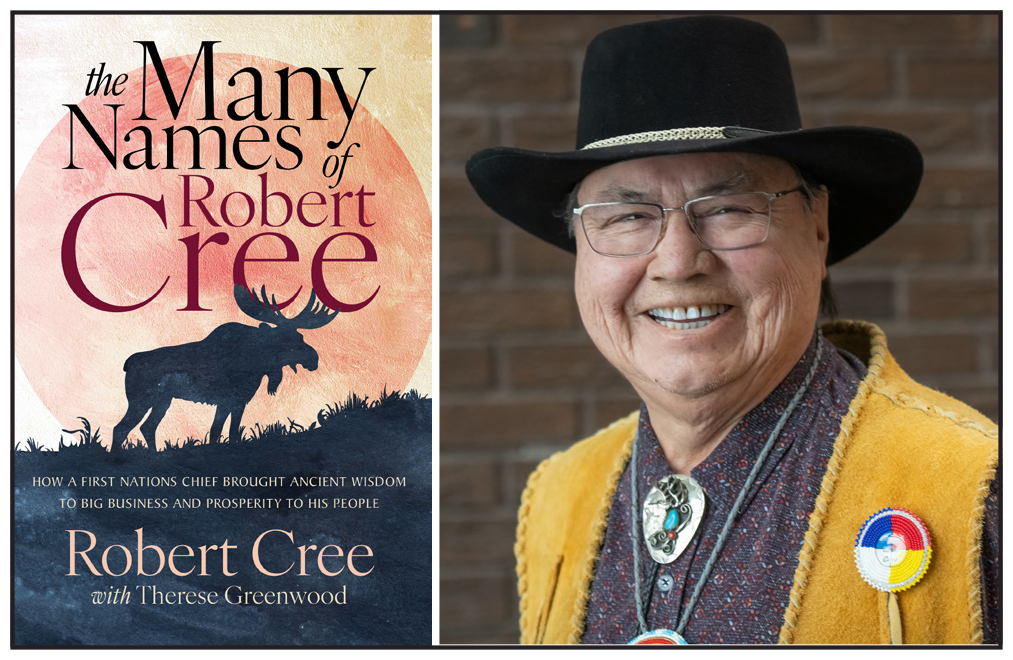
Image Caption
Windspeaker.com Books Feature Writer
Local Journalism Initiative Reporter
Update: June 25 at 2:30 p.m. (Alberta)
The Many Names of Robert Cree has received a Silver Medal from the 2026 Independent Publisher Book Awards, marking the memoir’s third win and fifth nomination since publication. The book received a Bronze Medal from the 2026 Axiom Business Book Awards, and in early June, it received the Alberta Literary Award for best memoir, presented by the Writers’ Guild of Alberta.
“I never imagined this when I decided to tell my story,” said Elder Cree, a member of Fort McMurray 468 First Nation on Treaty 8 territory. “I am deeply honoured my story has been recognized so widely. My hope has always been that it would help build bridges between Indigenous and non-Indigenous peoples. I am grateful to every reader and listener who has made that possible.”
Original story:
In a poignant recounting of when he first arrived at Ermineskin Residential School in Hobbema at age nine, former chief of Fort McMurray First Nation Robert Cree writes, “…on that very same day, they started to separate me from myself.”
In The Many Names of Robert Cree, he recounts that it was on that day that Robert Joseph Cree became his name, although he was called Number 53 throughout his years in residential school. His mother gave him the English name Bobby Mountain when he was born. He was named Napikan (Great Man) by his grandfather when he was a child. Later he would take on the names of Chief Cree (at the age of 27 for 10 years) and Elder Robert Cree. He is also Kisikowasha Ka’ Ki Kkawat (The Person with the Holy Child Within).
He moved forward with the name Robert Cree because Cree was his mother’s maiden name and, as he writes, “As Robert Cree, I overcame trauma and addiction.”
That was the first time he was separated from himself, but it would not be the last. In February 2025 he experienced a spiritual separation as he lay on the operating table undergoing a quadruple bypass.
“That's the exact same thing that I was told when I was up there,” he said, “when they stopped me at the gate (to Heaven). I didn't want to come back. It was so emotional. It was so beautiful. I didn't want to come back. They told me that I had to come back and finish my work. I had some work to do.” He was told this by the spirit who was the gatekeeper and who welcomed people to or turned them away from Heaven.
Then God spoke to Cree about the power of prayer.
“My head just dropped when he spoke and he said, ‘I own those prayers,’ he said. ‘Not the people. There's not one individual on earth that owns those prayers.’ He said, ‘I own them. I had loaned them to people to use them, to pray to me. I am the power of all. I'm the power of the universe. I'm the power of whatever you have on Earth’,” said Cree. “He said everything is spiritual.”
When God spoke, the gatekeeper went silent.
“That's how powerful the voice was. Even I felt that power and it was instilled in me. And I have to utilize that power to help,” said Cree.
When Cree came back to his body, he was surrounded by his family and his wife was wiping tears from his face.
Cree says the work he still has left to carry out is partly focused on his book.
The Many Names of Robert Cree is an account of Cree’s spiritual growth, which began as a youngster. Because he was grounded by his parents in his cultural ways, he managed to hold on to his beliefs while at both Ermineskin and Blue Quills residential schools.
“My people’s traditional knowledge and spiritual teachings guided my way home to a place of forgiveness, healing, tolerance, and understanding,” he writes. It wasn’t easy to forgive his abusers but it was something he came to realize that he needed to do in order to move on and be healthy.
As chief, Cree was able to open the lines of communication with the federal and provincial governments and industry. The result was the creation of the Athabasca Native Development Council and Christina River Enterprises, which in turn led to better employment, infrastructure and services for Fort McMurray First Nation members.
“Our bottom line would be the physical and spiritual wellness of our people and our traditional land,” he writes.
Cree credits the Elders and his mentors for guiding him both on his spiritual and professional journeys.
Integral in the message of his book is moving forward on truth and reconciliation on both a personal and national level.
“The Elders said I needed to face the truth and reconcile all the parts of myself,” he writes. “I could not walk my true road until I was a wholly integrated person.”
On the national level, he says that the truth of what happened must be told.
“There are many, many immense wrongs that must be properly addressed. That is why we need the truth part of Truth and Reconciliation,” Cree writes.
With The Many Names of Robert Cree to be released later this month, Cree expects to be travelling to cities and towns, attending different gatherings and talking to people. He also wants to be praying with them, something God told him, he says, that people have forgotten to do.
As an Elder, Cree prays with people, usually smudging and using the eagle feather. He asks them to pray with him because everybody’s prayers have “equal standing here. Nobody's higher than the other.”
“We're supposed to live equally, equilibrium, everything that we do on earth. That's how we were brought up. That's how we were made by the Creator,” he added. “We all pray and then our prayers are coming as one and we send a message to the Creator. And people feel very, very comfortable with that. And that's the way it should be.”
Cree says God told him to come back so he could also help bring about the changes that are needed on this earth.
“If you want to call it a miraculous incident, I mean, that's what it is. It's a miracle what happened to me. And I'm grateful for that, for the Creator giving me that chance to come back and help him with the work,” said Cree.
Discrimination and neglect need to be done away with, he says, and people need to feel “the emotional greatness, the emotional wellness and everything that comes with” God.
The Many Names of Robert Cree, written with Therese Greenwood, is published by ECW Press. It will be released Oct. 28. It can be pre-ordered or purchased at https://ecwpress.com/.