
Image
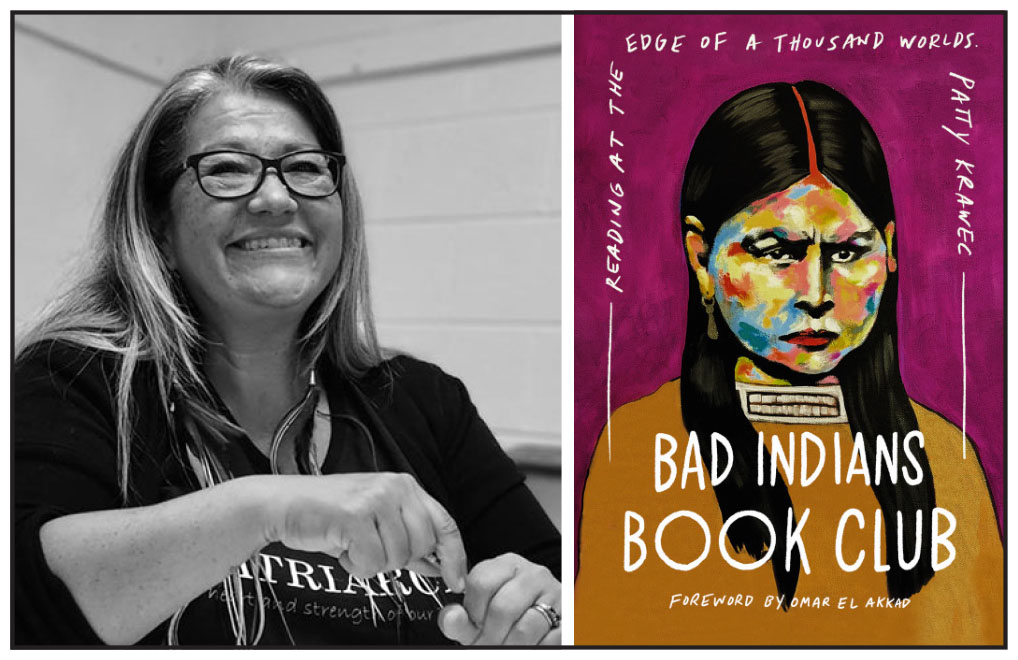
Image Caption
Windspeaker.com Books Feature Writer
Local Journalism Initiative Reporter
“This world is a dumpster fire,” said author Patty Krawec. “Good Indians” need to understand that following colonial rules won’t save them.
“That is harsh,” said Krawec, who drives her point home in her new book Bad Indians Book Club: Reading at the Edge of a Thousand Worlds.
Being Good Indians “may keep them alive for a while. They may feel safe,” she said.
“Bad Indians understand that it's not about what we do. We are excluded because of who we are and there's nothing we can do about that, so you may as well return to the stories and truths of your ancestors and who you are. You may as well stop trying to fit into a house that's on fire, because being good won't save you.”
Krawec, who is Anishinaabe and Ukrainian and a member of the Lac Seul First Nation, respects Good Indians “for surviving…(but) I'm not going to follow them into battle because where they're going is not a place I want to be.”
Krawec writes in Bad Indians Book Club, “…It was the Bad Indians to whom I felt drawn—and still do…So I followed these Bad Indians into protest and ceremony… We had no interest in rescuing this system or creating a kinder and more inclusive nationalist project that could save us from ourselves while it benefits from our displacement.”
Krawec’s bold, thought-provoking and disturbing book was preceded by a year-long series of podcasts featuring conversations with friends and writers about books read and written.
She initially planned to focus on Indigenous writing, but reconsidered following a conversation with Black writer Tiya Miles last February, which is recognized as Black History Month. Miles identified “gaps” in written and oral stories.
“I was starting to understand that Indigeneity was not specific to North America. That it was Central America and South America, too… That there were people around the world who have experienced colonization and displacement in all kinds of ways,” said Krawec. “I wanted to bring them in as well to see what do our stories say to each other…It's not necessarily the same, but there's commonalities in what happened to us and how we responded to it. And those things are contained within the stories we tell.”
Krawec draws on Nanaboozhoo, who in Anishinaabe stories walked around the world twice, once alone and once with a wolf “and he met all kinds of people. And so, their stories inform our stories and back the other way as well.”
In writing Bad Indians Book Club, which took about eight months, Krawec was deliberate in not replicating the podcasts and she admits that made it challenging.
“I wanted to pull (the podcasts) together and to see just where that took me,” she said.
She notes in her book that “Indigenous writing is really any writing done by Indigenous people, and it covers a wide range of topics.”
She summarizes author Daniel Heath Justice stating, “Indigenous literatures matters because we matter.”
Bad Indians Book Club is a deep dive into writing by Indigenous, Black, Jewish and other marginalized writers in a variety of writing genres, including science, history, memoir, science fiction, speculative fiction and horror. Krawec discovered things that unsettled her, that surprised her and that were new to her.
“The horror chapter is full of new ideas to me,” she said.
“The tropes and patterns that (horror) whitestream writers use are a kind of shorthand that can help us navigate unfamiliar terrain. But they often do this by relying on racist assumptions about the other, as well as who has access to which spaces, and under what circumstances. It isn’t only white-produced horror that does this,” Krawec writes in Bad Indians Book Club.
“I think that for me, that the most interesting and the most challenging aspect of it was … picking that settler colonialism out of our own stories,” she said, adding that authors had different ways of working through and thinking about settler colonialism.
In the speculative fiction chapter, Krawec writes, “I once made a list of all the various dystopic futures in the movies we watch: plagues, zombies, evil corporations, authoritarian governments, drought, floods. Looking at that list confirmed for me that all of these apocalypses — with the possible exception of zombies — are things that marginalized peoples around the world have already experienced….That means the futures we imagine can be filled with utopic vision.”
Bad Indians Book Club is written much like a running dialogue with Krawec pulling pieces from books and experts and “putting stories in conversation with others.” A friend suggested she move away from a more academic approach by adding her own stories.
Krawec weaves her book essays together with her serialized flash fiction story of Waawaashkeshi’Kwe or Deer Woman, who Krawec contends is a Bad Indian, who “stay(s) in the borderlands and refuse(s) to be civilized.” Kwe is “needed…to keep (the book) grounded in the Anishinaabe worldview,” she said.
Krawec stresses the importance of readers clearing mental space, an idea contained within the Ojibwe word dawisijigem, so they can “focus on books from a particular place or people.”
She also says it’s imperative that multiple authors be read on a single subject and that those authors are the ones impacted by the racial or cultural subject matter.
Krawec would like to see book clubs expand their reading beyond “comfortable” subject matters.
“There's times where I just pick up a book that is funny or that doesn't necessarily expand my world or any of those things,” she said. “But this world is not going to become a better place if we're not also willing to challenge ourselves.”
However, Krawec also stresses that not everybody has to lead, and Bad Indians Book Club won’t appeal to everybody.
“This book appeals to the people who want to be challenged, who want to be involved in figuring out what's next…We just need a few people to be motivated to do that and to start doing that in their classroom, wherever they are professionally,” she said.
Bad Indians Book Club was written for a specific audience, said Krawec. “It was written for me and my friends, for marginalized people. But I also know that…white people, Canadians, non-marginalized people are going to read the book and…I hope they get something out of it. I hope they understand that we are not monoliths…that we think a lot of things about a lot of things.”
Bad Indians Book Club: Reading at the Edge of a Thousand Worlds was published in September 2025 by Goose Lane Editions and is available at https://www.indigo.ca/en-ca/bad-indians-book-club-reading-at-the-edge-of-a-thousand-worlds/9781773104614.html
For the podcast go to Bad Indians Book Club