
Image
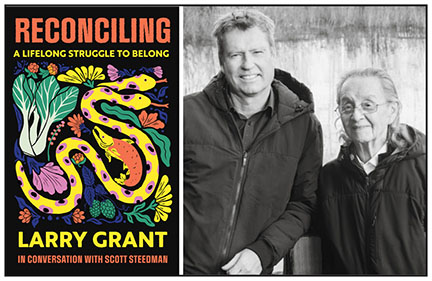
Image Caption
Windspeaker.com Books Feature Writer
Local Journalism Initiative Reporter
In Reconciling: a Lifelong Struggle to Belong, Musqueam-Chinese Elder Larry Grant tells a story that is unique, but not as unique as he initially thought.
Reconciling is told in conversation with co-author Scott Steedman, who largely uses geographical points to focus Grant’s recollections of his time growing up. The book is a weaving of historical facts with Grant’s personal tale.
Grant, who is now 88, was born to a Musqueam mother and a Chinese immigrant father.
“It's more widespread than people believe. Just working with the Chinese (Canadian) Historical Society (of British Columbia) with Dr. Henry Yu, I got to see how widespread the Chinese migration was. It's clean across Canada.”
Yu’s research team helped establish a database of 97,000 Chinese people, mostly men, who paid the Head Tax. Enacted by the Canadian government in 1885 and lasting 38 years, it required Chinese immigrants to pay a fee to enter Canada. That was followed in 1923 by the federal Chinese Immigration Act (also referred to as the Chinese Exclusion Act), effectively banning Chinese immigration. That act was repealed in 1947. In 2006, Prime Minister Stephen Harper issued a full apology for the Chinese Head Tax.
“Because of the Chinese Exclusion Act and the Chinese Head Tax, there were very, very, very few Chinese women. The Indigenous people had no problem welcoming the Chinese. And I'm finding out more and more people are Chinese and Native,” said Grant.
Grant’s father Hong Tim Hing paid the Head Tax to enter Canada. Grant’s grandfather Seymour Grant, a cultural authority of the Musqueam Indian Band in B.C., gave his daughter Agnes permission to marry Hong in 1933.
Under the Indian Act and the Reserve Act, Musqueam people were confined to their reserve. Chinese immigrants, many of whom were farmers, could not own Crown land.
“So these two marginalized groups—one with a background in farming but no land, the other with land but no tradition or desire to farm it—found one another…Chinese garden farmers were the only people at that time allowed to lease property on the Indian reserve,” writes Grant in Reconciling.
The relationship between the two groups of people was deepened further as many Chinese businesses were unable to hire white people and therefore employed Indigenous women.
Agnes’ marriage to Hong meant she lost her First Nation status and Larry and his siblings Gordon and Helen were also stripped of their status. Younger brother Howard never had status. It took until 1985 and a 34-year legal battle for them to be recognized as status members of the Musqueam Nation.
Grant thought of himself as a mix and he looked Chinese, but he felt more Musqueam because his mother raised him in that culture and with that language and because his father leased land on the reserve.
“It was kind of a really, really in-depth grounding that was there forever,” he said. “The background and understanding of China and the Chinese community I belonged to never came to be a prominent thing in my mind. That was kind of stifled.”
Although Grant and his older brother Gordon shuttled between Musqueam Nation and Vancouver’s Chinatown for 12 years as school-aged children, Grant admits it wasn’t until he made the trip to his father’s village that he truly embraced his Chinese side.
In 2013, at the age of 76, Grant and his three siblings visited Sei Moon in the Guangdong province of China. They were accompanied by two other generations of the Grant family. The visit was filmed and released in 2016 as a documentary entitled All Our Father’s Relations.
“What happened was all of a sudden it was a reality and there was some relevance to it. This is where my father and my grandparents come from. It brought a balance to it, between the two, like the Chinese and the Musqueam. It became the sense of balance there at that moment,” he said.
But the trip also created “confusion. Where does my loyalty lie?...It was being pulled in two directions,” said Grant.
Now he has found a balance and that balance was recognized when in October 2023 he received an honourary Doctor of Laws from Simon Fraser University for “inspir(ing) countless generations to learn more about Indigenous histories, rights and relations in Canada, including the history of the First Nations and early Chinese migrants.”
Accepting that honour, says Grant, allowed him to give voice “to the things that affected my life” and to keep educating people “so that we have a better understanding of the society we live in.”
That is a goal he hopes Reconciling will also accomplish.
He writes about the heartbreaking reality of his youth, “In the ethnic hierarchy that dominated all interactions…at the very, very bottom…were the Indigenous people…and just a little bit above them were the Chinese.”
Grant says he wants readers to understand what First Nations, Chinese and other people of colour had to live through and he wants readers to be able to ask “more informed” questions.
As for the title of his book, which makes “reconciling” an active verb, he said, “It’s (about) being fully recognized by all three entities still, like the Musqueam and Chinatown and in academia and the industrial world. In the colonial world view, why am I not accepted in here as a full equal human being? That's still going on.”
Reconciling: a Lifelong Struggle to Belong, published by ECW Press, will be released Sept. 9. It is available through amazon.ca.