
Image
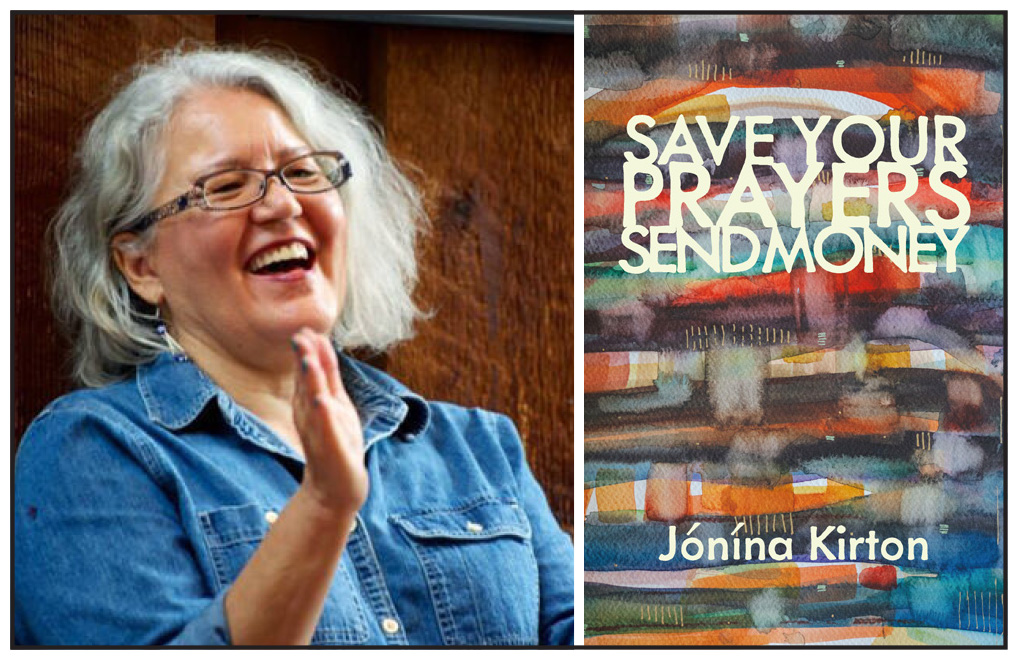
Image Caption
Windspeaker.com Books Feature Writer
Local Journalism Initiative Reporter
Red River Métis-Icelandic author Jónína Kirton hopes her newest book, Save Your Prayers – Send Money, makes people think about how they respond to those who have chronic illnesses.
The title “is a bit cheeky. And you know, we Métis, we're cheeky. It's one of our favourite things,” said Kirton. She said the title is meant to be poetic. The word money is intended to be a metaphor for support.
“We need actual practical support.”
The “we” Kirton refers to are people who have chronic illnesses and their caregivers. She contends that better supports are needed for both.
“Prayers are not enough,” she writes.
The mixed media book also examines the connection between childhood trauma and chronic illnesses.
“Researchers have long speculated that in some cases chronic illnesses like fibromyalgia have a connection to traumatic childhoods,” writes Kirton.
“I often thought that the effects of my illness mirrored life in a home with an unpredictable and cruel father. Home was not a safe place...Fibromyalgia made me feel unsafe in my own body,” she said.
Fibromyalgia is a chronic condition that causes, among other things, pain in the muscles and bones, tenderness, general fatigue, and sleep and cognitive disturbances.
Initially Kirton had planned for Save Your Prayers to be a collection of poetry. However, when her writing mentor suggested the work was too chronological and too tight, Kirton decided to “mess it up a little bit” by bridging her poems with prose.
“There's some people who feel you should never explain a poem,” she said. “But I, personally, as a writer, I like to hear the backstory. I like to understand what it means to the person who's written it, because it doesn't always mean the same thing to the person who's reading it. We come with our life experience.”
Through poems and prose, Kirton examines her life and the trauma that unfolded both as a child and as an adult. Her father was Métis, a Korean war veteran and violent when drinking. He beat her, her mother and her two brothers. Her mother was the oldest of 17 children born of an Icelandic mother and an Irish father and she was ridiculed at school because of the size of her family and deep poverty.
Kirton was a single mother, involved in an abusive relationship and became an alcoholic. She attained sobriety 40 years ago at the age of 31. In 2005, she met the man she would marry. She now cares for him as he is also experiencing a chronic illness.
Over the years, Kirton has utilized different methods to unpack and deal with her trauma, which she examines in her book. She has employed the Emotional Freedom Technique, Eastern teachings and Indigenous traditions.
“I find myself moving away from the Eastern healing, Eastern teachings now,” she told Windspeaker.com. “The more contact I have with Indigenous teachings, the more it does something different to my body. It's something different that happens.”
Writing has also helped. Using a technique called Writing from the Body, which starts with breathing techniques and other physical relaxation before moving into writing, has allowed Kirton to produce first drafts of poems “that are very different than what I would write by myself staying here at my computer.”
Writing Save Your Prayers worked toward Kirton unpacking some of her trauma. While it helped her heal, she says, it also brought up feelings she hadn’t realized she had.
“I learned I was really angry,” she said. That realization made her change the title of the last section of her book to “To Be a Daughter,” taking a line from a poem by Nikita Gill.
“I found this poem…in which she talks about (being)…the one who carries generational rage and the echoes of grief and fury of every woman in your lineage. It hit me. And you've got to wonder how much that rage is harming your body. It’s because I was unable to allow myself to be angry. For some reason, I could not allow myself to be angry.”
Kirton says she was able to let go of some of that rage.
“I think every book I've written has helped me claim a little bit more of myself. And that is healing. And also, it's never just for me…I'm doing this for the women in my family. So taking hold of my narrative, telling my story in my own way, took time. I have four books now. Every attempt brought me closer to the women in my lineage. And the women have not been written about in the Métis world. And a lot of the world we’re just written out. We're not starring roles in stories. So that did help,” she said.
Kirton’s first book, page as bone – ink as blood, was released in 2015.
All her books have been woman-centred, she notes. She was thinking about her mother as she wrote Save Your Prayers
But Save Your Prayers goes beyond a personal story. It’s about anyone who has health issues, Kirton says, anyone who has suffered trauma or racism or poverty. And the timing is good as dealing with chronic health issues seems to be more prevalent for both the federal Liberal and British Columbia NDP governments. Kirton lives in Vancouver.
Kirton’s publicist has given copies of Save Your Prayers to the B.C. Minister of Health. This won’t be the first time Kirton’s work has been embraced by the B.C. government. In March, Labour Minister Jennifer Whiteside read Kirton’s poem “Fraser River Forgetting” from her book Standing in a River of Time as part of the “prayer or reflection” in opening the Legislature.
Kirton will also be giving copies of Save Your Prayers to all her health providers.
“I'm giving it out to people in the health professions, and I'm hoping for it to go beyond a poetry book. I'm hoping for it to become part of discussion around health in general,” she said.
Save Your Prayers – Send Money, published by Talonbooks, was released April 28. It can be purchased at https://talonbooks.com/books/save-your-prayers-send-money