
Image
Windspeaker.com Books Feature Writer
Local Journalism Initiative Reporter
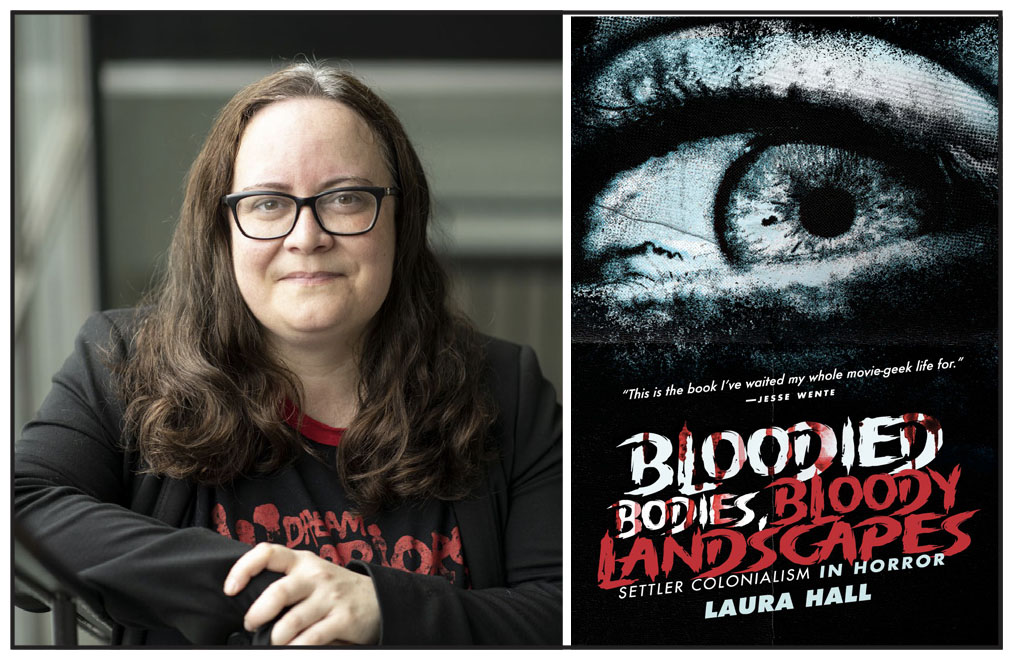
There's more to horror movies than guts, gore and dismemberment, argues author Laura Hall in her debut book Bloodied Bodies, Bloody Landscapes: Settler Colonialism in Horror.
Since 2005, after viewing the horror movie The Descent, Hall has been formally studying the “Indigenous-coded other,” stereotypes and harmful motifs that permeate the plots and subplots of the horror genre.
Hall, a professor of anthropology and sociology at Carleton University, describes herself as an "urban Native.” Her mother is Mohawk, and her maternal grandfather was from Kahnawake in Quebec.
In the The Descent, a British horror film, “A woman falls into a deep pool of thick blood and emerges only to be attacked by a cannibalistic humanoid in the depths of caves in Cherokee homelands,” writes Hall in her book. “She emerges drenched in blood and loses her expensive suburban mom–fleece, picks up an animal bone, and kills a cannibalistic devolved human.”
“What I thought I was seeing in horror (was)… old stereotypes still popping up,” Hall said. Her view of this movie is that Indigenous people are represented as the cannibals.
Hall took to the library at the University of Toronto to see what she could find on the subject of “the ongoing dispossession of Indigenous Peoples,” as she refers to it in Bloodied Bodies, Bloody Landscapes, and she found little on the topic.
When she delivered her views on The Descent at a conference in England around 2006, she received “a negative reception from some English folks who were, ‘Why do you want to talk about Indigenous people to us? What do we have to do with any of this?’ And I was, ‘Well, you still have British filmmakers making movies about cannibalistic Native people, right?’”
The use of Indigenous tropes and patterns in the horror genre seems “to both fixate on and yet also erase Indigenous Peoples in North America,” Hall writes, and that is not understood by writers, producers or viewers.
“The horror film also perpetuates fear and tropes that are rooted in fear and domination of the constructed Indian, as demon, as ghost, as witchy and cannibalistic,” writes Hall.
As for mainstream horror scholars, she said, “they'll talk about the Indian Burial Ground not really in depth and really kind of as, ‘Oh, it's a quick trope, it's a problem and…it signals that there's a past guilt about Indigenous people.’ Well, that's a real tricky thing to say, because is the land no longer Indigenous and the Indigenous people no longer there? Because if you're saying it's about past guilt, that's what you're saying.”
Hall added that referencing issues as past guilt, “like the original guilt of the Americas…really does a disservice, obviously, to Native people who are alive and here.”
Horror movies are often presented “through this particular Eurocentric lens, as though all humans are scared of the same things,” said Hall.
That Eurocentric lens, she writes, has “the central subjects of horror… often (as) white settler women, who battle against some monstrous entity on behalf of their family or community, or the subject may be that family or that town, in its struggle against ‘savagery at the gates,’ in the form of demons, devils, witches, ghosts, vampires, and others. The constructed Indian is coded in these fantasies of invasion…”
Hall also argues that in horror, white settler culture appropriates Indigenous suffering, “which is central to horror”, as white settlers beat off the ghostly uprising in order to protect their families, homes and lands.
She writes: “It is this appropriation of Indigenous suffering that makes horror so crucial to settler colonial storytelling. Horror may seem to disrupt settler worlds, but it appropriates the suffering and bloody violence of colonization… Alongside appropriations of suffering, there are those fears that the colonized will seek revenge.”
Hall also discusses misogyny, “queer subtext without main text,” racism, and the dominance of white settler heteropatriarchy.
While Hall clearly makes her points through her analysis of numerous horror movies, such as the franchise movies Friday the 13th, Scream, A Nightmare on Elm Street, and The Texas Chainsaw Massacre, she lightens Bloodied Bodies, Bloody Landscapes with humour, including such chapter headings as “The Bloodsucking Brady Bunch” and “Jason Gives a Land Acknowledgement.”
“If we start looking at horror through this lens of settler colonial studies and critical Indigenous studies, we can see that these fears, these anxieties about settlement, about the family, they do lead to some pretty funny, funny moments of maybe revenge from the monster or a retribution,” she said.
For the horror genre to shift from the settler colonialism lens, Hall contends that Indigenous writers, actors and producers need to be the content creators.
In the past five years, she says, more Indigenous scholars have become involved in opening up important critical dialogue about the horror genre.
“I think, because I'm coming at it from a particular angle, I'm just trying to argue that what I'm doing is kind of tilling the garden to make even more ideas emerge. I'm not trying to have the final say or be the only person saying about 25 different things, but I'm trying to churn up the soil a bit and say, ‘Well, this actually has some potential for discussion’,” said Hall.
Bloodied Bodies, Bloody Landscapes: Settler Colonialism in Horror is published by University of Regina Press. It was released Sept.16 and can be ordered through amazon.ca.