
Image
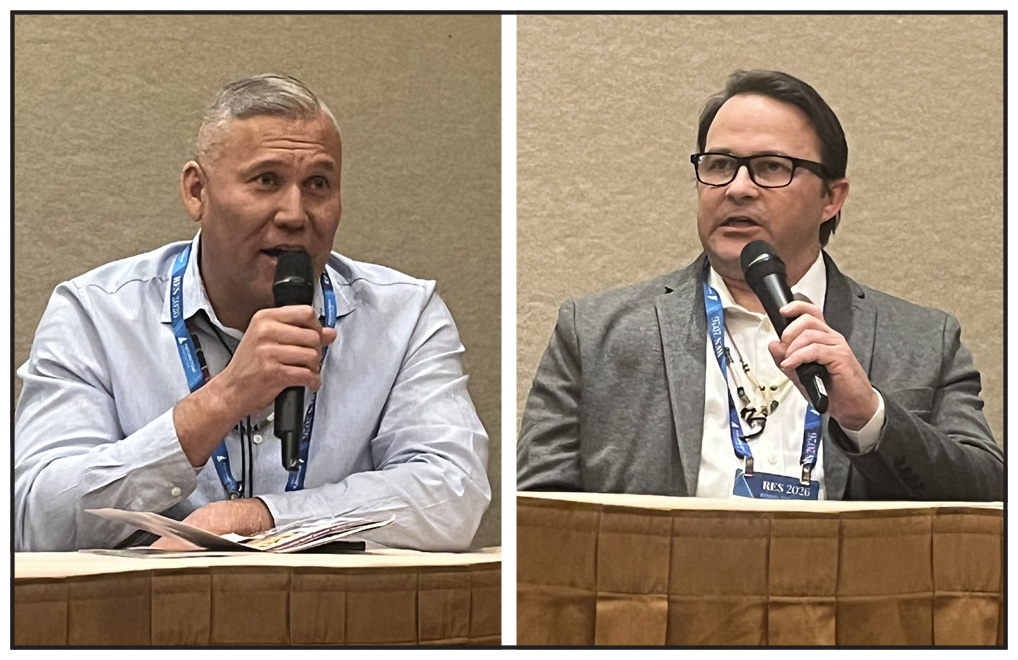
Image Caption
When the U.S. administration implemented President Donald Trump’s tariffs on countries worldwide last year, global supply chains went into disarray.
Since then, manufacturers have sought creative solutions to survive resulting cost hikes.
A pair of representatives from a customs house in Akwesasne Mohawk Territory, which spans three jurisdictions—Ontario, Quebec and the state of New York—spoke at the four-day Resolution Economic Summit in Las Vegas that concluded March 27. As part of a panel session titled Tariffs, Treaties and Tribes, they shared how they launched their business and are making use of a treaty signed more than 200 years ago to tackle the tariff chaos.
Sakoneseriiosta Maracle and Skahentati Thompson are customs operators at the Kanienke'háka Central Commerce House located on the Ontario side of Akewsasne. Maracle said it’s believed to be the only First Nations custom house operating in North America.
It primarily moves pharmaceuticals from Canada to buyers in the United States, who as a result pay reduced costs for the products because of the Jay Treaty of 1794. That treaty provides tariff-free importations to tribes and tribal members.
“We have been in operation now for six months or so, since October,” Thompson said. “And we have been doing everything the way we’re supposed to be doing.”
Company officials said they have not had any issues arise to date.
“We've been successful so far here and everything is in a peaceful, legal manner that's coming through,” said Thompson, adding that Kanienke'háka Central Commerce House is looking to broaden its horizon and join forces with other Nations “so that we can move other products and then we can all work together to create a better future for the next seven generations using what we have.”
While the Kanienke'háka Central Commerce House has been operating only since last fall, Maracle said company officials were hard at work for much longer planning a launch.
“We worked for a year-and-a-half to circumnavigate all of their rules so that we could use their rules for our benefit rather than against us,” he said. “We were going through laying down all the frameworks because we understand that there's other jurisdictions that they have their own rules.
“So, what we did was we navigated between their rules so that so we had to make sure we weren't hitting any of their hotwire issues that would throw red flags up for us.”
Maracle said “so far so good.
“If there are problems, we've already mitigated for those, so that the jurisdiction that decides to interfere, they have their processes and the people that are harmed are within those processes not ours.”
Maracle said company officials are prepared if any challenges to its operations do surface.
“We haven't had any contention yet,” he said. “We have a strict policy so that if we do get pulled over by an outside jurisdiction, we have talking points that we have to illustrate that these are our laws that you have to follow… but, if you choose to escalate it, you need to sign this piece of paper. We’ve already gone through these points based on jurisdiction, because we're dealing with multiple jurisdictions.”
Maracle said if one of its medicines the company is transporting were to be confiscated and somebody ends up dying because it’s not delivered, Kanienke'háka Central Commerce House would not be liable.
“It’s a fight between their citizen and their jurisdiction,” he said. “If somebody dies, it's not in our jurisdiction. It's their jurisdiction. So, they subject themselves to lawsuits.”
Maracle further explained the issue by stating the customs house is simply legally trying to get medicines to those in the U.S.
As an example, he cited ‘Grandma Jane in South Carolina’.
“What's happening is the medicine comes to us and we go through our inspection process,” he said. “We put it to FedEx and Grandma Jane gets her medicines.
“But if there's interference from the U.S. or Canada, then we have very particular points that demonstrate that they're violating their own laws and they're receiving the liability that if Grandma Jane dies because she doesn't get her medicine, then they're now liable when we release all liability to them.”
Maracle also talked about Kanienke'háka Central Commerce House’s possible expansion plans to move more than pharmaceuticals.
“Other products could be coffee, vanilla beans or it could be any kind of commodity that would otherwise need to be traded in North America,” he said.
The Tariffs, Treaties and Tribes panel was moderated by Dr. Gavin Clarkson, a member of the Choctaw Nation of Oklahoma.
Clarkson is the former deputy assistant secretary for policy and economic development of Indian Affairs at the U.S. department of the interior.
The panel also included Citizen Potawatomi Nation member Dr. James Collard. He is currently serving as a vice-chair of the International Inter-tribal Trade & Investment Organization. And he’s also a board member for the Forum for International Trade Training.
This year’s Summit attracted more than 5,000 delegates. It was organized by the National Center for American Indian Enterprise Development.